
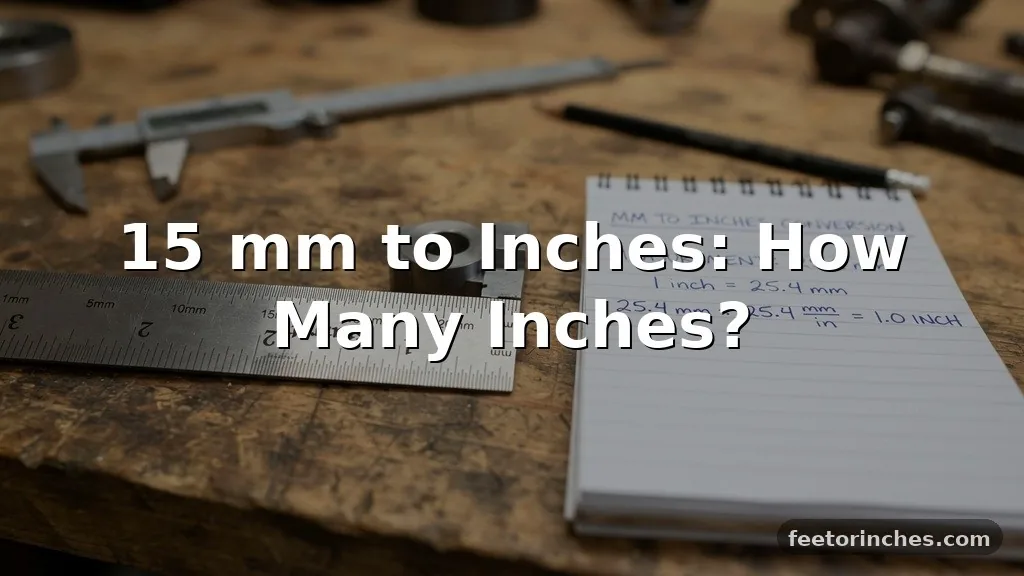
Converting 15 mm to inches reveals a value of approximately 0.590551 inches. If you are looking for a practical measurement, you can comfortably round this to 0.59 inches or roughly 19/32 of an inch for most standard applications.
Understanding how these units interact is essential for anyone working with hardware, manufacturing, or precision crafts where metric and imperial systems frequently overlap. This guide provides the exact math, common comparison points, and the context you need to handle these conversions with total confidence.
The Math Behind the Conversion
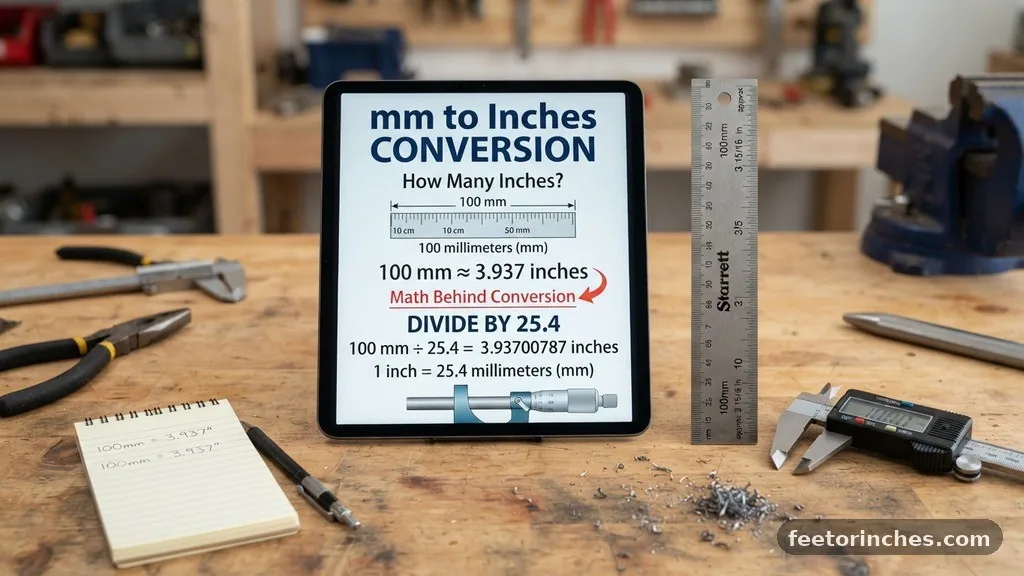
To understand the relationship between these units, you must start with the standard definition of an inch. By international agreement, one inch is exactly 25.4 millimeters. Because the millimeter is a smaller unit of length, you must divide your millimeter value by 25.4 to arrive at the correct inch equivalent.
When you divide 15 by 25.4, the result is 0.59055118. In most practical scenarios, you rarely need that level of precision. Whether you are measuring a bolt or a small piece of wood, rounding to the nearest hundredth or a common fraction is usually sufficient for the task at hand.
Precision vs. Practicality
Engineers and machinists often require high-level accuracy, but home improvement projects rarely demand it. If you are checking a drill bit size or a pipe diameter, the difference between 0.59 and 0.60 is negligible. Always consider the tolerance of your project before deciding how many decimal places to retain.
If you find yourself frequently performing these calculations, using a reliable conversion factor reference is a smart way to ensure accuracy. Sticking to the standard 25.4 ratio keeps your work consistent across different tools and hardware sets.
Conversion Table for Quick Reference
Having a quick-reference table is useful when you are in the middle of a project and cannot stop to perform manual math. This table displays the relationship between common millimeter values and their inch equivalents, including the specific conversion for 15 mm.
| Millimeters (mm) | Inches (in) | Common Fraction |
|---|---|---|
| 10 mm | 0.3937 in | ~3/8″ |
| 12 mm | 0.4724 in | ~15/32“ |
| 15 mm | 0.5906 in | ~19/32″ |
| 20 mm | 0.7874 in | ~25/32″ |
| 25 mm | 0.9843 in | ~1″ |
Common Objects Measured at 15 mm
It can be difficult to visualize 15 millimeters without a reference point. Below are fifteen real-world examples categorized by their typical use cases to help you gauge the size.
- Household Items
- A standard AA battery diameter is roughly 14.5 mm, making it very close to our target.
- The thickness of a standard heavy-duty smartphone case often sits right at 15 mm.
- Most standard cabinet knobs have a base diameter of approximately 15 mm.
- A standard metal paperclip wire is much thinner, but the width of the main loop is often 15 mm.
- The diameter of a modern copper penny is 19 mm, so a small button is a better 15 mm comparison.
- Kitchen Essentials
- The thickness of a thick-cut slice of artisan bread is often 15 mm.
- Standard wooden skewers for grilling have a diameter of about 3 mm, so a bundle of five is roughly 15 mm.
- The height of a standard espresso cup handle grip is often close to 15 mm.
- A large blueberry can reach a diameter of 15 mm during peak season.
- The width of a standard stainless steel straw is approximately 6 mm, meaning two side-by-side are close to 15 mm.
- Tech and Office
- The depth of a standard mechanical keyboard switch housing is approximately 15 mm.
- A common USB-A connector head has a width of 12 mm, with the plastic casing pushing it to 15 mm.
- The thickness of a standard external hard drive enclosure is often 15 mm.
- A standard SD card width is 24 mm, but the thickness is roughly 2 mm, so a stack of seven cards is 14 mm.
- The diameter of a standard cooling fan hub on a PC case is often 15 mm.
Estimating Without Tools
Sometimes you are away from your workbench and need to estimate a measurement quickly. Since you know 15 mm is slightly more than half an inch, you can use your hand or common objects to get a close approximation.
A standard piece of legal-size paper is 8.5 inches wide, which is roughly 215 mm. If you fold that paper into a specific number of segments, you can create a makeshift ruler. Alternatively, the width of an average adult index finger at the first knuckle is often very close to 15 mm.
Always verify your estimate with a digital caliper or a standard ruler before making any permanent cuts. Estimation is a great starting point, but it should never replace precise measurement in critical construction or repair tasks.
Comparing 15 mm to Nearby Sizes
Understanding how 15 mm fits into the broader spectrum of measurements helps prevent common errors. Many people confuse 15 mm with 1/2 inch, which is actually 12.7 mm. That difference of 2.3 mm is enough to cause a bolt to strip or a hole to be drilled incorrectly.
Comparing 15 mm to 12 mm or 20 mm also provides scale. You can think of 15 mm as the midpoint between a half-inch (12.7 mm) and three-quarters of an inch (19.05 mm). It sits comfortably in the middle, making it a common size for specialty fasteners.
Scale Reference Table
This table helps you visualize where 15 mm sits compared to other common imperial and metric measurements.
| Metric | Imperial | Difference |
|---|---|---|
| 12.7 mm | 0.50″ | -2.3 mm |
| 15.0 mm | 0.59″ | Base |
| 19.1 mm | 0.75″ | +4.1 mm |
Addressing Common Misconceptions
A frequent point of confusion involves the difference between length and diameter. If a product description lists a 15 mm diameter, it refers to the circular cross-section. If it lists 15 mm length, it refers to the longest straight axis.
Another common mistake involves screen sizes. A 14-inch laptop screen refers to the diagonal measurement from corner to corner, not the physical width of the device. Always look for the specific dimension being provided, whether it is width, height, or diagonal.
The Importance of Standardized Units
Whether you are working with a metric set or an imperial set of tools, maintaining consistency is key. Mixing units within a single project is the most common cause of assembly errors. If your plans are in millimeters, stay in millimeters until the final stage.
When you convert between systems, always round at the very last step. If you round your numbers early in the calculation, those small errors will multiply and lead to a significant discrepancy by the time you reach the final result.
Frequently Asked Questions
Is 15 mm equal to 3/4 of an inch?
No, 15 mm is not equal to 3/4 of an inch. Three-quarters of an inch is equal to 19.05 mm, which is significantly larger than 15 mm.
Is 15 mm the same as 1/2 inch?
No, 15 mm is slightly larger than 1/2 inch. A half-inch is exactly 12.7 mm, meaning 15 mm is about 2.3 mm larger than a half-inch measurement.
How do I read 15 mm on a standard ruler?
On a standard metric ruler, 15 mm is represented by the line labeled 1.5 cm. It is exactly halfway between the 1 cm and 2 cm marks.
Why is the conversion factor 25.4?
The value 25.4 is the internationally agreed-upon conversion factor established to ensure that inch-based and millimeter-based engineering components remain compatible worldwide.
Can I use a 15 mm socket for a 5/8 inch bolt?
While they are very close, 5/8 inch is 15.875 mm. A 15 mm socket will likely be too tight and may not fit, so you should use the correct 5/8 inch (or 16 mm) tool instead.
Final Thoughts on Measurement
Mastering the conversion of 15 mm to inches is a practical skill that bridges the gap between the two most common measurement systems in the world. Whether you are building furniture, performing mechanical repairs, or just trying to understand the size of an object, knowing that 15 mm is roughly 0.59 inches gives you a reliable baseline.
Always double-check your measurements against a physical tool whenever possible, as digital conversions are only as good as the initial data provided. By keeping the 25.4 conversion factor in mind, you can navigate any project with confidence.
If you need to make precise adjustments, remember that small differences in millimeters often equate to significant gaps in imperial fractions. Keep your tools sharp and your measurements accurate as you apply this knowledge to your next project.
Explore more on FeetOrInches.




