
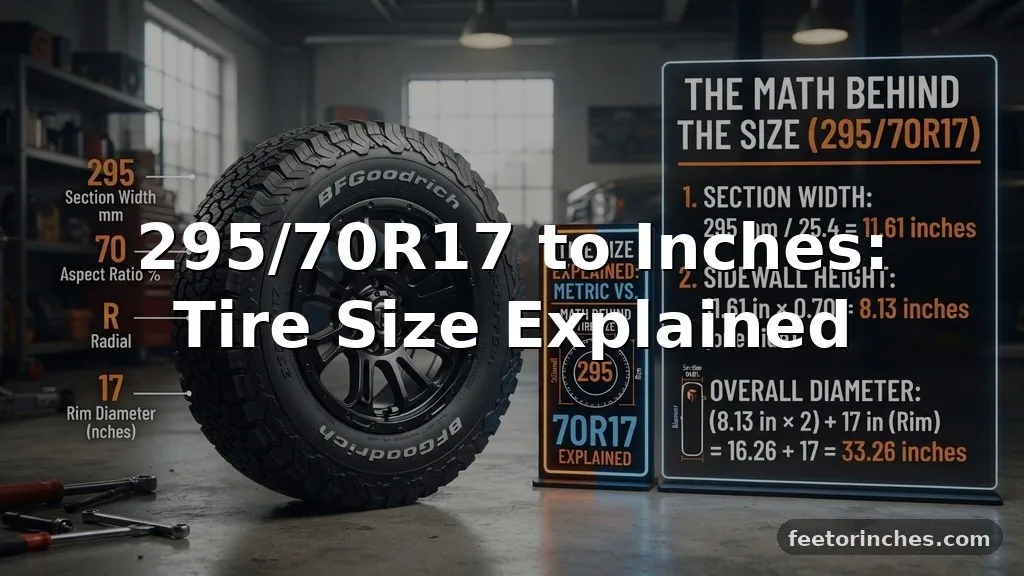
Converting a metric tire designation like 295/70R17 to inches is a common challenge for truck owners looking to upgrade their vehicle’s stance or off-road performance. By understanding how the numbers on your sidewall correlate to real-world measurements, you can avoid costly errors regarding tire clearance and speedometer calibration.
This guide breaks down the math behind your tire’s dimensions, providing the clarity needed to make informed choices for your next set of tires. Mastering the conversion from 295/70R17 to inches ensures your vehicle remains safe and road-legal while achieving the specific look or function you desire for your daily driver or trail rig.
The Math Behind the Tire Size
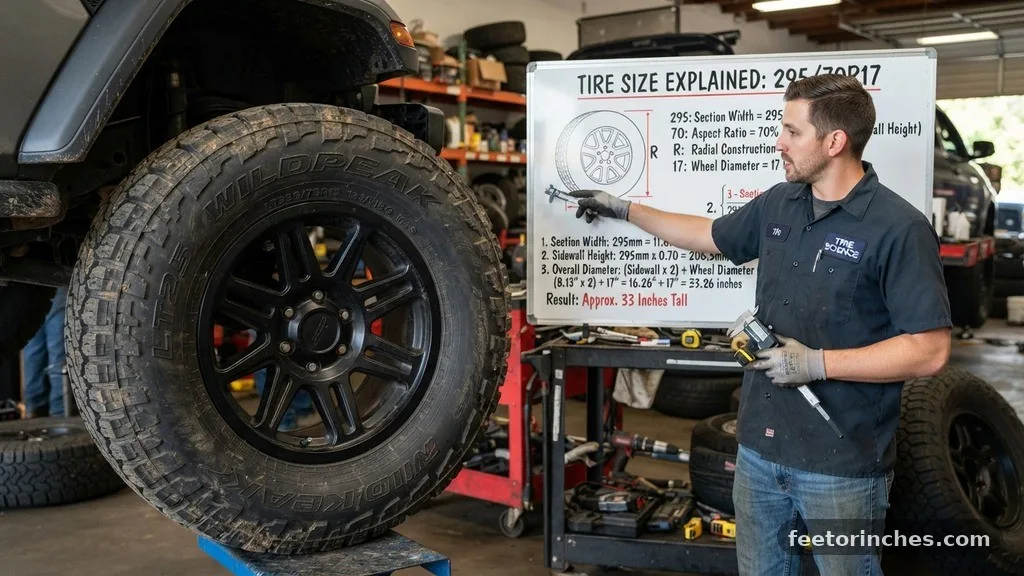
To calculate the dimensions of a 295/70R17 tire, you must apply a standard formula used in automotive engineering. The first number, 295, represents the tire section width in millimeters.
The second number, 70, is the aspect ratio, meaning the sidewall height is 70% of the section width. Finally, the R17 indicates the wheel diameter in inches.
Calculating the total tire diameter requires a few distinct steps. First, you find the sidewall height in millimeters by multiplying 295 by 0.70, which equals 206.5 millimeters. Since a tire has two sidewalls—top and bottom—you double this to get 413 millimeters.
Converting this to inches involves dividing by 25.4, resulting in roughly 16.26 inches. Adding the 17-inch wheel diameter gives you a total diameter of approximately 33.26 inches.
Understanding Aspect Ratio and Section Width
The aspect ratio is often misunderstood as a fixed measurement, but it is actually a percentage. A higher ratio results in a taller sidewall, which is beneficial for off-road tires that require lower air pressure. The tire section width measures the widest point of the tire from sidewall to sidewall, not just the tread width.
Why Wheel Diameter Matters
The R17 designation is critical because it dictates the rim size you must use. You cannot mount a tire designed for a 17-inch wheel onto an 18-inch or 16-inch rim. Always verify your current wheel diameter before purchasing, as this is the one variable in the equation that cannot be adjusted through tire selection.
Conversion Comparison Table
The following table provides a quick reference for common tire sizes in this category, showing how small changes in width or aspect ratio impact the final diameter. These figures are calculated using the standard tire calculation formula provided by industry standards.
| Tire Size | Width (mm) | Sidewall Ratio | Calculated Diameter (Inches) |
|---|---|---|---|
| 285/70R17 | 285 | 70% | 32.71 |
| 295/70R17 | 295 | 70% | 33.26 |
| 305/70R17 | 305 | 70% | 33.81 |
| 295/75R17 | 295 | 75% | 34.42 |
Common Misconceptions About Tire Size
Many enthusiasts assume that all 295-width tires are identical in height, but the aspect ratio changes the final result significantly. A 295/70R17 is not the same as a 35-inch tire, despite some aggressive tread patterns making them appear larger. The “33-inch” classification for a 295/70R17 is a nominal size, meaning the actual measured diameter can vary by brand and tread depth.
Another common confusion involves the difference between tire diameter and circumference. The circumference determines how many times the tire rotates per mile, which directly affects your speedometer accuracy. If you move to a larger diameter tire, your speedometer will read slower than your actual speed unless you recalibrate the vehicle’s computer.
Impact on Vehicle Performance
Upgrading to a larger tire size like the 295/70R17 often requires attention to your vehicle’s mechanical limits. Larger tires increase the tire footprint, which can improve traction on loose surfaces but may also increase rolling resistance. This often leads to a slight decrease in fuel efficiency and a change in gear ratios.
You must also consider tire clearance within the wheel wells. A wider tire may rub against the frame or control arms during tight turns, especially if you have not installed a leveling kit. Always check for full steering lock clearance to ensure safety during daily driving.
Key Considerations for Off-Road Tires
When selecting all-terrain or mud-terrain tires, consider the ply rating and load index alongside the physical dimensions. A higher ply rating adds durability for rock crawling but increases the overall weight of the tire. This unsprung weight can impact suspension performance and ride quality.
- Verify your current rim width is compatible with the 295 section width.
- Check if a suspension lift is required to prevent rubbing.
- Ensure the load index meets or exceeds the vehicle’s manufacturer requirements.
- Confirm the speed rating is appropriate for your driving habits.
- Inspect the tire tread pattern to match your primary terrain usage.
Estimating Tire Size Without Tools
If you need a rough estimate of size, you can use standardized objects. A standard piece of legal-sized paper is 14 inches long, which provides a useful visual anchor for comparing tire width. While not as precise as a tape measure, comparing the tire to a known object can help you visualize how much extra space you need in your wheel well.
To estimate diameter on the fly, look at the gap between the tire and the top of the fender. If you can fit a standard notebook or a specific number of fingers in that gap, you have a baseline for how much larger a new tire can be. Always follow up with a physical measurement before committing to a purchase.
Metric Versus Flotation Sizing
Metric sizing, such as 295/70R17, uses millimeters for width and percentages for sidewall height. Flotation sizing, often seen as 33×12.50R17, uses inches for all three dimensions. These two systems are not perfectly interchangeable, and manufacturers often round their flotation sizes.
A 295/70R17 is often marketed as a “33-inch” tire, but the true measurement is usually closer to 33.2 inches. Always consult the manufacturer’s specific data sheet for the exact diameter, as tread depth and rubber compound can cause variations between two tires labeled with the same size.
FAQ: Common Tire Questions
Is a 295/70R17 a 33-inch tire?
Yes, it is generally considered a 33-inch tire in the off-road community. The mathematical calculation yields approximately 33.26 inches, which is close enough that most shops and owners categorize it as such.
Is a 295 tire bigger than a 285?
A 295 tire is wider than a 285 tire. If the aspect ratio remains the same, the 295 will also be slightly taller because the 70% sidewall calculation is based on the wider section width.
Do I need a lift for 295/70R17 tires?
It depends on your specific vehicle and wheel offset. Many trucks can fit this size with minimal or no rubbing, but some configurations require a leveling kit or wheel spacers to prevent contact with the frame.
How does tire width affect handling?
Wider tires provide a larger contact patch, which can improve grip in dry conditions. However, they are also more prone to hydroplaning in wet weather and may follow ruts in the road more aggressively.
Conclusion
Navigating the transition from a standard tire size to a larger 295/70R17 setup is a rewarding project for any truck owner. By grounding your decision in the actual math of tire conversion, you ensure that your vehicle remains both functional and safe on the road. Remember that while the 295/70R17 is nominally a 33-inch tire, variations between manufacturers mean you should always check the specific specs for your chosen model.
Proper planning regarding clearance and speedometer recalibration will save you time and money in the long run. If you are ready to upgrade, take a moment to measure your current clearance and consult your vehicle’s manual to see how these changes align with your truck’s capabilities. We hope this explanation gives you the confidence to move forward with your next tire purchase.
Related conversions: How Many Inches in a Foot? (Complete Guide with Real Examples & Visuals), How Many Inches in a Yard? Complete Conversion Guide With Examples, What Is 6 mm in Inches? Complete Conversion Guide, How Many Cubic Inches in a Cubic Yard? Complete Conversion Guide.
Explore more on FeetOrInches.




