
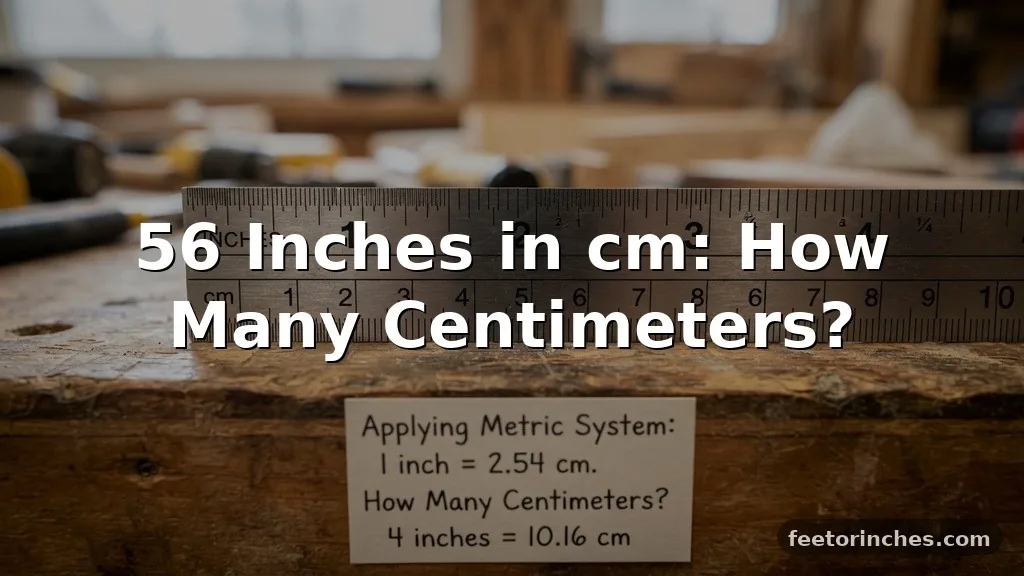
Converting 56 inches to cm is a common task for anyone working across the imperial and metric systems. Whether you are measuring furniture, assessing fabric, or checking height, knowing the exact metric equivalent is essential for precision. 56 inches is exactly 142.24 centimeters.
This conversion relies on the standard international agreement that one inch equals exactly 2.54 centimeters. By multiplying 56 by 2.54, you arrive at the precise result of 142.24. Understanding how these units relate helps you move between systems without confusion, whether you are building, designing, or simply comparing sizes in your daily life.
Conversion Table for Common Measurements
To help you visualize how 56 inches compares to other common increments, the following table breaks down relevant values into feet, centimeters, millimeters, and meters. These figures are rounded to the nearest decimal for practical use.
| Measurement (Inches) | Feet | Centimeters | Millimeters | Meters |
|---|---|---|---|---|
| 12 inches | 1.0 ft | 30.48 cm | 304.8 mm | 0.3048 m |
| 24 inches | 2.0 ft | 60.96 cm | 609.6 mm | 0.6096 m |
| 48 inches | 4.0 ft | 121.92 cm | 1219.2 mm | 1.2192 m |
| 56 inches | 4.67 ft | 142.24 cm | 1422.4 mm | 1.4224 m |
| 72 inches | 6.0 ft | 182.88 cm | 1828.8 mm | 1.8288 m |
The Math Behind the Conversion
The conversion factor between an inch and a centimeter is fixed by international standards. Since 1959, the National Institute of Standards and Technology defines the inch as exactly 25.4 millimeters. This makes the math straightforward for anyone needing to convert inches centimeters.
To perform this calculation manually, you simply take your inch value and multiply by 2.54. For 56 inches, the process looks like this: 56 x 2.54 = 142.24. This constant holds true regardless of the object being measured.
Applying the Metric System
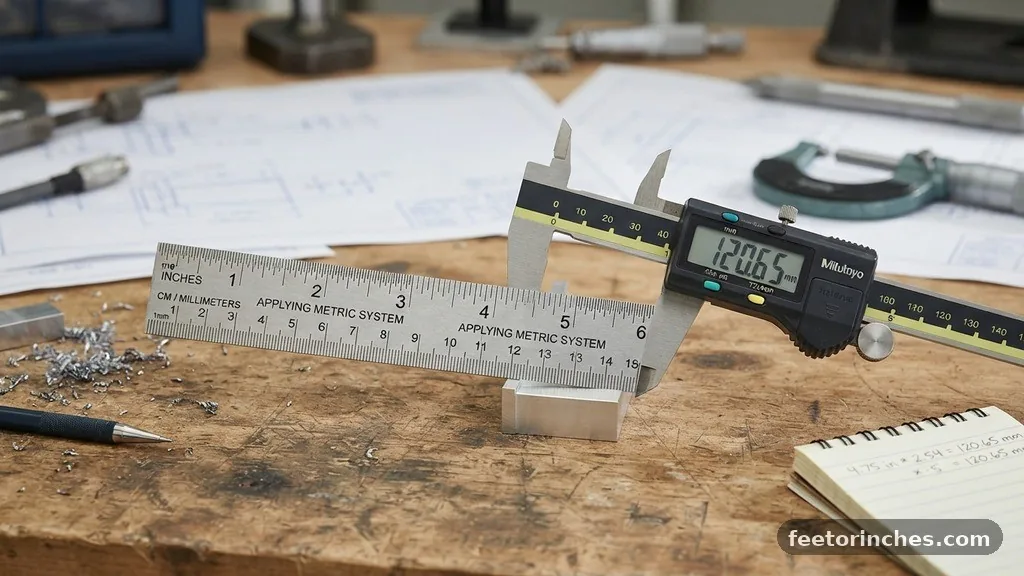
Once you have your result in centimeters, moving to meters or millimeters is just a matter of shifting the decimal point. There are 100 centimeters in a meter and 10 millimeters in a centimeter. This makes the metric system highly intuitive once you have mastered the base unit.
Estimating 56 Inches Without Tools
Sometimes you don’t have a tape measure handy, but you still need an accurate estimate. You can often find common objects that serve as reliable proxies for specific lengths.
- Standard legal-size paper is 14 inches long; four sheets laid end-to-end equal exactly 56 inches.
- A standard kitchen counter height is typically 36 inches; adding a standard 20-inch stool or object gets you close to the mark.
- The average wingspan of an adult is roughly proportional to their height, which can provide a rough gauge if you know your height in inches.
- Standard ceiling tile dimensions are often 24 inches; two full tiles plus an 8-inch segment equal your target.
- Most standard acoustic guitar lengths from headstock to bridge hover near 40 to 42 inches, meaning a 56-inch span is significantly longer.
56 Inches in Real-World Context
Visualizing 142.24 cm can be difficult without a reference point. Below is a list of categories and items that help ground this measurement in physical reality.
Household and Furniture
- Small dining table width: A compact table for two often spans about 56 inches.
- Standard loveseat length: Many smaller sofas are designed to be roughly 56 inches wide.
- Curtain rod length: A window frame of this size requires a rod roughly 56 inches long.
- Entryway console: A narrow table placed against a wall often hits this length.
- Bedside bench: A bench placed at the end of a full-size bed is often around 56 inches.
Kitchen and Appliances
- Kitchen island width: A medium-sized island often features a 56-inch workspace.
- Countertop run: A standard section of base cabinets typically covers this span.
- Large range hood width: High-end professional hoods can reach this width.
- Double-oven height: The total vertical footprint of some units approaches 56 inches.
- Utility sink length: Large laundry or mudroom sinks often measure 56 inches.
Technology and Screens
- 56-inch diagonal display: While rare, some specialized monitors use this diagonal measurement.
- Server rack height: A standard rack often stands well above this, but 56 inches is a common internal clearance.
- Large-format printer width: Professional printing hardware often exceeds 56 inches in total width.
- Cable conduit length: Pre-cut sections for home theaters are often sold in 56-inch segments.
- Desk riser span: A wide standing desk converter can span 56 inches.
Common Misconceptions in Measurement
A frequent error involves confusing diagonal screen measurements with physical width. A “56-inch TV” refers to the diagonal length of the screen, not the width of the frame or the total footprint of the device.
Always check the manufacturer’s specifications for the actual physical width. If you are fitting a screen into a cabinet, the diagonal measurement is secondary to the physical horizontal width. This distinction is vital when planning custom cabinetry or wall mounts.
Diameter vs. Circumference
Another common mistake is confusing diameter and circumference. If you have a circular object with a 56-inch diameter, its circumference is actually 175.9 inches. Always clarify which part of the object you are measuring before applying conversion factors.
Comparing 56 Inches to Nearby Measurements
Understanding how 56 inches sits in relation to other common lengths can help you refine your spatial awareness. The following table provides a quick comparison to nearby increments in the customary system.
| Inch Value | Centimeters | Relationship to 56 Inches |
|---|---|---|
| 48 inches | 121.92 cm | 8 inches shorter |
| 52 inches | 132.08 cm | 4 inches shorter |
| 56 inches | 142.24 cm | The Target |
| 60 inches | 152.40 cm | 4 inches longer |
| 64 inches | 162.56 cm | 8 inches longer |
Accuracy and Precision
When you convert inches to centimeters, the result is exact. Because the inch is defined as 2.54 centimeters, there is no rounding error involved. If your measurement tool is accurate, your conversion will be mathematically perfect.
However, real-world measurements often involve physical variables like temperature expansion or tool calibration. If you are working on a project where 142.24 cm is a critical tolerance, ensure your measurement tool is calibrated correctly. Small variances in tape measures can lead to larger discrepancies than the math itself.
Frequently Asked Questions
How can I convert inches to cm quickly?
To convert any inch value to centimeters, multiply the number of inches by 2.54. This simple conversion factor works for any length, whether it is a small part or a large span.
Is 56 inches the same as 5 feet 6 inches?
No, 56 inches is not 5 feet 6 inches. Since there are 12 inches in a foot, 5 feet 6 inches is actually 66 inches. 56 inches is equivalent to 4 feet 8 inches.
Why is the conversion factor 2.54?
The 2.54 factor is an international standard adopted in 1959. It aligns the inch with the metric system, ensuring that scientific and industrial measurements remain consistent across different global regions.
Does the conversion change based on the object?
The conversion factor never changes regardless of the object. Whether you are measuring a piece of wood, a screen, or a piece of cloth, 56 inches always equals 142.24 centimeters.
Conclusion
Mastering the relationship between imperial and metric units allows for greater accuracy in every project. By knowing that 56 inches is exactly 142.24 centimeters, you have the foundation needed to handle measurements with confidence. Whether you are using a tape measure or estimating by sight, keeping this conversion factor in mind simplifies the process.
We hope this overview of 56 inches in cm helps you navigate your next measurement challenge with ease. If you have further questions or need help with other unit conversions, feel free to reach out and keep exploring the world of measurements.
Related conversions: 5.8 Inches in cm · 29.5 Inches to cm · 24 Inches to cm




