

Writing height correctly ensures your data remains clear and professional across medical records, personal profiles, or technical blueprints. Using the proper feet and inches symbol helps readers immediately distinguish between measurements, preventing confusion between units. While casual writing often relies on abbreviations, formal documentation follows specific typographic standards that rely on the prime and double prime marks.
Mastering these symbols ensures you communicate dimensions accurately in any context. By learning the standard conventions for these marks, you will save time and avoid common errors in your daily writing and documentation.
Understanding the Prime and Double Prime
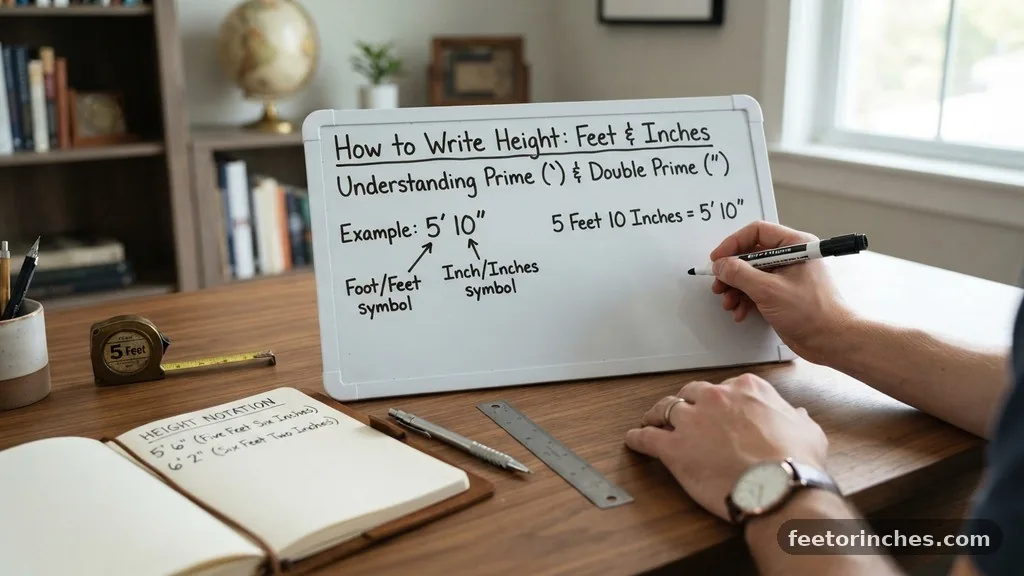
The correct symbols for feet and inches are the prime (′) and the double prime (″). Many people mistakenly use the typewriter apostrophe (‘) and quotation mark (“) because they are easily accessible on a standard keyboard. While these are acceptable for informal emails or quick notes, they are technically incorrect in typesetting and formal engineering.
The prime mark is specifically designed to indicate feet, while the double prime indicates inches. Using the proper symbols provides a professional aesthetic and adheres to technical standards. When you are writing a height like five feet seven inches, the correct notation is 5′ 7″.
Standard Notation for Human Height
When recording human height, clarity is the primary goal. The most common standard involves placing the foot measurement first, followed by the inch measurement. You should include a space between the two values to improve readability.
If you are writing a height that consists only of feet, such as exactly six feet, you should still include the symbol. Writing 6′ is much clearer than simply writing 6, which could refer to any unit of measure. If the height includes inches, always ensure the double prime is used for the inches portion.
- Five feet ten inches: 5′ 10″
- Six feet two inches: 6′ 2″
- Four feet eleven inches: 4′ 11″
- Five feet five inches: 5′ 5″
Conversion Data for 14 Inches
Understanding how 14 inches translates into other units helps bridge the gap between the imperial system and the metric system. Whether you are measuring a small object or a specific distance, having these figures on hand is helpful for quick calculations.
| Unit | Measurement |
|---|---|
| Feet and Inches | 1′ 2″ |
| Centimeters | 35.56 cm |
| Millimeters | 355.6 mm |
| Meters | 0.3556 m |
Estimating 14 Inches Without Tools
Sometimes you need to verify a length when you don’t have a ruler or a tape measure nearby. A standard sheet of legal-size paper is 14 inches long, making it a perfect reference point. If you have a piece of legal paper handy, you can use it to gauge the length of an object accurately.
Another method involves using your own hand. For many adults, the span from the tip of the thumb to the tip of the pinky finger when stretched wide is roughly 8 to 9 inches. Adding a few extra inches can give you a rough estimate, though this is less precise than using a standardized object.
Common Misconceptions in Measurements
A frequent point of confusion involves the difference between screen diagonals and physical width. When a laptop is described as 14 inches, this measurement refers to the diagonal length of the screen, not the width of the chassis. Always check the manufacturer specifications if you are planning to fit a device into a specific bag or sleeve.
Another common error is confusing diameter with circumference. If you are measuring a circular object, 14 inches of diameter will result in a much larger circumference. The National Institute of Standards and Technology provides detailed information on how these units function within the international system of measurements.
Comparing 14 Inches to Nearby Scales
Understanding how 14 inches sits in relation to other common lengths helps you visualize space more effectively. It is slightly longer than a standard ruler, which is typically 12 inches long. This two-inch difference is often significant when considering tight storage spaces or hardware components.
When you look at 13 inches, you are looking at a measurement common in smaller notebook computers. Moving up to 15 or 16 inches, you enter the territory of larger displays and standard kitchen cutting boards. Recognizing these small increments helps you make better decisions when purchasing items or planning layouts.
Technical Usage in Engineering and Design
In fields like architecture and industrial design, the precision of your notation is critical. Using the wrong symbols can lead to misinterpretations by contractors or manufacturers. Always ensure your design software is configured to display the correct prime and double prime symbols rather than generic quotation marks.
When documenting dimensions on a drawing, the placement of the symbol is just as important as the symbol itself. Place the mark immediately following the number without an intervening space if the style guide for your specific industry mandates it. Consistency across a project document is essential for maintaining a high standard of work.
Formatting for Digital Platforms
Writing height on a website requires careful attention to character encoding. If you copy and paste symbols from a word processor, they may sometimes display as strange characters on certain browsers. Using the HTML entity codes for these symbols ensures they appear correctly on all devices.
If you are a developer, consider using the specific Unicode characters for the prime (U+2032) and double prime (U+2033). These characters are widely supported and provide the most professional look for any web-based application. Testing your display on both mobile and desktop browsers will confirm that your height data remains readable and accurate.
Frequently Asked Questions
Is it okay to use apostrophes for height?
While common in casual text, apostrophes are technically incorrect for formal writing. Use the prime and double prime symbols for professional or technical documents to maintain accuracy.
How do I write 5 feet 7 inches correctly?
The standard way to write this is 5′ 7″. Ensure there is a space between the two measurements for clarity.
Do I need a space between the number and the symbol?
In most style guides, the symbol follows the number directly without a space. For example, 6′ is the preferred format over 6 ′.
Are inches and feet symbols the same in all countries?
The prime and double prime are standard in English-speaking countries that use the imperial system. Other regions primarily use the metric system, where centimeters and millimeters are the standard units of measure.
Conclusion
Mastering the use of the feet and inches symbol is a simple way to elevate the quality of your writing and documentation. By choosing the prime and double prime marks over standard keyboard punctuation, you demonstrate attention to detail and a commitment to clarity. Whether you are filling out a formal form or drafting a technical specification, these small marks carry significant weight in terms of precision.
Use these conventions consistently to ensure your measurements are never misunderstood. Taking a moment to verify your notation makes your work more authoritative and easier for others to read. If you have questions about specific formatting requirements for your industry, don’t hesitate to check the latest style manuals for guidance on technical notation.




