
Converting 163cm to inches is a common task when you need to understand height or length across different standards. Whether you are filling out a medical form, checking clothing sizes, or comparing physical dimensions, knowing exactly how these units align helps you avoid confusion. By understanding the relationship between centimeters and inches, you gain a clearer perspective on how measurements are communicated globally.
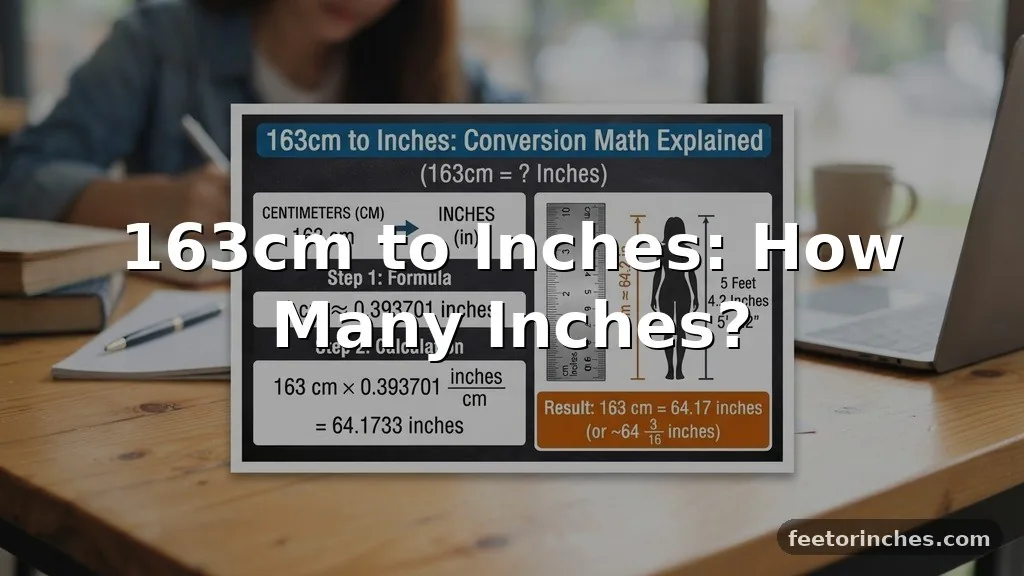
At its core, the conversion relies on the fixed ratio where one inch is defined as exactly 2.54 centimeters. When you calculate 163cm to inches, the result is approximately 64.17 inches. This figure serves as the foundation for broader height and length comparisons, allowing you to bridge the gap between the metric and imperial systems with confidence.
The Conversion Math Explained

To convert 163cm into inches, you divide the total centimeters by 2.54. This constant is the international standard for the inch, established to ensure consistency in engineering, manufacturing, and daily life. Since 163 divided by 2.54 results in 64.1732, most people round the figure to 64.17 or 64.2 inches for practical use.
The metric system is a base-ten system, whereas the imperial system relies on units like feet and inches. Understanding how these systems intersect is essential for those who frequently switch between them. You are essentially translating a decimal-based measurement into a system that uses fractions and whole numbers to represent reality.
Step-by-Step Calculation
Performing this calculation manually is straightforward once you have the conversion factor. You take your starting value of 163 and apply the standard National Institute of Standards and Technology definition of the inch. This ensures your math remains accurate regardless of the specific context, such as measuring a room or personal height.
If you prefer to work in reverse, you can multiply the inch value by 2.54 to verify the result. For instance, multiplying 64.17 inches by 2.54 brings you back to 162.99 centimeters. This simple check confirms that your conversion is sound and ready for any practical application you might have in mind.
Height and Physical Measurements
When discussing 163cm to inches in the context of human height, the conversion is often expressed in feet and inches. A height of 163cm is equivalent to approximately 5 feet and 4.2 inches. Because there are 12 inches in a foot, you subtract 60 inches from the total to find the remainder.
This method is widely used in doctors’ offices and fitness tracking apps. It provides a more intuitive way to visualize a person’s stature compared to a raw number of inches. Many people prefer this format because it fits neatly into the common language of height measurement used in the United States and other regions.
| Metric/Imperial | Value |
|---|---|
| Total Centimeters | 163 cm |
| Total Inches | 64.17 in |
| Feet and Inches | 5′ 4.2″ |
| Total Millimeters | 1630 mm |
Estimating Measurements Without Tools
Sometimes you need to estimate 163cm or 64 inches without a tape measure. You can use standardized objects or body parts to get a rough idea of the scale. For example, a standard piece of legal-size paper is 14 inches long, meaning you would need about 4.5 sheets lined up to reach the equivalent of 64 inches.
Another trick involves using your own wingspan or stride length. Most adults find their arm span is roughly equal to their height.
If you know you are 163cm tall, spreading your arms horizontally gives you a quick, tangible reference for that specific length. This is an easy-to-use method for rough visualization in everyday scenarios.
- Standard A4 paper is approximately 11.7 inches long.
- A standard door handle is usually placed around 36 inches from the floor.
- A typical kitchen counter stands at 36 inches high.
- A standard yardstick is exactly 36 inches, making it a useful reference for longer items.
Common Misconceptions in Measurement
A frequent error occurs when people confuse screen diagonal measurements with physical width. A 14-inch laptop screen is measured from corner to corner, not across the horizontal edge. This means the actual width of the device is significantly less than 14 inches, usually closer to 12 inches depending on the bezel size.
Another area of confusion involves diameter versus circumference. If you have a circular object with a diameter of 14 inches, the distance around the edge, or circumference, is nearly 44 inches. Always clarify whether you are measuring a straight line or a curved surface to maintain accuracy in your results.
Comparing 163cm and 64 Inches to Nearby Scales
Understanding how 64 inches sits in relation to other common lengths helps you build a better sense of scale. A 64-inch measurement is slightly longer than 5 feet, placing it in a category of objects that are roughly human-height. Comparing this to slightly smaller or larger benchmarks clarifies the physical footprint.
For instance, 60 inches is exactly 5 feet, a common milestone for height. Moving up to 72 inches brings you to 6 feet. Seeing 64 inches as a point between these two major markers makes it easier to visualize the size without needing a calculator every time you encounter a measurement.
Benchmarks for Comparison
Consider a standard dining table height, which is usually around 30 inches. A measurement of 64 inches is more than twice that height. When you compare it to common household items, you can see that 64 inches is a substantial length, roughly the height of a small refrigerator or a tall bookshelf.
The Role of Metric and Imperial Systems
The global divide between the metric and imperial systems stems from historical development. Most of the world uses the metric system, which is based on powers of ten. The imperial system, used primarily in the United States, relies on older, traditional units that evolved from physical references like the length of a foot or the width of a thumb.
When you convert 163cm to inches, you are bridging these two distinct philosophies of measurement. One is designed for mathematical precision and ease of division, whereas the other is built on human-scale references. Being able to move between them is a skill that allows you to interact with information from any source, whether it is a scientific paper or a carpentry project.
Practical Applications in Daily Life
You might encounter 163cm or 64 inches in a variety of real-world scenarios. In interior design, knowing this length helps when choosing curtains or furniture.
A 64-inch long bench or piece of art provides a specific visual weight that changes how a room feels. Using these measurements accurately prevents the common headache of buying items that do not fit their intended space.
In fitness, tracking height is a standard health metric. Whether you are adjusting a bicycle seat or determining the correct size for a piece of athletic gear, the conversion remains vital. Precision here ensures that equipment supports your body correctly, reducing the risk of strain and improving your overall comfort.
FAQ
Is 163cm the same as 5 feet 4 inches?
It is very close, but slightly different. 163cm is approximately 5 feet 4.17 inches. Therefore, 5 feet 4 inches is a very accurate shorthand for 163cm.
Why do we use both centimeters and inches?
Different countries adopted different standards based on history and trade. The metric system is the international scientific standard, while the imperial system remains deeply embedded in the culture and construction industries of specific nations.
How do I convert inches back to centimeters?
You multiply the number of inches by 2.54. For example, 10 inches multiplied by 2.54 equals 25.4 centimeters.
Are there tools to help with these conversions?
Yes, many online calculators provide an easy-to-use interface for instant results. You can also use mobile apps or even simple search engine queries to perform the math in seconds.
Final Thoughts
Mastering the conversion of 163cm to inches gives you a reliable reference point for both height and physical length. By remembering the 2.54 factor, you can quickly estimate measurements and understand how different standards relate to one another in your daily life. Whether you are checking your own height or measuring a piece of furniture, the ability to switch between systems is a practical asset.
We hope this overview has clarified how to handle these conversions effectively. Keeping these simple math rules in mind will save you time and prevent confusion whenever you encounter mixed measurement data. If you have more questions about specific lengths or need help with other conversions, please feel free to reach out and explore further.




