
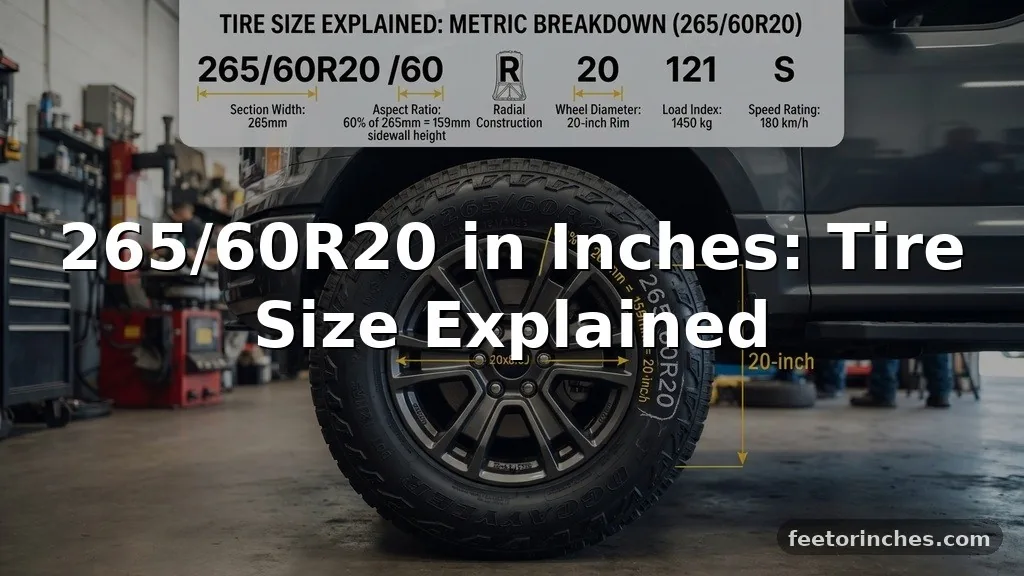
When you look at the sidewall of your truck or SUV tires, you see a cryptic string of numbers that dictates how your vehicle interacts with the road. Understanding 265/60R20 in inches is essential for anyone considering a tire swap, a lift kit, or simply trying to find the correct replacement for their current setup. By breaking down these metrics into standard imperial measurements, you gain full control over your vehicle’s performance and handling characteristics.
This guide provides the exact math required to translate metric tire specifications into real-world dimensions. Whether you are checking clearance for new rubber or recalibrating your speedometer, you will find the precise data needed to make an informed decision for your vehicle.
The Metric Breakdown
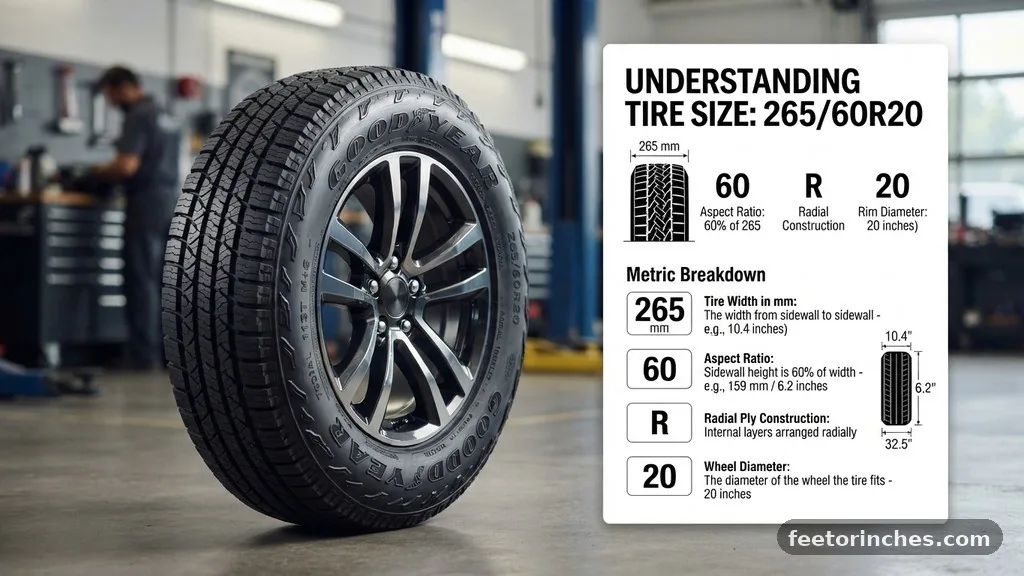
The sequence 265/60R20 follows the standard ISO metric tire sizing system used globally. Each number serves a specific purpose in defining the physical dimensions of the tire, starting with the width and ending with the rim diameter.
- 265: The section width of the tire measured in millimeters.
- 60: The aspect ratio, representing the height of the sidewall as a percentage of the width.
- R: Indicates radial construction, the industry standard for modern passenger vehicles.
- 20: The rim diameter in inches, specifying the wheel size required for mounting.
To find the total tire diameter in inches, you must first calculate the sidewall height. Multiply the width (265 mm) by the aspect ratio (0.60) to get 159 mm.
Converting this to inches by dividing by 25.4 gives you approximately 6.26 inches per sidewall. Since a tire has a top and bottom sidewall, you double this figure to 12.52 inches and add the 20-inch rim diameter, resulting in a total height of roughly 32.52 inches.
Conversion Table for Tire Dimensions
Having a quick reference table helps when comparing tire specifications across different brands and models. Below is the conversion for the core dimensions of a 265/60R20 tire into various standard units.
| Dimension | Millimeters | Inches | Centimeters |
|---|---|---|---|
| Section Width | 265 mm | 10.43 in | 26.5 cm |
| Sidewall Height | 159 mm | 6.26 in | 15.9 cm |
| Rim Diameter | 508 mm | 20.00 in | 50.8 cm |
| Total Diameter | 825.8 mm | 32.51 in | 82.58 cm |
Why Tire Diameter Matters
The total diameter of your tire dictates more than just the look of your truck; it fundamentally changes the mechanical output of your drivetrain. A larger tire circumference means your wheels travel further with every single rotation. If you move from a smaller stock tire to a 32.5-inch 265/60R20, your odometer and speedometer will likely read slower than your actual speed.
This discrepancy is why professional shops emphasize proper tire specifications when upgrading. Failure to account for this change can lead to inaccurate fuel economy readings and delayed transmission shift points. You may need a digital tuner or a dealer-level scan tool to perform a speedometer calibration after installing larger rubber.
Comparing 265/60R20 to Other Sizes
Many drivers compare this size to the 275/60R20, which is a common factory upgrade for many half-ton trucks. While the 265 width is narrower, the 275/60R20 is slightly taller and wider, which can impact your turning radius and clearance inside the wheel well. Understanding these nuances prevents rubbing issues that often occur when moving to a wider contact patch.
When you look at smaller alternatives like the 265/55R20, the difference is significant. A 265/55R20 is roughly 31.5 inches tall, meaning you lose about an inch of ground clearance compared to the 265/60R20. Choosing the right size often comes down to balancing your need for ground clearance against the limitations of your current suspension setup.
The Impact of Load Index and Speed Rating
Beyond the physical dimensions, you must consider the load index and speed rating printed after the size. A 265/60R20 tire might come in a standard load or an E-rated heavy-duty version. The latter features a stiffer sidewall designed for towing, but it will significantly degrade ride quality on an unloaded vehicle.
Always verify that the tire you choose meets the minimum requirements set by your vehicle manufacturer. Installing a tire with a lower load index than specified is a safety risk, especially when hauling heavy payloads or navigating highways at speed. Check your door jamb sticker to confirm the factory-recommended specifications for your specific trim level.
Physical Estimation Without Tools
Estimating whether a tire will fit without a formal tire calculator requires using standardized objects as a reference. A sheet of legal-size paper is 14 inches long, which provides a helpful benchmark for visualizing space. If you have a tape measure, remember that the tire diameter is the most critical factor for vertical clearance, while the section width determines lateral clearance near the control arms.
You can also use the “finger test” to check for potential rubbing at full steering lock. With the vehicle parked, turn the wheel all the way to one side and check for at least an inch of space between the tire and the frame. If you have less than that, moving to a wider or taller tire may require wheel spacers or a suspension lift to remain safe.
Common Misconceptions
One frequent error is confusing the rim diameter with the total tire diameter. A 20-inch rim is just the metal wheel; the rubber surrounding it adds significantly to the total height of the assembly. People often assume that all tires with the same rim size are interchangeable, but the aspect ratio creates vastly different total dimensions.
Another myth involves the contact patch. While a wider tire is often associated with better grip, the actual footprint is determined by your tire pressure and the vehicle’s weight.
Over-inflating your tires will actually reduce the contact patch, leading to uneven wear and poor traction in wet conditions. Always stick to the manufacturer’s recommended PSI, adjusting only for specific off-road scenarios.
Frequently Asked Questions
Is a 265/60R20 the same as a 33-inch tire?
No, it is technically smaller. A 265/60R20 measures approximately 32.5 inches in diameter, which is slightly shy of a true 33-inch tire. Many people group them together because they occupy the same general size category for truck fitment.
Will 265/60R20 tires rub on a stock truck?
In most modern full-size trucks, this size fits without rubbing. However, if your truck has a very aggressive offset on the wheels, or if you are using wide aftermarket rims, you might experience minor contact at full lock.
How does changing to this size affect my gas mileage?
Moving to a larger or heavier tire increases rolling resistance and rotational mass. You will likely notice a slight decrease in fuel efficiency, often ranging from 1 to 2 miles per gallon depending on your driving habits and the weight of the new tire tread.
Do I need to change my rims to run 265/60R20?
You only need to change your rims if your current wheels are not 20 inches in diameter. As long as your rim width falls within the manufacturer’s recommended range for the tire, you can use your existing wheels.
Conclusion
Navigating the specifications of your vehicle’s footwear is a vital part of maintaining performance and safety. By understanding the math behind 265/60R20 in inches, you can confidently select the right tires for your driving needs without relying on guesswork. Whether you are prioritizing fuel economy, off-road capability, or aesthetic appeal, these measurements provide the roadmap for your next upgrade.
Keep these dimensions in mind when comparing load ratings and tread designs, and always ensure your speedometer is calibrated correctly if you decide to change your overall diameter. If you have specific questions about your vehicle’s clearance or handling after a tire change, consult with a local tire professional who can verify your setup in person.
You may also like: 295/60R20 in Inches
You may also like: 265/60R18 in Inches




