
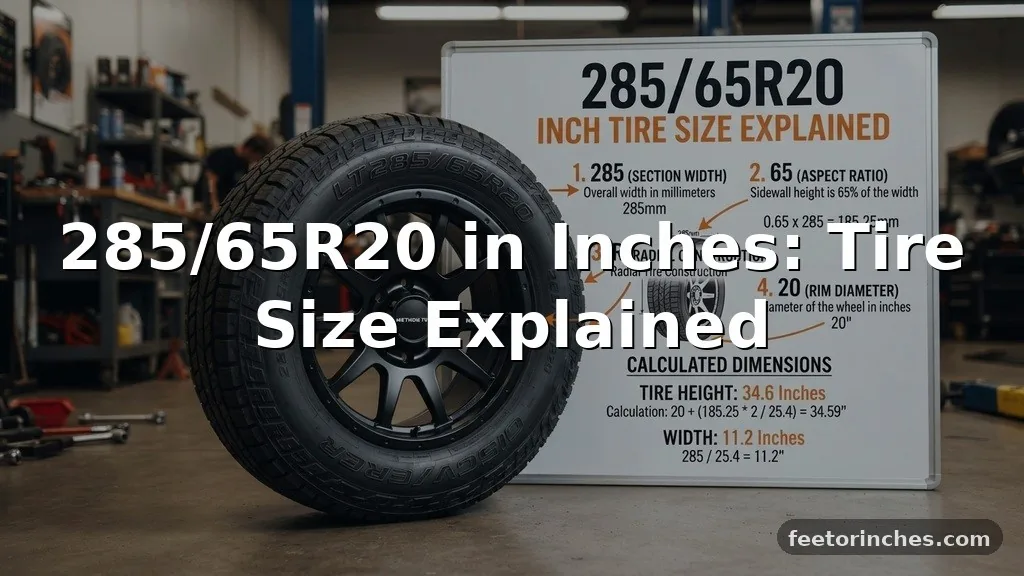
When you look at a 285/65R20 tire, the string of numbers tells a precise story about the rubber mounted on your truck. Understanding these dimensions is essential for anyone planning a suspension upgrade or choosing a replacement set for better off-road performance. While the metric system governs the manufacturing process, most drivers in North America think in standard units.
Calculating 285/65R20 in inches helps you visualize exactly how much space those tires will occupy in your wheel wells. This breakdown provides the math and context you need to make an informed purchase without guesswork.
The Mathematical Breakdown
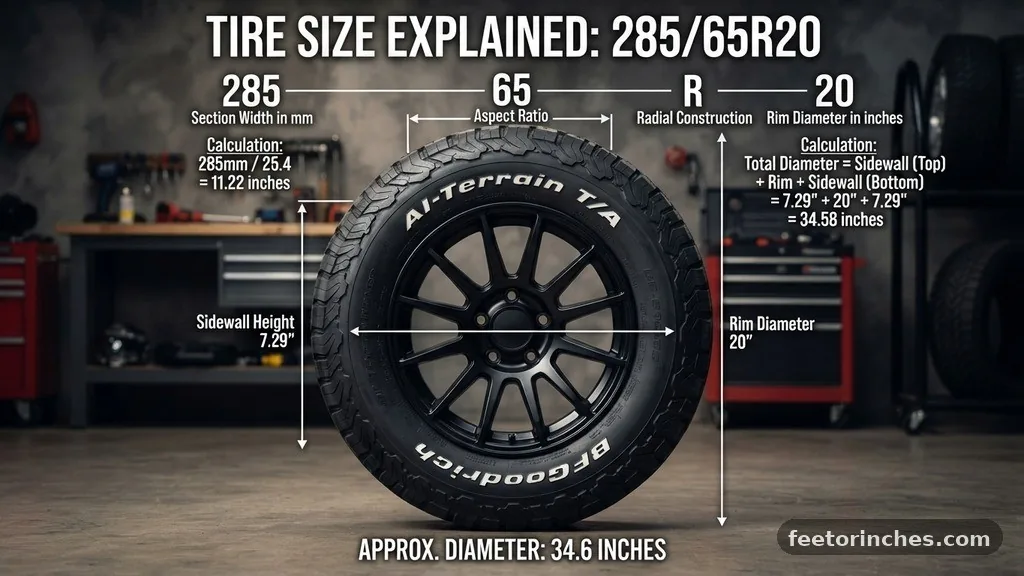
A 285/65R20 tire is approximately 34.6 inches in total diameter. To reach this number, you must calculate the sidewall height and add it to the rim size twice.
The “285” represents the section width in millimeters, while the “65” is the aspect ratio, meaning the sidewall is 65% of that width. Finally, the “R20” indicates a 20-inch wheel diameter, which remains constant regardless of the tire’s overall height.
| Dimension | Metric Value | Conversion to Inches |
|---|---|---|
| Section Width | 285 mm | 11.22 inches |
| Sidewall Height | 185.25 mm | 7.29 inches |
| Rim Diameter | 20 inches | 20.00 inches |
| Total Diameter | 879.5 mm | 34.63 inches |
Understanding Metric Tire Sizing
The metric tire sizing system is a global standard that provides a shorthand for complex engineering specifications. Every number serves a specific purpose in defining the physical footprint and structural integrity of the tire. By learning how to interpret these digits, you can compare different models without relying on vague marketing terms.
Deciphering the Code
The first number, 285, indicates the section width. This is the measurement in millimeters from the widest point of one sidewall to the widest point of the other.
It is not the same as the tread width, which is the part actually touching the pavement. Wider tires can provide more grip, but they also increase rolling resistance and potential steering effort.
The aspect ratio of 65 acts as a percentage multiplier for that section width. A higher ratio results in a taller sidewall, which is beneficial for off-road driving because it allows the tire to deform over obstacles. Lower ratios, conversely, provide sharper handling on pavement by reducing sidewall flex.
You can verify specific manufacturer specifications on the U.S. Tire Manufacturers Association website to ensure your chosen model matches these theoretical dimensions.
The Physics of Tire Diameter
Total tire diameter is the most critical factor when checking for clearance in your truck’s wheel well. As you increase diameter, you change the vehicle’s final drive ratio and speedometer accuracy. A 34.6-inch tire is significantly larger than most factory-spec tires, which usually hover around 32 inches.
Why Clearance Matters
When you upgrade to a 34.6-inch tire, you must account for the swing of the front wheels during a turn. If the tire is too wide or tall, it will rub against the plastic fender liners or the metal frame components. Always check the full lock-to-lock turning radius before committing to a larger tire size.
Suspension geometry also changes when you increase the tire rolling radius. Your truck’s computer, including the ABS and traction control systems, expects a specific number of rotations per mile.
Installing larger tires will make your speedometer read slower than your actual ground speed. You may need a digital calibrator to adjust the vehicle’s onboard computer to compensate for this change.
Comparing 285/65R20 to Other Sizes
Selecting the right tire often involves a trade-off between aesthetics and utility. Many drivers compare the 285/65R20 to the more common 275/65R20, which is slightly narrower and shorter. Understanding these differences prevents the disappointment of buying a tire that does not fit your specific driving needs.
- 275/65R20: Roughly 34.1 inches tall; provides a slightly narrower footprint that can improve fuel economy.
- 285/65R20: Roughly 34.6 inches tall; offers a wider stance that enhances stability on loose terrain.
- 295/60R20: Roughly 33.9 inches tall; a wider tire that sacrifices height for a more aggressive, “meaty” look.
- 305/55R20: Roughly 33.2 inches tall; a very wide tire that requires careful offset planning to avoid rubbing.
Load Index and Speed Rating
The physical dimensions are only part of the equation when selecting a tire for your vehicle. You must also consider the load index and speed rating to ensure the tire can handle the weight and performance characteristics of your truck. These ratings are usually found immediately after the size code, such as “127S.”
The load index indicates the maximum weight the tire can support at its maximum air pressure. For heavy-duty trucks, choosing an E-rated tire—often referred to as a 10-ply tire—is standard practice. These tires feature a higher ply rating, which makes the sidewall stiffer and more resistant to punctures from rocks or debris.
Speed ratings, denoted by a letter, indicate the maximum speed at which the tire is designed to operate safely. While most all-terrain tires in the 285/65R20 size are rated for “S” or “T” speeds, you should always match the rating to your vehicle’s capabilities. Never install a tire with a lower load capacity than what the manufacturer recommends for your truck’s Gross Vehicle Weight Rating.
The Role of Radial Construction
Modern light truck tires almost exclusively use radial construction. This method involves running the body plies at a 90-degree angle to the centerline of the tread. This design is superior for heat dissipation and provides a more consistent contact patch compared to older bias-ply designs.
Radial tires offer a smoother ride and better fuel efficiency because the sidewalls are more flexible. However, this flexibility can be a disadvantage when you are carrying heavy loads or navigating sharp, jagged rocks. This is why many off-road enthusiasts prefer tires with reinforced sidewalls or extra plies, even within the radial category.
Understanding the internal structure helps you appreciate why certain brands cost more than others. A premium tire will often feature specialized rubber compounds that maintain flexibility in cold temperatures while resisting chunking on hot, abrasive surfaces. Always look for the “LT” designation on the sidewall, which stands for Light Truck, indicating a more durable carcass than a standard passenger vehicle tire.
Measuring Your Setup at Home
If you want to verify your current tire size without relying on a calculator, you can perform a simple manual check. Park your vehicle on a flat, level surface and use a long level or a straight edge. Hold the level horizontally across the very top of the tire, parallel to the ground.
Measure the distance from the ground to the bottom of the level using a tape measure. This gives you the actual, under-load diameter of your tire. Remember that a tire’s “loaded” diameter is always slightly smaller than its “unloaded” diameter because the weight of the vehicle compresses the rubber where it touches the road.
If you are trying to measure the width, you can use a set of calipers or a large adjustable wrench. Place the wrench around the widest part of the tire sidewall, then measure the gap between the jaws. This measurement is rarely perfectly accurate, but it will confirm if you are in the 11-inch range or closer to 12 inches.
Common Misconceptions About Size
One of the most frequent errors drivers make is confusing section width with tread width. A tire might be labeled 285mm wide, but the actual tread that touches the road might only be 230mm wide. This depends entirely on the tread design and the shoulder profile of the tire.
Another common point of confusion involves the rim diameter. Many people believe that a 20-inch rim allows for better performance, but it actually limits your options for off-roading.
Smaller rims allow for more sidewall, which provides better cushioning and protection for the wheel itself. If you prioritize off-road durability, you might eventually decide to downsize your wheels to an 18-inch or 17-inch setup.
Finally, do not assume that all tires labeled as the same size will measure exactly the same. Different manufacturers have different molding processes and rubber compounds that lead to slight variations in physical size. One brand’s 285/65R20 might measure a true 34.6 inches, while another brand’s version might run slightly small or large.
FAQ
Is a 285/65R20 considered a 34-inch tire?
Yes, it is effectively a 34.6-inch tire. Most people refer to it as a 35-inch tire in casual conversation, but it sits right between the 34 and 35-inch categories.
Will these tires fit my stock truck without a lift?
It depends on your specific vehicle’s wheel offset and suspension configuration. Many trucks require at least a 2-inch leveling kit to prevent rubbing with a tire of this size.
Does the tire width affect my fuel economy?
Yes, a 285-width tire is wider than many factory options, which increases rolling resistance and aerodynamic drag. You will likely see a minor decrease in your overall miles per gallon.
Can I use these on my factory 20-inch wheels?
Most 285/65R20 tires are designed to fit on wheels between 8 and 10 inches wide. As long as your factory wheels fall within this range, you can safely mount these tires.
Are all 285/65R20 tires all-terrain?
No, you can find this size in all-season, all-terrain, and mud-terrain configurations. Choose the tread pattern that best matches your typical driving environment.
Final Thoughts
Selecting the right rubber for your vehicle is a balance between form and function. By calculating 285/65R20 in inches, you have moved beyond the vague labels and now understand the physical requirements for your truck’s setup. Whether you are aiming for a more aggressive look or improved traction on trails, knowing your tire diameter is the first step toward a successful modification.
Remember to consider your wheel offset and suspension clearance before finalizing your purchase. These tires represent a significant investment in both appearance and capability, so verify your fitment specifications with a professional if you have any doubts.
Once installed, take the time to calibrate your speedometer to ensure your vehicle remains legal and efficient. Enjoy the improved stance and performance that comes with your new, larger tires as you hit the road.
You may also like: 285/55R20 in Inches
You may also like: 285/55R22 in Inches




