
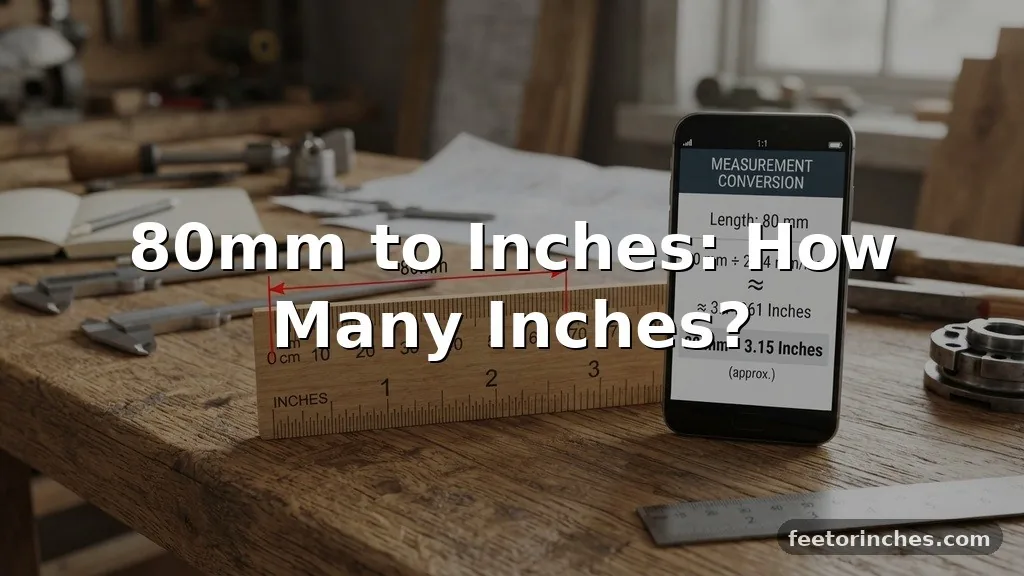
Calculating 80mm to inches is a common task for anyone working with hardware, photography, or precision engineering. Whether you are sizing a computer case fan or measuring a mechanical component, knowing the exact decimal is essential for a proper fit. Converting between these systems often feels tedious, but the math is straightforward once you have the right constant.
If you need the quick answer, 80mm is exactly 3.1496 inches. In practical, everyday terms, this measurement is just slightly over three and an eighth inches. Understanding this conversion helps you avoid costly errors when ordering parts or designing layouts that require specific clearances.
Understanding the Conversion Math
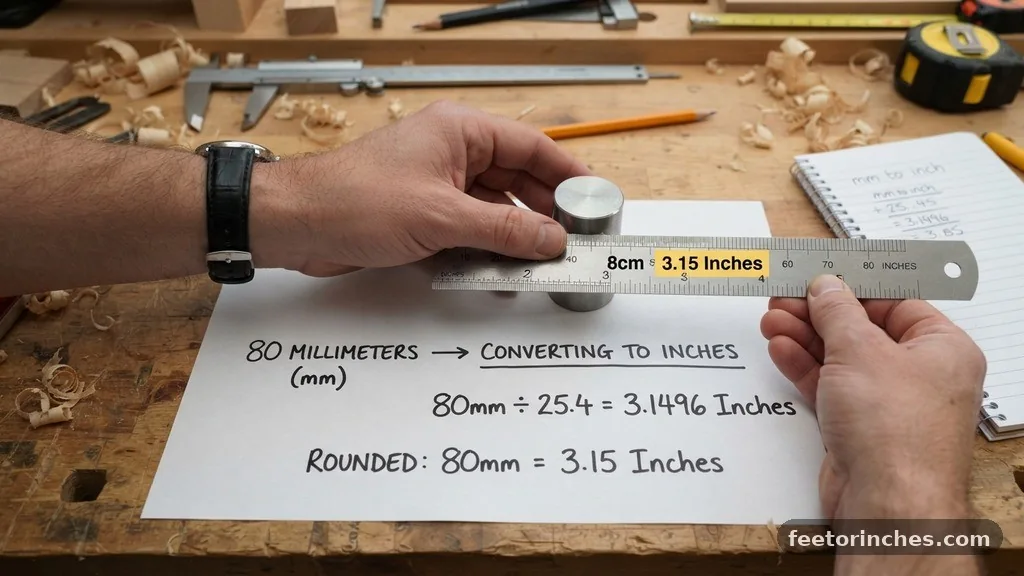
To convert from millimeters to inches, you must use the internationally accepted standard where one inch is defined as exactly 25.4 millimeters. This constant is the bedrock of global manufacturing and trade. Using this figure ensures that parts produced in Europe or Asia fit perfectly into designs originated in the United States.
The mathematical process involves dividing your millimeter value by 25.4. For an 80mm measurement, the calculation is 80 / 25.4, which yields the recurring decimal of approximately 3.149606. For most workshop applications, rounding to three decimal places—3.150 inches—is more than sufficient to maintain structural integrity.
Why 25.4 is the Magic Number
The history of the International System of Units explains why we rely on this specific ratio. Before the mid-20th century, various national standards for the inch led to slight discrepancies in manufacturing. Standardizing the inch at 25.4 millimeters eliminated these variations across global supply chains.
This consistency allows engineers to swap components without recalibrating their entire design. When you see a part labeled at 80mm, you can trust that it will consistently relate to the imperial measurement of roughly 3.15 inches regardless of the manufacturer’s location.
Conversion Table for Common Lengths
Having a quick-reference chart saves time when you are performing multiple measurements in a single session. The following table provides the inch equivalents for common metric lengths often encountered alongside the 80mm standard.
| Millimeters (mm) | Inches (in) | Fractional Approximation |
|---|---|---|
| 25.4 mm | 1.000 in | 1″ |
| 50.0 mm | 1.969 in | 2″ |
| 75.0 mm | 2.953 in | 2 15/16″ |
| 80.0 mm | 3.150 in | 3 5/32″ |
| 100.0 mm | 3.937 in | 3 15/16″ |
Practical Estimation Without Tools
Sometimes you find yourself in a situation where you lack a digital caliper or a ruler. Estimating 80mm to inches becomes easier when you compare the length to common household items. You can use these benchmarks to verify if a part will fit your project.
- Standard Credit Cards: The long edge of a credit card is approximately 85.6mm, which is just over 3.3 inches. If your object is slightly shorter than the long edge of a card, you are likely in the 80mm range.
- Legal Paper Width: The width of standard letter-sized paper is 8.5 inches, while the width of a standard legal sheet is also 8.5 inches. Folding a sheet of paper into roughly thirds provides a segment close to 2.8 inches, giving you a baseline for “just under 3 inches.”
- Finger Width: The average adult index finger is roughly 15mm to 20mm wide. Placing four fingers side-by-side often gets you very close to the 75mm to 80mm range.
Common Applications of 80mm Measurements
The 80mm dimension is a classic standard in the computer hardware industry. You will frequently encounter it when selecting cooling fans for desktop PC cases. These fans are designed to fit into specific mounting holes spaced at standard intervals to ensure universal compatibility.
Beyond computing, 80mm is a common diameter for small pipes and structural tubing. In photography, you may see 80mm lenses, which refer to the focal length rather than the physical diameter of the glass. Always distinguish between the physical size of an object and its functional rating to avoid confusion during installation.
Addressing Differences in Measurement
It is vital to distinguish between a linear measurement and a diagonal one. When you see a monitor or screen listed as 14 inches, that is a diagonal measurement from corner to corner. This does not tell you the actual width or height of the screen, only the hypotenuse of the display area.
Conversely, 80mm usually refers to a physical width or diameter. If you are measuring a circular object, clarify whether you are measuring the diameter or the circumference. Measuring the circumference of an 80mm pipe would result in a much larger number, roughly 251mm, because of the constant pi.
Comparing 80mm to Nearby Metric Sizes
Understanding how 80mm sits in relation to other common metric sizes helps you visualize the scale. Many projects allow for a small margin of error, but in precision engineering, a 5mm difference is significant. This comparison helps you visualize the relative sizes.
70mm is approximately 2.76 inches. 75mm is approximately 2.95 inches, sitting just shy of the 3-inch mark.
80mm crosses that 3-inch threshold, landing at roughly 3.15 inches. Finally, 90mm jumps to approximately 3.54 inches, which is a noticeable increase in physical footprint.
The Importance of Precision
Precision is not just about using the right tool; it is about knowing the tolerance of your project. If you are building a shelf or installing a bracket, a fraction of an inch can lead to a gap or a failure to close. Always measure twice before cutting or drilling.
When working with digital designs, software often handles the conversion for you. However, you should still verify the output to ensure the units are set correctly. A simple error in toggling between metric and imperial can result in a design that is 25.4 times larger or smaller than intended.
Common Misconceptions
Many people assume that 80mm is exactly 3 inches. While 3 inches is 76.2mm, the 3.8mm difference is enough to prevent a component from seating correctly in a chassis. Always use the precise conversion factor of 25.4 rather than rounding to the nearest whole inch.
Another misconception involves the confusion between millimeters and centimeters. It is easy to misread 80mm as 8cm.
While they are mathematically identical, keeping your notation consistent prevents errors in communication with suppliers or partners. Use millimeters for small, high-precision work and centimeters or inches for larger, macroscopic dimensions.
FAQ
Is 80mm exactly 3 inches?
No, 80mm is not exactly 3 inches. As noted, 3 inches equals 76.2mm. Therefore, 80mm is approximately 3.15 inches, which is about 3.8mm longer than 3 inches.
How do I convert millimeters to inches on a ruler?
Look at the side of the ruler marked with inches. Each inch is usually divided into 16 smaller marks. Since 80mm is 3.15 inches, you are looking for the mark at the 3-inch line plus one small tick mark, as each tick represents 1/16 of an inch, or approximately 0.0625 inches.
Why do manufacturers use both millimeters and inches?
Global trade requires standardized units. Many international manufacturers use the metric system, while the United States often relies on the imperial system. Using both ensures that products remain marketable and compatible across different regions of the world.
What is the easiest way to remember the conversion?
Remembering that 25mm is roughly 1 inch is a great starting point for rough estimates. For precision, always divide by 25.4. If you need a mental shortcut, simply multiply the inches by 25 to get a close approximation in millimeters.
Conclusion
Mastering the conversion of 80mm to inches allows you to move between metric and imperial systems with complete confidence. Whether you are troubleshooting a hardware installation or verifying specifications for a new project, remember that 80mm equates to approximately 3.15 inches. By relying on the 25.4 conversion constant, you eliminate the risk of small discrepancies that often plague DIY projects and professional designs alike.
Keep a physical ruler handy for quick checks, but use a calculator for any critical measurements where precision matters. As you continue your work, you will find that these conversions become second nature. If you have specific parts that require precise fitting, always double-check the manufacturer’s provided data sheet to ensure your measurements align with their engineering standards.
You may also like: 18 mm in Inches
You may also like: 225 mm to Inches




