
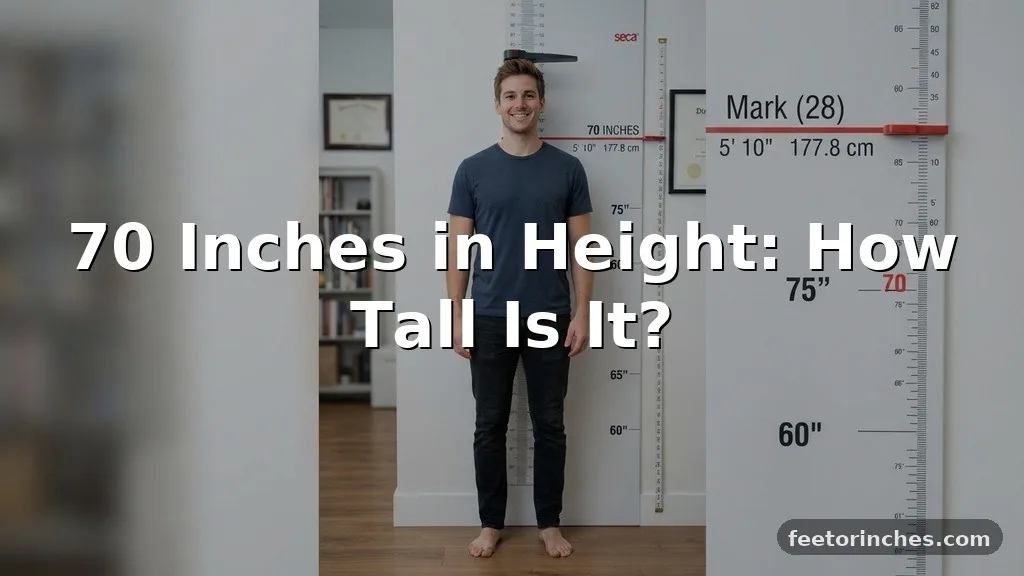
When you encounter a measurement like 70 inches in height, it is common to wonder exactly how that translates into the standard feet and inches format used in daily life. Understanding this specific measurement is straightforward once you apply basic conversion math, helping you visualize the scale of everything from human stature to architectural features. This article provides the precise breakdown you need to interpret this value confidently.
Knowing that 70 inches equates to exactly 5 feet and 10 inches allows you to quickly assess height requirements, furniture dimensions, or personal stats without needing a calculator. Whether you are checking your own height or sizing up a doorway, this guide offers the clarity you need to master these common height measurements.
The Precise Conversion of 70 Inches
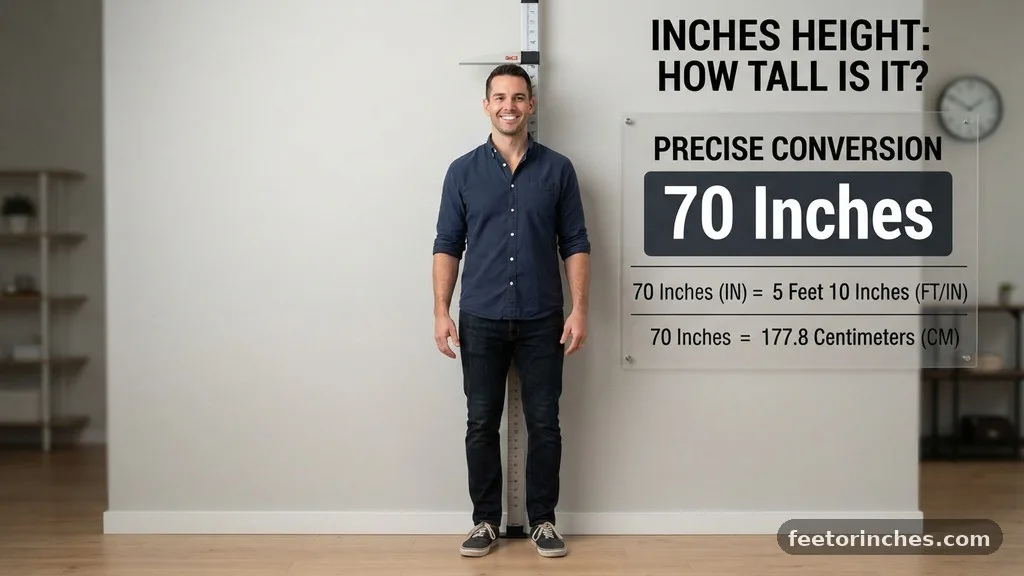
To convert 70 inches into feet, you divide the total by 12, as there are 12 inches in every foot. This calculation results in 5 feet with a remainder of 10 inches, making the final height 5’10”. This measurement is a common benchmark for adult male height in many parts of the world, often serving as a point of comparison for physical stature.
Beyond the imperial system, 70 inches also has clear equivalents in metric units. Understanding these conversions is essential for international travel or technical projects where millimeters and centimeters are the standard. The following table illustrates how this single value looks across different measurement systems.
| Unit System | Measurement Value |
|---|---|
| Feet and Inches | 5 feet, 10 inches |
| Total Inches | 70 inches |
| Centimeters | 177.8 cm |
| Meters | 1.778 m |
| Millimeters | 1,778 mm |
Visualizing 70 Inches in the Real World
Visualizing 70 inches in height becomes easier when you compare it to common objects you encounter during your daily routine. Because 5’10” is a significant vertical distance, many household items and structural elements are built around this scale. Below is a curated list of objects that help ground this measurement in physical reality.
- Household: A standard interior door handle is often placed around 36 to 40 inches, but a full-length mirror is frequently 70 inches tall to provide a complete view.
- Kitchen: Many standard upright refrigerators or pantry cabinets reach exactly 70 inches in height to maximize vertical storage space.
- Tech: A 70-inch television is measured by its diagonal screen size, which is quite different from a physical 70-inch vertical height.
- Furniture: A high-back office chair or a floor-standing lamp often reaches this height when fully extended.
- Fitness: Many standard heavy-duty weight racks or squat stands are designed with a height of 70 inches or more to accommodate various user heights.
- Clothing: A standard floor-length garment bag designed for a dress or overcoat is typically sized around 70 inches to prevent wrinkling.
- Construction: Some standard residential shower curtains or liners are produced in 70-inch lengths to ensure they hang correctly from standard rod heights.
- Gardening: A tall, mature tomato plant staked in a garden bed can easily reach 70 inches in height by the end of the summer season.
- Office: A standard cubicle divider panel is often 70 inches tall to provide privacy while sitting, while still allowing for some ambient light.
- Automotive: The total height of many modern mid-size SUVs from the ground to the roofline sits right around 70 inches.
- Art: Large-scale canvas prints or floor-standing easels are often designed to reach 70 inches to command attention in a room.
- Safety: A standard fire extinguisher cabinet mounted on a wall often has a top edge height near 70 inches for accessibility.
- Sports: The height of a standard volleyball net for men is approximately 95 inches, but the reach of a player standing 70 inches tall is a critical stat.
- Retail: Display shelving units in large hardware stores often stand 70 inches tall to keep products within reach for the average shopper.
Estimating Height Without Tools
When you do not have a measuring tape or a digital tool handy, you can estimate 70 inches using your body or common reference points. One reliable method involves using your own arm span, which is often roughly equal to your height. If you know you are close to 5’10”, you have a built-in ruler for quick visual checks.
You can also use standard paper sizes as a makeshift guide. A piece of legal-size paper is 14 inches long; stacking five of these end-to-end gives you exactly 70 inches. This simple trick provides a high degree of accuracy when you need to verify a height measurement in a pinch.
Common Misconceptions in Measurement
People often confuse screen diagonals with physical height. When you see a 70-inch TV, that number refers to the diagonal distance from corner to corner, not the vertical height of the screen. A 70-inch television is typically only about 35 to 40 inches tall, depending on the bezel size.
Another frequent error involves confusing diameter with circumference. If you are measuring a circular object like a pole or a wheel, 70 inches in diameter is massive, while 70 inches in circumference results in a much smaller object. Always clarify whether you are measuring a linear, vertical, or radial distance to ensure your data is accurate.
Comparing 70 Inches to Nearby Measurements
Understanding where 70 inches sits in relation to other common height measurements helps you develop a better sense of scale. The difference of just a few inches can significantly change how an object fits into a space or how a person appears in a group. Use the following comparisons to keep your perspective sharp.
The 60 to 72 Inch Range
At 60 inches, you are looking at exactly 5 feet, which is a common baseline for height charts. Moving up to 66 inches (5’6″) and 68 inches (5’8″) shows how quickly the vertical scale increases. By the time you reach 70 inches (5’10”), you are noticeably taller than the 5-foot baseline, often creating a different visual presence in both architecture and human comparison.
Scalability and Proportion
Comparing 70 inches to 72 inches (6 feet) reveals a two-inch gap that is often the difference between being “tall” and being “very tall” in social contexts. Conversely, comparing it to 64 inches (5’4″) highlights a six-inch difference that is physically substantial in almost any setting. You can find more detailed information on these standard units through the National Institute of Standards and Technology to ensure your measurements remain consistent.
The Role of Measurement in Daily Life
Accurate height measurements influence everything from the ergonomic design of your workspace to the safety of your home environment. Knowing that a counter is 70 inches high—or rather, avoiding one that is—can prevent unnecessary strain and improve your daily comfort. Precision in these small details makes for a more functional living space.
When you enter height data into forms or health applications, using the correct conversion is vital for accurate health tracking. A simple error of an inch or two might seem minor, but it can skew body mass index calculations or other health metrics. Always double-check your numbers to ensure the data you provide reflects reality.
Frequent Questions About Height
Is 70 inches considered 6 feet tall?
No, 70 inches is not 6 feet tall. Since 6 feet is 72 inches, 70 inches is exactly 2 inches shorter than 6 feet.
How do I calculate my height if I only know inches?
Divide your total inches by 12. The whole number is your feet, and the remainder is your additional inches.
Does 70 inches in height change between males and females?
The measurement itself is an absolute value and does not change based on gender. However, how that height is perceived or categorized in terms of “tall” or “short” can vary based on population averages.
Why is my digital height calculator giving me different results?
If your calculator is showing unexpected results, ensure it is set to “imperial” rather than “metric.” Some tools may also be rounding to the nearest foot, which can hide the specific 10-inch remainder.
Final Thoughts on Understanding Height
Mastering the conversion of 70 inches in height allows you to navigate physical spaces and technical data with greater confidence. Whether you are measuring a piece of furniture for your home or checking your own height, understanding that 70 inches equals 5’10” provides a clear, reliable baseline. This simple conversion remains one of the most useful tools for maintaining accurate records and visualizing your surroundings effectively.
As you encounter various measurements in your daily life, remember that having a solid grasp of these small units makes a significant difference. You can now easily handle any situation requiring this specific height, ensuring you always have the right perspective. If you have further questions about specific measurements or need help with other conversions, feel free to reach out and explore more on the topic.
Related conversions: How Tall Is 78 Inches in Feet · How Tall Is 5 3 in Inches · How Tall Is 48 Inches in Feet
Explore more on FeetOrInches.




