
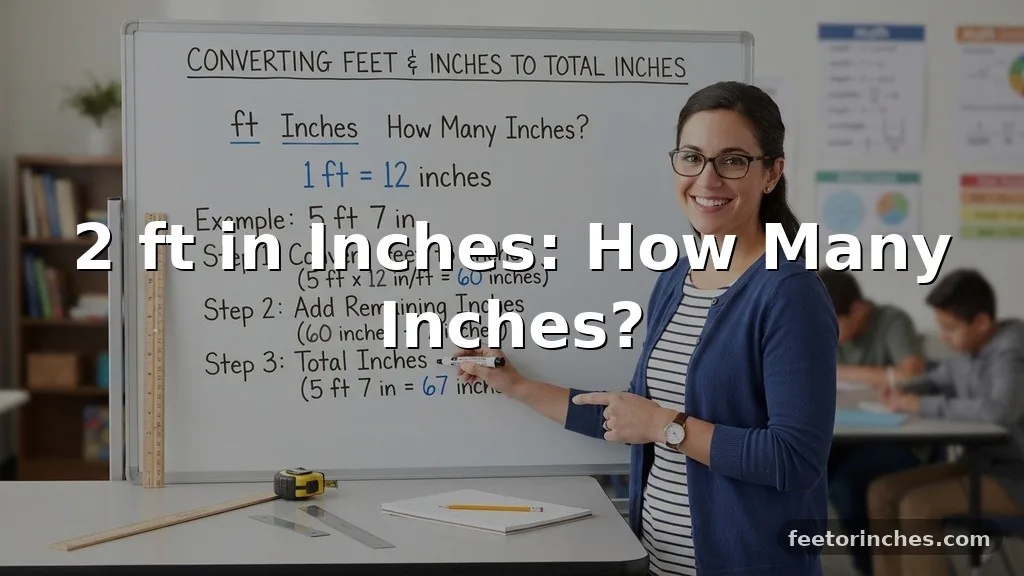
If you are wondering about the conversion of 2 ft in inches, the answer is straightforward: 2 feet is exactly 24 inches. Because every foot contains 12 inches, you simply multiply the number of feet by 12 to find the total length. This measurement is a staple of the imperial system, used daily in construction, home decor, and various retail specifications.
Whether you are measuring a shelf, a piece of fabric, or a small appliance, knowing this conversion helps you quickly visualize the distance. We will break down how this measurement fits into common standards, how to estimate it without tools, and how it compares to other nearby units.
The Core Math Behind Feet and Inches
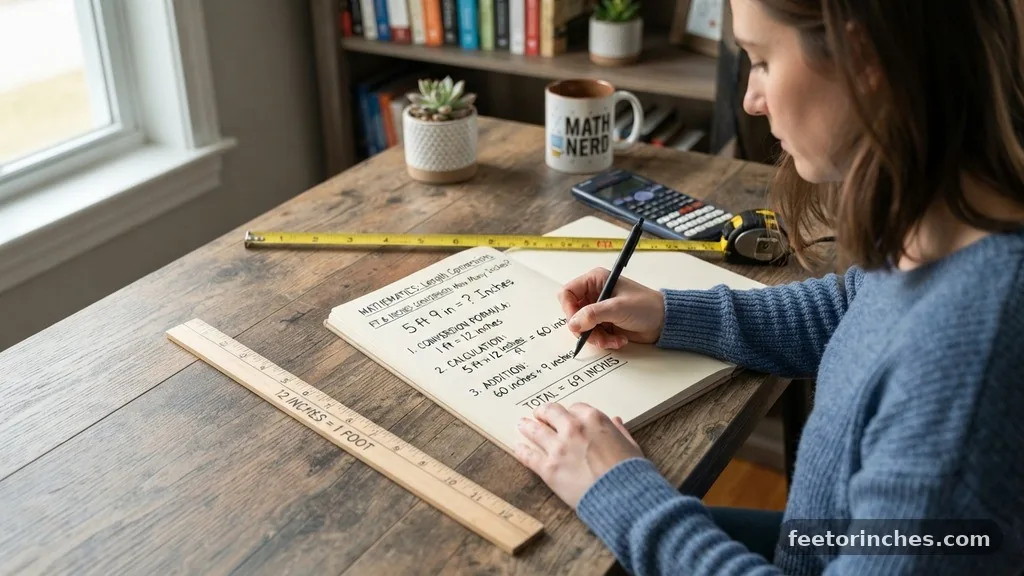
Understanding the relationship between feet and inches starts with the base unit. In the United States customary system, the foot is defined as 12 inches. This fixed ratio makes converting feet to inches a simple multiplication task.
If you have a measurement in feet, you multiply that value by 12 to arrive at the inch equivalent. Conversely, to go from inches to feet, you divide by 12.
This system relies on the historical standard where a foot was roughly based on the length of a human foot, though it was later standardized for precision. Today, these measurements are strictly defined by international yard and pound agreements. You can rely on these figures for all your DIY projects and professional calculations.
Conversion Reference Table
The following table provides a quick reference for converting various measurements between feet and inches, as well as their metric equivalents. Use this to compare how 2 feet stacks up against smaller or larger segments.
| Measurement in Feet | Inches | Centimeters | Meters |
|---|---|---|---|
| 0.5 ft | 6 inches | 15.24 cm | 0.152 m |
| 1 ft | 12 inches | 30.48 cm | 0.304 m |
| 2 ft | 24 inches | 60.96 cm | 0.609 m |
| 3 ft | 36 inches | 91.44 cm | 0.914 m |
Common Objects at 24 Inches
Visualizing 2 feet is easier when you consider common household items. Many standard products are manufactured to this specific length to fit into typical residential spaces. When you see a product labeled as 24 inches, you are effectively looking at a 2-foot span.
- Standard kitchen base cabinet width: 24 inches is the most common width for a single-door base cabinet.
- Large bathroom vanity sink width: Many single-basin vanities are exactly 24 inches wide to fit small powder rooms.
- Computer monitor width: A 27-inch monitor often has a physical width close to 24 inches, depending on the bezel.
- Standard floor tile length: While tiles vary, many large-format porcelain tiles come in 24-inch by 24-inch squares.
- Small microwave depth: Many countertop microwaves measure roughly 24 inches in width across the front panel.
Estimating Length Without a Ruler
Sometimes you need to measure something but lack a physical tool like a tape measure. You can use your own body or common household objects to get a very close estimate of 2 feet. Most adults have a stride or an arm span that can be calibrated to these measurements.
Your forearm, from the elbow to the tip of your middle finger, is often close to 18 inches for an average adult. If you add half of your hand or a small portion of your upper arm, you can approximate a 24-inch length.
Alternatively, a standard sheet of legal-size paper is 14 inches long. Placing one and three-quarter sheets of paper end-to-end gets you very close to the 2-foot mark.
Comparing 2 Feet to Nearby Measurements
Understanding where 2 feet sits in relation to other common lengths helps prevent errors in planning. The difference between 12, 24, and 36 inches is significant in construction. A 12-inch difference often determines whether an object will fit into a specific alcove or opening.
A 13-inch measurement is often found in laptop screen diagonals, which is a common point of confusion. People frequently mistake a 13-inch screen for a 13-inch wide device, but the diagonal measurement is much smaller than the physical width. Always check if a product refers to the diagonal or the side-to-side width when evaluating space.
The Role of Metric Conversion
While feet and inches are standard in the U.S., many technical fields require conversion to the metric system. The international standard for these conversions is maintained by the National Institute of Standards and Technology. They provide the precise factors used for engineering and scientific applications.
Knowing that 1 inch equals exactly 2.54 centimeters is the key to all these calculations. For 2 feet, which is 24 inches, the math is 24 multiplied by 2.54, resulting in 60.96 centimeters. This precision is vital when buying imported goods or working with international hardware components.
Common Misconceptions in Measuring
One of the biggest errors people make involves the difference between length and diameter. If you have a pipe that is 2 feet long, its length is 24 inches. However, if that pipe has a 24-inch diameter, it is massive and would not fit through a standard door frame.
Another common issue is the confusion between internal and external dimensions. A box might be 24 inches wide on the outside, but the internal storage space could be only 22 inches due to the thickness of the walls. Always verify whether you are measuring the footprint of an object or the actual usable space inside it.
Tools for Precise Measurement
If you need to be exact, relying on estimation is not enough. A standard retractable tape measure is the most reliable tool for measuring 2 feet. Most tape measures are marked with both inches and centimeters, making it easy to see the 24-inch mark.
For professional-grade accuracy, laser distance measurers are preferred. These tools bounce a laser off a surface to calculate the distance instantly. They eliminate the “sag” that occurs with long metal tapes, ensuring your 2-foot measurement is accurate to the millimeter.
FAQ Section
Is 2 feet always exactly 24 inches?
Yes, in the imperial system, 1 foot is defined as 12 inches. Therefore, 2 feet is mathematically fixed at 24 inches.
How do I convert feet to inches if I have a fraction?
Simply multiply the whole number of feet by 12, then add the remaining inches. For example, 2 feet 3 inches is (2 * 12) + 3, which equals 27 inches.
Why do some items say 2 feet but measure slightly differently?
Manufacturing tolerances or the inclusion of external casings can cause slight variations. Always check the technical specifications for the exact dimensions if the fit is tight.
Can I use my phone as a 2-foot measuring tool?
Some augmented reality apps use your phone’s camera and sensors to measure distances. While useful for rough estimates, they are generally less accurate than a physical tape measure for critical projects.
What is the most common mistake when measuring 2 feet?
The most common error is starting the measurement from the 1-inch mark instead of the zero mark on a ruler. Always ensure your starting point is aligned with the very edge of the tool.
Final Thoughts
Mastering the conversion of 2 ft in inches provides a foundation for more complex spatial planning. Whether you are arranging furniture, calculating materials for a home project, or simply verifying the size of a package, knowing that 24 inches is the magic number saves time and prevents costly mistakes. By keeping a mental or physical reference for this length, you can quickly assess your environment with confidence.
Remember that while estimation techniques are helpful in a pinch, precision tools remain the gold standard for any permanent installation. If you are ever unsure about a measurement, double-check the manufacturer’s data sheets to ensure your 2 feet of space is truly 24 inches of clearance. We hope this overview clarifies the relationship between these common units and helps you tackle your next measuring task with total accuracy.
Related conversions: How Many Inches in a Foot · How Many Inches Are in a Foot · How Many Inches in 8 Feet




