
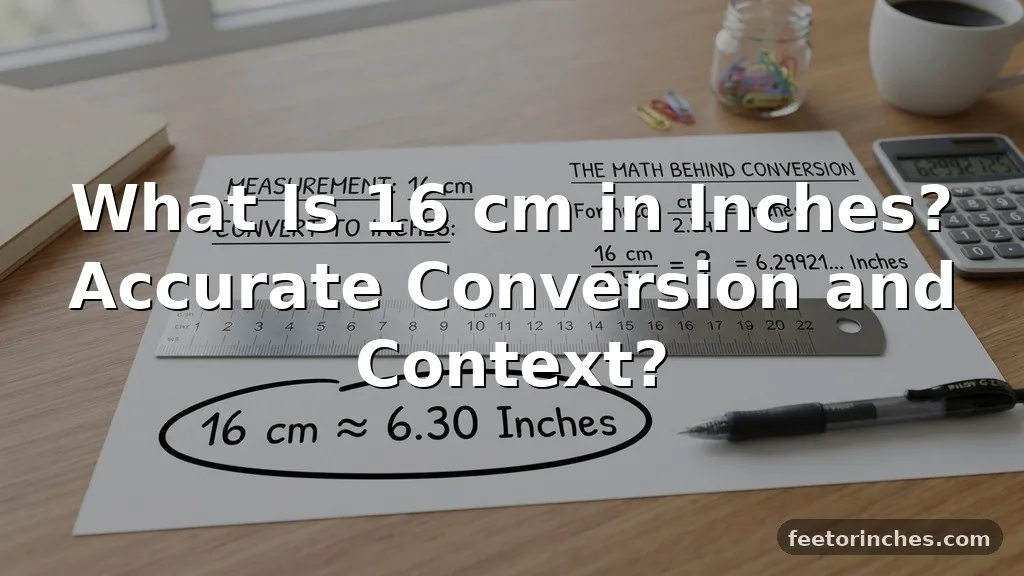
Knowing exactly how 16 cm in inches translates is essential for anyone bridging the gap between the metric system and the US customary system. Whether you are measuring a screen, sizing up a piece of hardware, or looking at a craft project, the precise value is 6.299 inches. Most people find it easiest to round this to 6.3 inches for quick, everyday tasks.
Understanding this conversion helps you avoid costly errors when buying tools or materials that come in mixed units. We will break down exactly how this math works and where you will see these measurements in the real world.
The Math Behind the Conversion
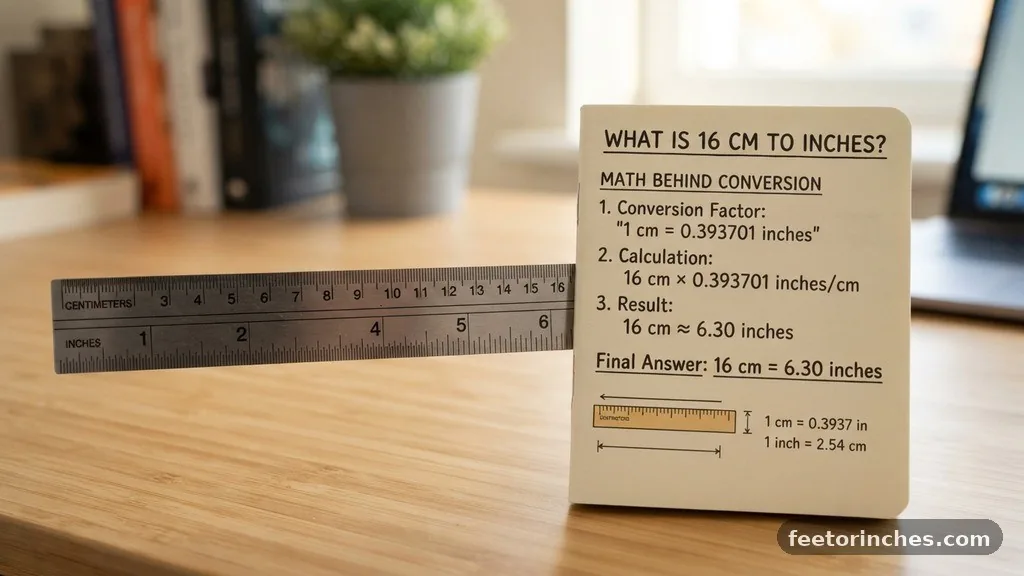
The international standard for length defines one inch as exactly 2.54 centimeters. To find out what 16 cm in inches is, you simply divide 16 by 2.54. This calculation gives you a repeating decimal, but for most practical applications, rounding to two or three decimal places is sufficient.
When you need to perform an inches conversion on the fly, remembering the 2.54 factor is the most reliable method. If you are dealing with a tape measure or ruler that lists both units, you can often see the alignment directly.
Conversion Table for Common Metric Units
The following table provides a quick reference for common metric lengths in inches. This helps you visualize how 16 cm fits into the broader range of standard measurements.
| Centimeters (cm) | Inches (in) |
|---|---|
| 12 cm | 4.72 in |
| 14 cm | 5.51 in |
| 15 cm | 5.91 in |
| 16 cm | 6.30 in |
| 18 cm | 7.09 in |
| 20 cm | 7.87 in |
Visualizing 16 Centimeters
Seeing a number on a screen is one thing, but visualizing it in physical space is another. A standard sheet of paper is 8.5 inches wide, meaning 16 cm is significantly shorter than the width of a standard document. If you look at a typical smartphone, the diagonal screen size is often between 15 and 17 cm.
You can also think about common household objects to gauge the length. A standard ballpoint pen is typically around 14 to 15 cm long, so 16 cm is just a hair longer than your average writing instrument. Using a familiar object as a mental anchor makes it much easier to estimate size without reaching for a tool.
Estimating Without a Ruler
Sometimes you don’t have a ruler or an interactive tool handy to measure a specific item. In these cases, using your hand or common objects is the best strategy. The width of an average adult palm is often close to 8 or 9 cm, so two palm widths will put you right in the 16 to 18 cm range.
You can also rely on standardized paper sizes for a more accurate manual estimate. A standard US letter-size page is 11 inches tall.
If you fold that page roughly in half, you are looking at 5.5 inches, which is approximately 14 cm. Adding a small thumb-width to that length will get you very close to the 16 cm mark.
Common Misconceptions in Measurement
A frequent point of confusion is the difference between diameter and circumference when measuring circular objects. If you have a pipe or a wheel with a diameter of 16 cm, that is the straight-line distance across the center. The circumference, or the distance around the outside, would be significantly larger—roughly 50 cm.
Another common issue arises when reading screen sizes. Manufacturers measure monitors and TVs by their diagonal length, whereas the physical footprint (width and height) is much smaller.
A 16 cm diagonal measurement is quite small, often found in handheld electronics or small decorative frames. Always verify whether the dimension provided is a linear width or a diagonal measurement.
Comparing 16 cm to Nearby Sizes
Understanding the scale of 16 cm requires looking at the surrounding increments. The following list highlights how this measurement compares to common sizes found in manufacturing and design.
- 12 cm: Roughly 4.7 inches, often the width of small photo frames.
- 14 cm: Approximately 5.5 inches, a common height for smaller paperback books.
- 15 cm: Very close to 6 inches, a standard length for many small kitchen tools.
- 16 cm: Exactly 6.3 inches, a common size for tablet bezels or large phone screens.
- 18 cm: About 7.1 inches, often seen in the length of small garden hand trowels.
The Role of Precision in Engineering
In professional settings, the distinction between centimeters and inches is critical. The National Institute of Standards and Technology provides comprehensive data on the transition between these systems to ensure industrial consistency. Even a small error of a few millimeters can lead to parts not fitting together or structural instability in a design.
When you convert inches to centimeters or vice versa, always use the 2.54 conversion factor rather than rough estimates. If you are ordering parts from an international supplier, confirm the units explicitly. Never assume that a “6-inch” part is exactly 16 cm, as that minor difference can cause significant assembly issues.
System Measurement Differences
The metric system is based on powers of ten, making it highly intuitive for scientific calculations. In contrast, the US customary system often relies on fractions like 1/8, 1/4, or 1/2 of an inch. When you need to express 16 cm in inches, you end up with 6.299, which is hard to write as a clean fraction.
Most people settle for 6 5/16 inches, which is an extremely close approximation. Using fractions is common in carpentry and construction, whereas decimal inches are more common in engineering and manufacturing. Choose your unit based on the precision required for your specific project.
Frequently Asked Questions
Is 16 cm the same as 6 inches?
No, 16 cm is slightly longer than 6 inches. While 6 inches is exactly 15.24 cm, 16 cm is roughly 6.3 inches.
How do I convert 16 cm to inches for a shoe size?
Shoe sizing uses different, proprietary scales depending on the region and manufacturer. You cannot simply convert 16 cm to inches to find a shoe size, as sizing systems are not linear measurements of the foot.
What is the easiest way to remember the conversion?
Remember that 1 inch is roughly 2.5 cm. If you divide your centimeter value by 2.5, you will get a very close estimate of the inches.
Can I use 16 cm as a standard for a screen size?
Screen sizes are measured in inches, and a 16 cm diagonal is approximately 6.3 inches. This would be considered a very small screen, typical of a large smartphone or a small handheld gaming device.
Conclusion
Understanding how 16 cm in inches translates allows you to navigate both metric and customary systems with confidence. While the exact conversion is 6.299 inches, rounding to 6.3 inches is perfectly acceptable for most daily tasks and DIY projects. Whether you are using a ruler, a tape measure, or simple estimation techniques, knowing the relationship between these units prevents frustration and ensures your projects turn out as expected.
Keep this conversion factor of 2.54 in mind whenever you encounter metric labels on products or materials. If you find yourself needing more precision, stick to decimal inches to maintain accuracy. Feel free to reach out if you have more questions about specific measurements or need help with other unit conversions in the future.




