
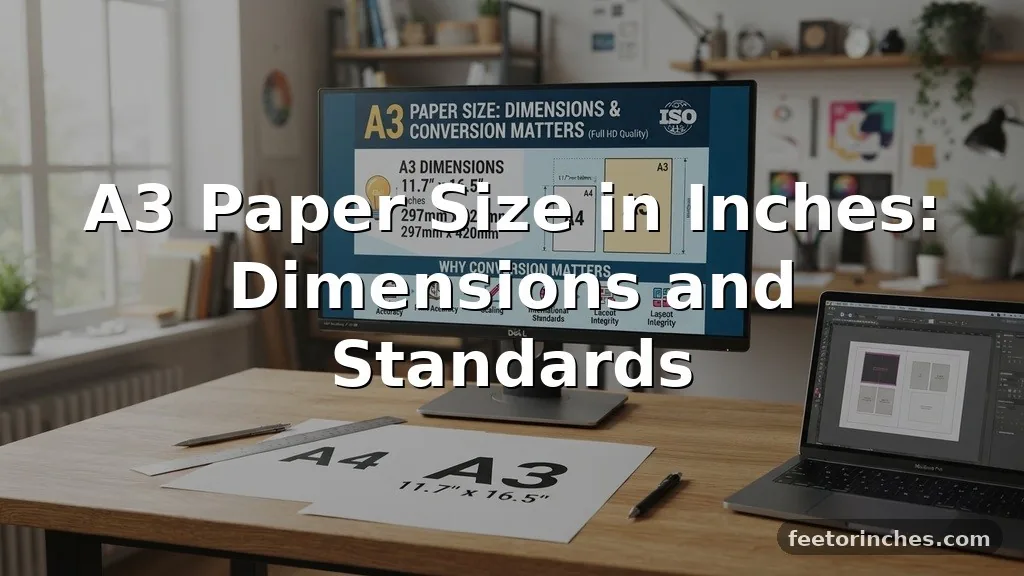
Finding the exact A3 paper size in inches is a common challenge for those who work primarily with the ISO 216 standard but need to communicate measurements to colleagues in regions using imperial units. Because A3 is a European metric standard, it doesn’t have a perfectly clean, round-number equivalent in inches.
You’ll find the dimensions are slightly fractional, which often surprises those expecting standard letter or tabloid measurements. Knowing these precise values saves you from scaling errors when you are preparing professional documents, technical drawings, or marketing materials.
The standard A3 sheet measures exactly 297 millimeters by 420 millimeters. When converted for design and printing purposes, this equates to 11.69 inches by 16.54 inches.
This size is exactly half of an A2 sheet and twice the size of an A4 sheet, making it a foundational element in the international paper series. Whether you are printing high-quality brochures or architectural sketches, understanding these dimensions ensures your layout remains consistent across different regional printers.
Core Conversions for A3 Paper
To ensure your printer settings and document margins are configured correctly, you need accurate data. The following table breaks down the A3 dimensions into various units of measurement to provide a comprehensive reference for your workflow.
| Unit | Width | Height |
|---|---|---|
| Inches | 11.69 in | 16.54 in |
| Centimeters | 29.7 cm | 420 cm |
| Millimeters | 297 mm | 420 mm |
| Meters | 0.297 m | 0.420 m |
Why the Conversion Matters
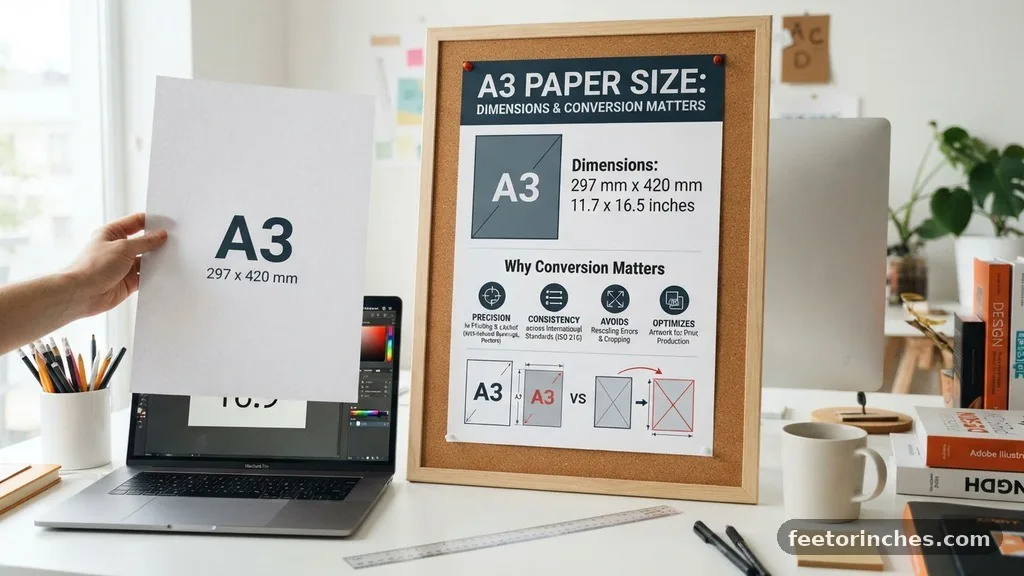
Precision is vital when you are dealing with bleeds and crop marks in professional printing. Even a slight rounding error, such as treating 11.69 inches as 11.7 inches, can cause alignment issues on high-end presses. Always use the two-decimal point standard to maintain the integrity of your design files. If you are working in software like Adobe InDesign or Illustrator, you can often set your document units to millimeters to avoid these conversion discrepancies entirely.
The ISO 216 Standard Explained
The A-series of paper sizes is defined by the ISO 216 standard, which is used by almost every country in the world except for the United States, Canada, and parts of the Philippines. The beauty of this system lies in its mathematical ratio.
Every sheet size in the series is created by cutting the previous, larger size in half along its longer side. This allows the aspect ratio of 1:√2 to remain constant regardless of the final sheet dimension.
How the Series Functions
When you fold an A2 sheet in half, you get an A3. Similarly, folding an A3 sheet yields an A4, which is the most common office paper size globally. This property is known as self-scaling. It allows for consistent enlargement or reduction of documents without losing the original proportions of the text or images. For further technical details on these specifications, you can visit the ISO 216:2007 standard document to see the official definitions.
Comparing A3 to Nearby Sizes
Understanding how A3 fits into the broader spectrum of paper sizes helps you choose the right format for your project. Often, people confuse A3 with the American 11×17 tabloid size, but they are not identical. While they are close, the A3 sheet is slightly narrower and taller than a standard US tabloid sheet.
- A4: 8.27 x 11.69 inches (The standard office size).
- A3: 11.69 x 16.54 inches (The standard size for large diagrams).
- A2: 16.54 x 23.39 inches (Commonly used for technical drafting).
- Tabloid (US): 11.00 x 17.00 inches (The standard US equivalent).
When to Use Each Size
Use A4 for daily correspondence and standard reports. Move to A3 when you need more surface area for complex charts, detailed posters, or spread-out brochure layouts. If your design requires even more space, A2 is the natural progression. Always confirm your printer’s tray capacity, as not all office machines can handle paper wider than 11 inches.
Estimating A3 Without Tools
Sometimes you are in the field and need to approximate A3 dimensions without a ruler. Because A3 is quite large, you can use common objects or body measurements as a reference.
A standard sheet of A4 paper is 11.69 inches tall. If you place two sheets of A4 side-by-side, you have a width of approximately 16.54 inches, which perfectly mimics the height of an A3 sheet.
Using Body Parts for Scale
For a quick estimate, the average adult hand span from thumb to pinky is roughly 8 to 9 inches. An A3 sheet is about one and a half hand spans wide and nearly two hand spans long. While this is not precise enough for a print-ready file, it is perfectly adequate for selecting the right size frame or planning desk space. Always remember that the height of an A3 sheet is slightly more than the length of a standard legal-size clipboard.
Common Misconceptions
Many users assume that all “large” paper sizes are the same. One of the most frequent errors is confusing the diameter of a roll with the width of a sheet.
A3 is a flat, rectangular sheet; it has no diameter. If you are ordering supplies, ensure you are not looking at rolls, which are measured by their total width and the length of the material wound around the core.
Diagonal vs. Width
Another common confusion involves screen sizes versus paper sizes. Laptop screens are measured by their diagonal length, whereas paper is always measured by its width and height. A 14-inch laptop screen is significantly smaller in total surface area than an A3 sheet of paper. Never use the diagonal measurement of a screen to infer the dimensions of a physical document.
Practical Applications for A3
Because of its generous dimensions, A3 is the preferred size for visual communication. It provides enough room to present information clearly without becoming as cumbersome as the larger A1 or A0 formats used in engineering. Many creative professionals rely on this size for their initial drafts and proofs.
Industry Usage
* Architecture: Used for smaller schematic drawings and site plans. * Marketing: Common for event posters and folded menus. * Education: Ideal for classroom visual aids and biology diagrams. * Office: Used for large spreadsheets that require extra columns.
Technical Considerations for Printing
Printing on A3 requires a machine capable of handling the 11.69-inch width. Most standard home printers are limited to A4 or Letter sizes.
If you plan to output your work on A3, check your printer’s “media size” settings in the print dialogue box. You may need to manually select “A3” rather than letting the printer default to “Auto” or “Letter.”
Handling Margins
Always account for the non-printable area of your printer. Most laser and inkjet printers cannot print all the way to the edge of the paper. If you need a full-bleed design, you will need to print on a larger sheet and trim it down to the final A3 dimensions. This is standard practice in professional printing shops to ensure a clean, borderless finish.
FAQ
Is A3 paper the same as 11×17 inches?
No, they are different. A3 is 11.69 x 16.54 inches, while 11×17 (often called tabloid) is slightly wider and shorter. Using the wrong size can lead to alignment issues or unwanted white borders during printing.
Which is bigger, A3 or A4?
A3 is twice the size of A4. The A-series numbering system works in reverse; the lower the number, the larger the sheet of paper. Therefore, A3 is larger than A4, A5, and A6.
Can I use A3 paper in a standard home printer?
Only if your printer is specifically designed as an “A3 printer” or “wide-format printer.” Most standard desktop printers are restricted to the A4 or 8.5×11-inch format and cannot physically feed an A3 sheet through the rollers.
Why does the A-series use such specific numbers?
The dimensions are based on the square root of two. This mathematical ratio ensures that when you cut or fold a sheet in half, the resulting pieces maintain the exact same proportions as the original. It is a highly efficient system for scaling documents.
Final Thoughts
Mastering the A3 paper size in inches is an essential skill for anyone operating in a global design or business environment. By understanding that A3 dimensions are defined by the ISO 216 standard, you can avoid the common pitfalls of regional measurement differences. Whether you are formatting a technical drawing or creating a promotional poster, using the correct 11.69 by 16.54-inch specification ensures your final product looks exactly as intended.
Keep these measurements handy as a reference for your next project, and you will find that your document preparation becomes much more efficient. If you have specific questions about printer settings or document scaling, feel free to reach out for further clarification on how these standards apply to your specific equipment.
You may also like: M8 to Inches
You may also like: Size 16 Jeans in Inches




