
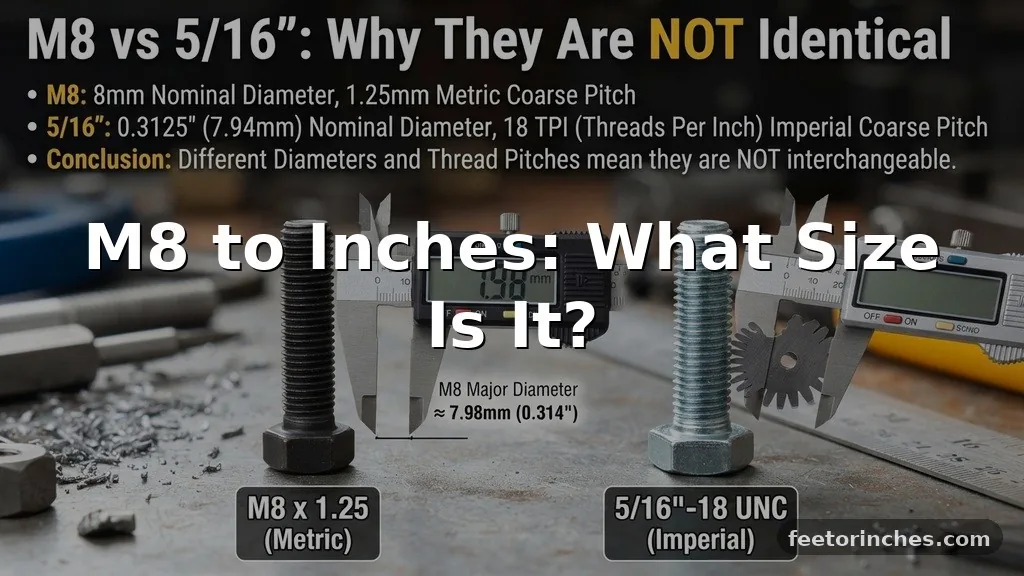
Understanding how M8 to inches conversions work is essential for anyone handling hardware or mechanical projects. An M8 bolt is a metric fastener with a nominal diameter of 8 millimeters, which translates to approximately 0.315 inches. Because standard inch-based fasteners like the 5/16-inch bolt have a diameter of 0.3125 inches, the two sizes are often mistaken for each other.
Getting these dimensions right matters because mixing metric and imperial threads can damage equipment or compromise structural integrity. This guide provides the clarity you need to distinguish between these standards and identify exactly what size you are holding in your hand.
The M8 designation is part of the ISO metric screw thread standard. The “M” stands for metric, and the “8” denotes the outer diameter of the thread in millimeters. This system is the global standard for fasteners, used in almost every country except the United States.
When you look at an M8 fastener, the 8mm measurement refers to the major diameter of the thread. This is the distance from the crest of the thread on one side to the crest on the opposite side. While the diameter is fixed at 8mm, the thread pitch can vary depending on the application.
Most common hardware store M8 bolts feature a coarse thread pitch of 1.25mm. You might also encounter fine pitch variations such as 1.0mm in automotive or precision engineering settings. Understanding that M8 describes the diameter rather than the length is the first step in avoiding assembly errors.
Conversion Reference Table
Comparing metric sizes to their closest imperial counterparts helps visualize the scale. The following table provides the conversion for common metric bolt diameters into inches.
| Metric Size | Diameter in Inches (Approx) | Closest Imperial Size |
|---|---|---|
| M6 | 0.236 inches | 1/4 inch (0.250) |
| M8 | 0.315 inches | 5/16 inch (0.3125) |
| M10 | 0.394 inches | 3/8 inch (0.375) |
| M12 | 0.472 inches | 1/2 inch (0.500) |
Why M8 and 5/16 Inch Are Not Identical
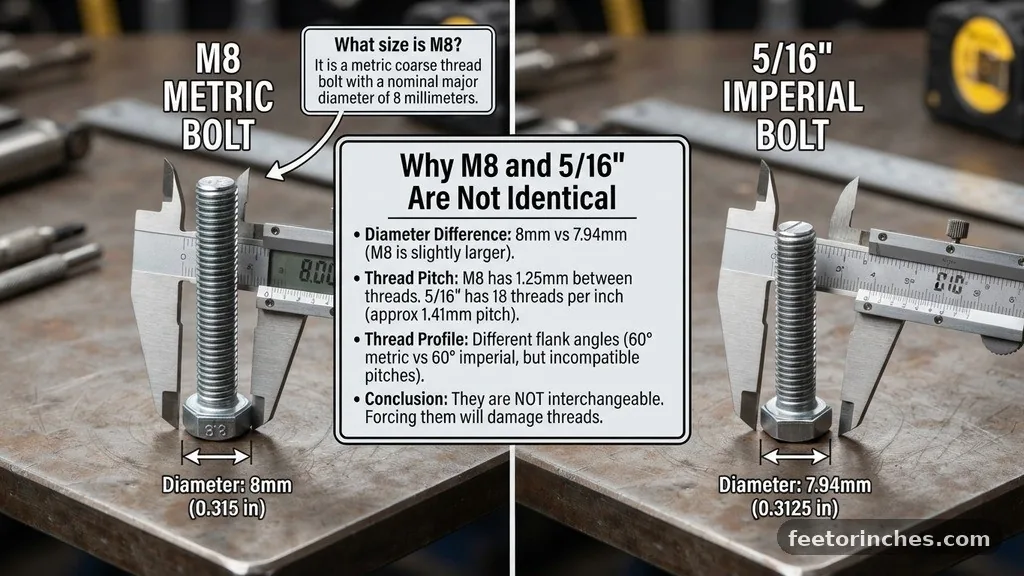
The confusion between M8 and 5/16-inch fasteners is one of the most common issues in mechanical repair. Mathematically, 8mm is 0.31496 inches, while a 5/16-inch bolt is exactly 0.3125 inches. While the difference is only about 0.002 inches, it is enough to prevent a nut from threading onto a bolt correctly.
Forcing a 5/16-inch nut onto an M8 bolt will eventually ruin the threads on both components. You might get a few turns in, but the mismatch in thread pitch will cause the metal to bind and gall. Always verify the origin of your hardware before attempting to thread it into a sensitive component.
If you are unsure of your bolt’s origin, look for markings on the head. Metric bolts usually display a property class number, such as 8.8 or 10.9. Imperial bolts, conversely, often use radial lines or manufacturer symbols to indicate grade.
Practical Identification Methods
You don’t always need a precision micrometer to identify a fastener size. A simple thread pitch gauge is the most reliable tool for the job. By matching the teeth of the gauge to the threads of your fastener, you can quickly distinguish between metric and imperial spacing.
If you lack specialized tools, try these methods:
- Use a digital caliper to measure the outer diameter of the bolt shank.
- Test the bolt in a known metric nut to see if it spins freely without resistance.
- Compare the bolt side-by-side with a known 5/16-inch bolt to check for differences in thread angle.
- Check the wrench size required to turn the head of the bolt.
Be aware that wrench sizes can also be misleading. An M8 bolt often takes a 13mm wrench, while a 5/16-inch bolt typically uses a 1/2-inch wrench. These two wrench sizes are close enough that a 13mm wrench will fit a 1/2-inch nut, but it will have a slight amount of “slop” that can lead to rounding off the corners of the fastener.
Understanding Thread Pitch
Diameter is only half the story when determining the size and compatibility of a fastener. The thread pitch is the distance between individual threads, measured in millimeters for metric hardware. An M8x1.25 bolt has a thread every 1.25mm.
If you try to screw an M8x1.25 bolt into a hole tapped for an M8x1.0 thread, it will stop after one or two turns. Using the wrong pitch is a frequent cause of stripped holes in engine blocks and aluminum frames. Always ensure the thread count matches the mating surface.
For further technical details on international standards, the International Organization for Standardization provides comprehensive documentation on thread profiles. This ensures that a bolt manufactured in one country will fit a nut produced in another.
Common Pitfalls in Measurements
One major mistake is confusing the diameter of the bolt with its length. When you buy an “M8 bolt,” you are specifying the width. The length is a separate measurement, usually taken from under the head to the tip of the threads.
Another pitfall involves measuring the head of the bolt rather than the shank. The size of the head depends on the bolt style—such as hex, socket cap, or carriage—and does not reflect the diameter of the threads. Always measure the threaded portion to get the correct size.
Finally, avoid relying on visual estimation. Because the difference between 0.312 and 0.315 inches is invisible to the naked eye, guessing will lead to damaged parts. Use a tool to confirm the measurement if you are in doubt.
Comparing Metric and Imperial Scales
When you shift from imperial to metric, it helps to group fasteners by their relative strength and use cases. Metric fasteners follow a clear, logical progression based on diameter. Imperial fasteners often rely on fractional increments that can feel less intuitive to those accustomed to decimal-based systems.
Understanding that M8 is slightly larger than a 5/16-inch fastener is a good rule of thumb. However, the larger you go, the more the discrepancy grows. An M12 bolt is significantly different from a 1/2-inch bolt, making the error much easier to spot visually.
Keep a small reference chart in your workshop or toolbox. This prevents the need to guess during a project. Having the right information readily available saves time and prevents the frustration of mid-project hardware store trips.
Frequently Asked Questions
Is M8 bigger than 1/4 inch?
Yes, an M8 bolt is larger than a 1/4-inch bolt. A 1/4-inch bolt has a diameter of 0.250 inches, while an M8 bolt has a diameter of approximately 0.315 inches.
Can I use a 5/16 nut on an M8 bolt?
No, you should not use a 5/16 nut on an M8 bolt. Even though the diameters are very close, the thread pitches are different, which will lead to damaged threads and a loose, unsafe connection.
Is 8mm the same as 3/8 inch?
No, 8mm is not the same as 3/8 inch. A 3/8-inch bolt is 0.375 inches in diameter, making it noticeably larger than an 8mm bolt.
How do I know if my bolt is metric or imperial?
Check the markings on the head of the bolt. Metric bolts usually have a property class number, while imperial bolts often have radial lines. If you have no markings, use a thread pitch gauge or a digital caliper to measure the diameter and the distance between the threads.
Final Thoughts on Fastener Sizing
Determining the right fastener is a fundamental skill for any repair or assembly project. By remembering that an M8 bolt has a nominal diameter of 8mm—roughly 0.315 inches—you can distinguish it from the slightly smaller 5/16-inch imperial fastener. While the two may look identical at a glance, the microscopic differences in thread pitch make them incompatible.
Always prioritize using a caliper or thread gauge to confirm your measurements before tightening any hardware. Mastering the relationship between M8 to inches conversions ensures your projects remain secure and your equipment functions as intended. If you have specific hardware questions or encounter a unique thread pattern, feel free to reach out for further clarification on your next build.
Related conversions: How Many Inches in a Foot? (Complete Guide with Real Examples & Visuals), How Many Inches in a Yard? Complete Conversion Guide With Examples, What Is 6 mm in Inches? Complete Conversion Guide, How Many Cubic Inches in a Cubic Yard? Complete Conversion Guide.




