
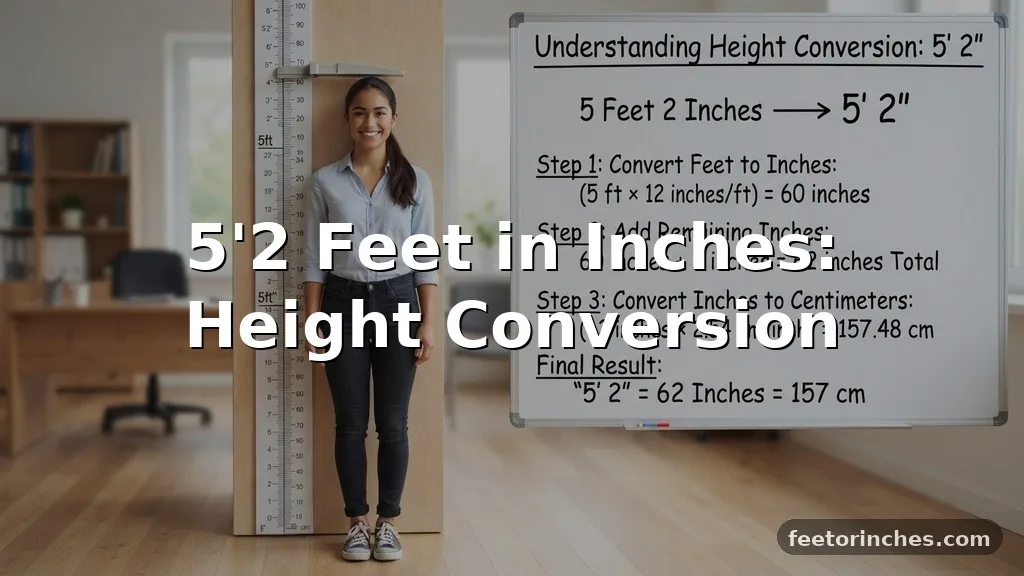
Calculating your height correctly is a common task, especially when you need to provide accurate measurements for medical forms, fitness tracking, or even clothing fit. If you are wondering how many inches are in 5’2 feet in inches, the math is straightforward: there are exactly 62 inches in a height of 5 feet and 2 inches. Since each foot consists of 12 inches, you simply multiply 5 by 12 and add the remaining 2 inches.
Understanding these basic unit conversions ensures you can fill out administrative documents or health records with total confidence. Let’s look at how these measurements break down and why they matter for your daily life.
Understanding the Math Behind Height
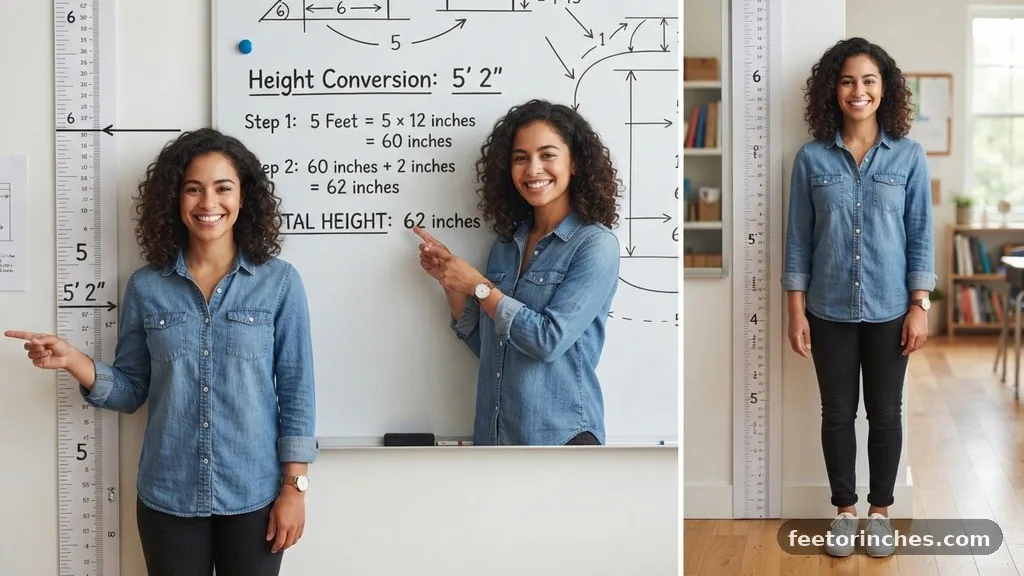
At its core, the imperial measurement system relies on fixed ratios that remain consistent regardless of the scale. One foot is defined as 12 inches, which makes the conversion process for height quite simple once you memorize this base multiplier. When you look at 5’2, you are essentially looking at a sum of two distinct parts.
The first part of the equation involves the feet component. You take the 5 feet and multiply that number by the 12 inches found in every foot, resulting in 60 inches.
The second part is simply adding the remaining 2 inches to that total. This gives you the final, precise figure of 62 inches.
Conversion Table for Reference
Whether you are comparing your height to others or converting for international travel, having a quick reference table is helpful. Below are the common conversions for nearby heights to help you visualize the scale.
| Height (Feet/Inches) | Total Inches | Centimeters (Approx) |
|---|---|---|
| 5’0 | 60 inches | 152.4 cm |
| 5’1 | 61 inches | 154.9 cm |
| 5’2 | 62 inches | 157.5 cm |
| 5’3 | 63 inches | 160.0 cm |
| 5’4 | 64 inches | 162.6 cm |
Metric Conversions and Global Standards
Many parts of the world utilize the metric system, which can make things confusing if you are used to feet and inches. When you convert 5’2 into the metric system, you are looking at centimeters and meters. One inch is exactly 2.54 centimeters, which is the standard conversion factor used globally.
For a person standing 5’2, the calculation is 62 multiplied by 2.54. This results in exactly 157.48 centimeters, which is usually rounded to 157.5 cm in casual conversation.
If you need to express this in meters, you simply move the decimal point two places to the left. This gives you 1.575 meters, a figure often used on international identification documents.
Common Misconceptions in Measurement
One frequent error is confusing the decimal representation of feet with the actual inches. People sometimes assume that 5.2 feet means 5 feet and 2 inches, but this is mathematically incorrect. In a decimal system, 5.2 feet actually represents 5 feet and 20% of a foot, or 5 feet and 2.4 inches.
Always remember that the imperial system is not base-10. Because it is a base-12 system for length, you cannot simply treat the decimal as inches.
If you see a digital scale or an automated form that asks for height in decimal feet, be careful. Using 5.2 instead of 5.16 (the decimal equivalent of 5’2) can lead to slight discrepancies in your recorded data.
Tools for Measuring Height at Home
You don’t always need a professional stadiometer to get an accurate reading. A standard tape measure fixed to a wall is the most reliable method for home use. Ensure the tape starts at the floor and runs vertically without any slack.
Tips for Accuracy
- Stand perfectly straight with your back against the wall.
- Remove your shoes to ensure you are measuring your actual height.
- Keep your heels, buttocks, and shoulders touching the wall.
- Use a flat object, like a book, to mark the top of your head.
- Look straight ahead rather than tilting your head up or down.
Why Precise Measurement Matters
Knowing your exact height is more than just a trivial fact. In medical settings, your height is used to calculate your Body Mass Index (BMI).
Even an error of one or two inches can shift your calculated health metrics significantly. You can find more details on how these measurements influence health statistics through the Centers for Disease Control and Prevention guidelines on weight and height.
Beyond health, height measurements play a role in ergonomics. If you are setting up a desk or a car seat, understanding your stature helps in adjusting equipment to prevent strain. Whether you are 5’2 or 6’2, the relationship between your body and your environment is dictated by these standard units of measurement.
Comparing 5’2 to Nearby Heights
It is useful to see how a height of 5’2 compares to the inches immediately surrounding it. Each inch represents a distinct step in height, and the difference is often more noticeable than you might think. Being 62 inches tall places you right in the middle of a specific range of human stature.
When you look at someone who is 5’1, they are 61 inches tall. Someone who is 5’3 is 63 inches tall.
These small increments are how we differentiate between height categories in fashion, sports, and athletic equipment. Understanding these small gaps helps you select the right size for clothing or gear that is designed based on specific height ranges.
FAQ
Is 5’2 considered short for an adult?
Height is relative to the population and regional averages. Globally, 5’2 falls within a common range for many populations, and “short” is a subjective label that varies by culture and gender.
How do I convert 5’2 to centimeters quickly?
The fastest way is to multiply the total inches (62) by 2.54. You will arrive at 157.48 cm every time.
Does my height change throughout the day?
Yes, it is common to be slightly taller in the morning than in the evening. Spinal discs compress during the day due to gravity, which can lead to a difference of up to half an inch.
Can I use a ruler to measure my height?
You can, but it is difficult to maintain accuracy. It is better to use a long measuring tape or a pre-marked height chart to avoid compounding errors from moving the ruler.
Why do some forms ask for height in inches only?
Systems often prefer total inches because it simplifies the math for computer databases. It removes the need to process two separate fields for feet and inches, reducing the chance of data entry errors.
Final Thoughts on Height Conversions
Mastering the conversion of 5’2 feet in inches is a simple but useful skill for keeping your personal records accurate. Whether you are updating a medical chart, buying clothes, or simply curious about your physical dimensions, remembering that 62 inches is the magic number will save you time. The imperial system might seem archaic compared to the metric system, but it remains the standard for many daily interactions.
By understanding the math behind these units, you ensure that your measurements remain consistent and reliable. Take a moment to verify your height using the tips provided, and you will always have the correct data ready when you need it.
You may also like: Feet and Inches Symbol
You may also like: How Tall Is 62 Inches in Feet




