
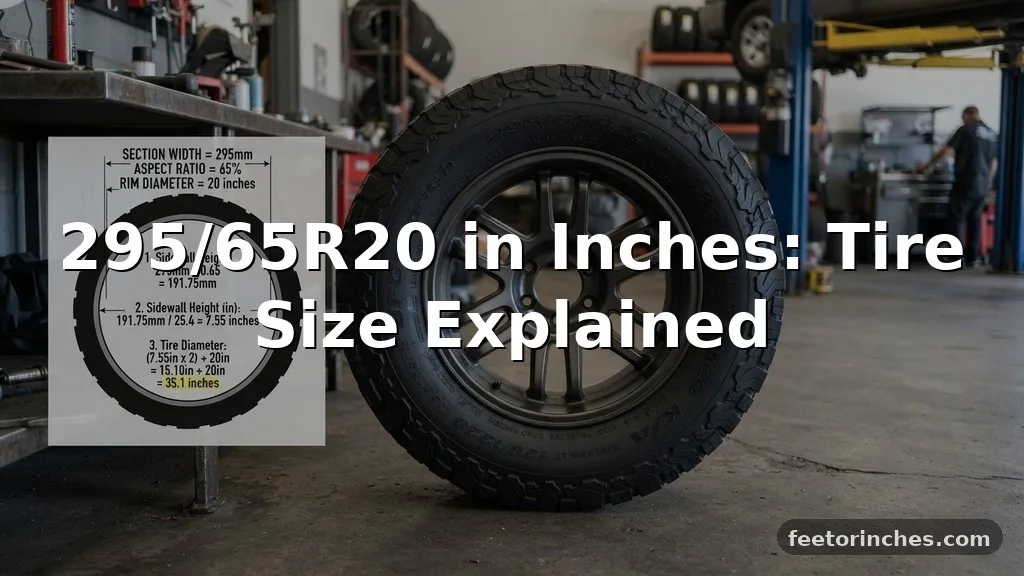
Deciphering the metric tire sizing system can feel like learning a foreign language, especially when you need to know how a 295/65R20 in inches translates to real-world dimensions. Owners of trucks and SUVs often search for this specific conversion to ensure proper clearance and compatibility before investing in new off-road tires. Understanding these numbers is critical for maintaining vehicle performance, speedometer accuracy, and suspension health.
By breaking down the section width, aspect ratio, and rim diameter, you can easily calculate the tire diameter and determine if this setup fits your specific build. This guide provides the clarity needed to make an informed choice for your vehicle’s next set of tires.
A 295/65R20 tire has an approximate overall diameter of 35.1 inches. This calculation is derived from the tire’s metric dimensions, which represent the section width, the percentage of that width for the sidewall height, and the wheel size.
When you convert these metric measurements into the standard inch system, you get a clearer picture of the tire’s physical footprint. Most enthusiasts classify this size as a “35-inch tire,” though the actual measurement varies slightly based on the manufacturer’s specific tread design and inflation pressure.
Metric Tire Sizing Explained
The metric system used for modern tires provides three distinct data points. The first number, 295, represents the section width in millimeters.
The second, 65, is the aspect ratio, meaning the sidewall height is 65% of the section width. Finally, the 20 indicates the rim diameter in inches.
Calculating Tire Diameter
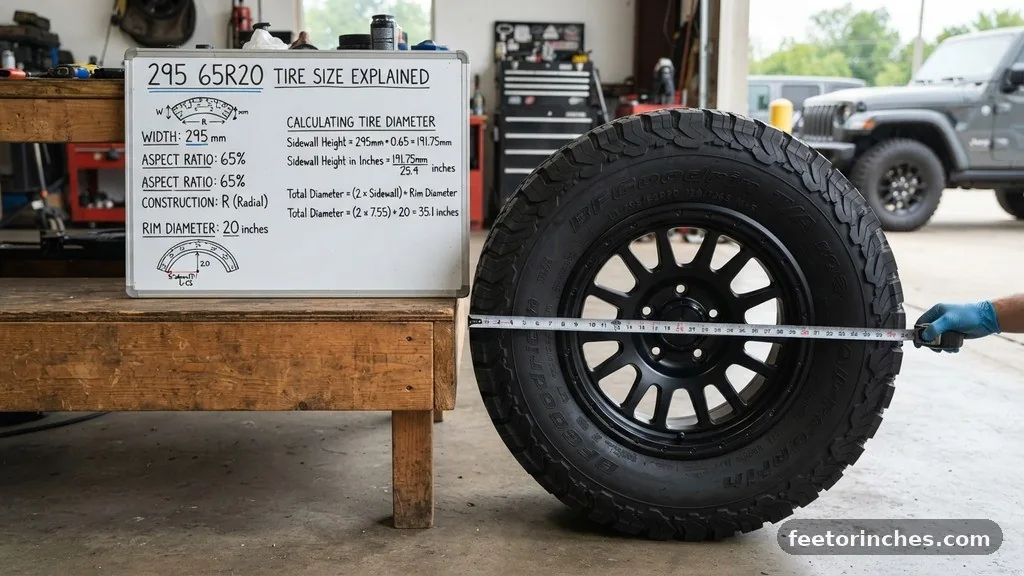
To find the diameter, you first calculate the sidewall height. You multiply the section width of 295 mm by 0.65 to get 191.75 mm.
Since a tire has two sidewalls, you double this figure to 383.5 mm and add the 20-inch rim, converted to 508 mm. This total of 891.5 mm converts to approximately 35.1 inches.
Why the Numbers Matter
Knowing the exact diameter prevents common issues like fender rubbing or speedometer errors. If your vehicle was calibrated for a smaller factory tire, moving to a 35-inch tire will cause your speedometer to read slower than your actual speed. You may need to use a tire calculator to recalibrate your vehicle’s electronic control module for accurate readings.
Tire Conversion Data
Understanding how these measurements translate across different units of length is essential for precise fitment. The following table provides a quick reference for converting the standard 14-inch reference point, which is often used to visualize smaller components or specific segments of a tire assembly.
| Unit | Measurement for 14 Inches |
|---|---|
| Feet | 1.167 ft |
| Centimeters | 35.56 cm |
| Millimeters | 355.6 mm |
| Meters | 0.3556 m |
Visualizing 14 Inches in Everyday Life
To help you grasp the scale of 14 inches, consider the following items commonly found in various environments. This list covers multiple categories to provide a practical sense of this specific length.
- Household: A standard legal-size piece of paper is 14 inches long.
- Kitchen: The width of a standard large pizza box is often 14 inches.
- Tech: Many smaller laptops feature a 14-inch diagonal screen size.
- Tools: A standard heavy-duty pipe wrench is often 14 inches in length.
- Stationery: A standard plastic ruler is exactly 14 inches long in some international formats.
Common Misconceptions in Tire Math
Many drivers assume that tire sizing is universal across brands, but this is rarely the case. Two tires labeled as 295/65R20 may differ by half an inch in height depending on the tread pattern. Aggressive mud-terrain tires often feature deeper lugs that add to the overall diameter compared to a highway-terrain tire.
Diameter vs. Circumference
People often confuse diameter with circumference, leading to errors in gear ratio calculations. The diameter is the straight line through the center, while the circumference is the distance around the outer edge. For a 35.1-inch tire, the circumference is roughly 110 inches, which dictates how far your vehicle travels with every single rotation.
Section Width and Tread Width
The section width is the widest point of the tire, including the sidewall bulge. The tread width is the actual surface area that touches the pavement. A 295 mm section width does not mean you have 295 mm of rubber on the road; the contact patch is usually significantly narrower.
Comparing 295/65R20 to Other Sizes
Selecting the right tire often involves comparing the 295/65R20 to other common configurations. The following points highlight how this size stacks up against its neighbors in the off-road world.
- 12-inch tires: Typically found on trailers or small utility equipment, far smaller than the 295/65R20.
- 13-inch tires: Common on older compact passenger cars, significantly narrower and shorter.
- 15-inch tires: Often seen on vintage trucks, these provide a larger sidewall but usually a smaller overall diameter.
- 16-inch tires: A middle ground for many light trucks, often running 31 to 33 inches in diameter.
Estimating Dimensions Without Tools
You don’t always need a tape measure to estimate if a tire will fit. Using a standard piece of legal-size paper, which is 14 inches long, provides a reliable reference. By placing two sheets end-to-end, you create a 28-inch span, which helps you visualize the scale of a 35-inch tire.
Using Body Parts
Most adults have a hand span of approximately 8 to 9 inches from the tip of the thumb to the pinky. Using this as a rough gauge, you can estimate that a 35-inch tire is roughly four hand spans across. While not precise, it is enough to determine if a tire is significantly larger than your current setup.
Standardized Objects
A common gallon of paint is roughly 7 to 8 inches in diameter. Stacking two of these side-by-side gives you a 14- to 16-inch reference point. Using these everyday items allows you to quickly assess the physical bulk of your tires before heading to the shop.
Performance Factors: Load and Speed
Beyond the physical dimensions, the 295/65R20 size comes with specific load index and speed rating requirements. These ratings indicate how much weight the tire can safely carry and the maximum speed it can sustain. Always verify that your new tires meet or exceed the factory specifications for your vehicle’s gross vehicle weight rating.
Tire Ply and Construction
The number of plies in a tire determines its resistance to punctures on the trail. A higher ply count, often referred to as “Load Range E” or “10-ply,” is common for this size. These tires are stiffer and offer better durability for towing and heavy off-road use.
Impact on Suspension
Installing larger tires changes the leverage on your steering components and suspension. You may notice a slight change in handling characteristics or a reduction in fuel efficiency. Proper tire fitment ensures that your steering geometry remains within safe limits.
FAQ: Common Tire Size Questions
Is a 295/65R20 the same as a 35-inch tire?
Yes, it is widely considered a 35-inch tire. While the exact math results in 35.1 inches, it is marketed and sold as part of the 35-inch category by most retailers.
Does the tire width affect my steering?
A 295 mm wide tire is significantly wider than many stock options. You might experience “tramlining,” where the tire follows grooves in the road, especially on uneven highway surfaces.
Can I put these tires on stock wheels?
You must check the recommended rim width for your specific tire model. Most 295/65R20 tires require a rim width between 8 and 10 inches to function correctly and wear evenly.
Will these tires rub on my wheel wells?
Rubbing depends on your vehicle’s offset and suspension lift. Many trucks require a leveling kit or a slight offset change to prevent the tires from contacting the frame or plastic liners at full steering lock.
How often should I rotate these tires?
Because of their size and typically aggressive tread, these tires should be rotated every 5,000 miles. Regular rotation is the best way to prevent uneven wear patterns and extend the life of your investment.
Conclusion
Navigating the specifications for a 295/65R20 in inches is a straightforward process once you break down the metric components. By understanding that this size translates to a 35.1-inch diameter, you can better prepare for the necessary modifications to your vehicle’s suspension or speedometer calibration. Whether you are upgrading for aesthetics or improved off-road capability, knowing your tire math ensures that your vehicle remains safe and road-legal.
Always prioritize the load index and speed rating that matches your specific driving needs, as these factors are just as important as the physical size. If you have questions about your specific vehicle’s clearance, consult with a local tire professional who can verify the fitment on your unique wheel setup. Taking the time to calculate these dimensions properly will save you significant frustration in the long run.
You may also like: 285/65R20 in Inches
You may also like: 295/60R20 in Inches




