
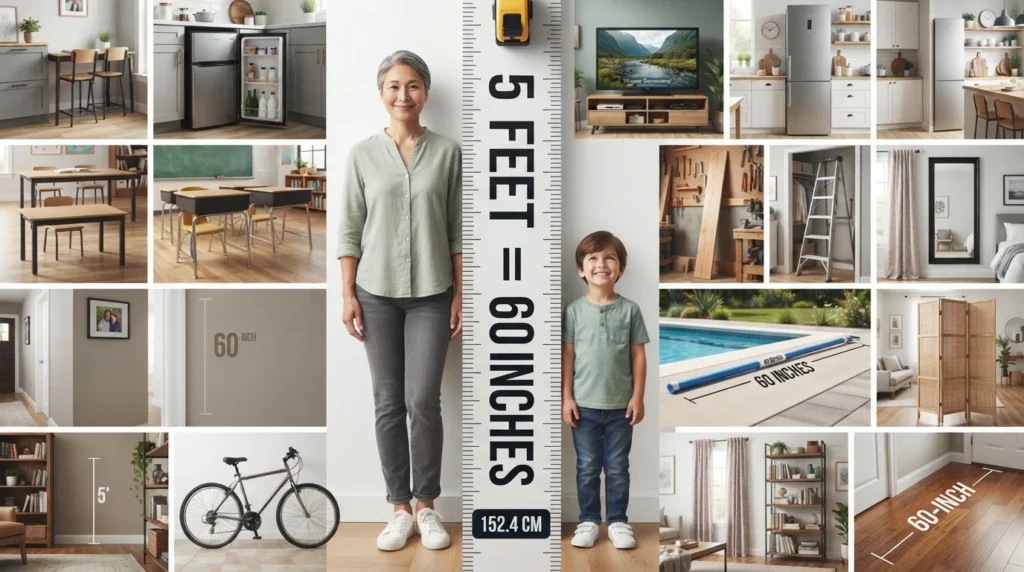
Ever wondered what 5 feet actually looks like in real life? The number is easy to calculate, but it can be surprisingly hard to picture.
Whether you’re checking someone’s height, measuring furniture, planning a room, or trying to understand the size of an object, knowing that 5 feet equals 60 inches gives you a useful starting point.
Once you connect 60 inches to familiar things around you—a refrigerator, desk, bicycle, door, or even a person—the measurement becomes much easier to visualize.
Here’s exactly how long 5 feet is, how it converts into other units, and 18 everyday examples that can help you picture it without reaching for a measuring tape.
Quick Conversion Chart
Before looking at real-life examples, here’s how 5 feet translates into other common measurement units.
| Unit | Measurement |
|---|---|
| Feet | 5 ft |
| Inches | 60 in |
| Centimeters | 152.4 cm |
| Millimeters | 1,524 mm |
| Meters | 1.524 m |
| Yards | 1.67 yd |
The basic formula
Feet × 12 = Inches
So:
5 × 12 = 60 inches
Therefore, 5 feet = exactly 60 inches.
There’s no rounding involved because 1 foot is always equal to 12 inches.
1. An Adult Person Around 5 Feet Tall
One of the easiest ways to picture 5 feet is to imagine a person who is exactly 5 feet tall.
That means the person measures:
5 feet = 60 inches = 152.4 cm
A 5-foot person is relatively easy to picture because human height is one of the most common ways we use feet and inches.
For many women, 5 feet can be around an average or slightly below-average height depending on the country and population. For men, 5 feet is generally shorter than average.
The important point is that if you see a 60-inch height marker, you’re looking at exactly 5 feet.
2. A Tall Refrigerator
A refrigerator is another useful visual reference for 5 feet.
Many compact and smaller refrigerators measure around 60 inches tall, although full-size refrigerator models can be considerably taller.
Imagine standing next to an appliance that reaches about chest or shoulder level on many adults.
That gives you a practical picture of what 5 feet looks like vertically.
| Object | Approximate Height |
|---|---|
| Compact refrigerator | ~55–60 in |
| 5-foot measurement | 60 in |
| Full-size refrigerator | ~60–70+ in |
So, depending on the model, a refrigerator can be almost exactly 5 feet tall.
3. Two Dining Tables Stacked
A typical dining table stands around 30 inches high.
Now imagine placing two similar tables directly on top of each other.
30 + 30 = 60 inches
That gives you approximately 5 feet.
Of course, you would never actually stack tables this way in normal use. It is simply a useful mental comparison.
If you can picture a standard dining table reaching around waist height, doubling that vertical measurement gives you a surprisingly good idea of 5 feet.
4. Two School Desks Stacked
School desks provide another simple comparison.
A typical desk or classroom table may stand around 28 to 30 inches high.
Two desks measuring approximately 30 inches each would reach:
30 + 30 = 60 inches
So two desk heights stacked together give you roughly 5 feet.
This comparison is especially useful for students because classroom furniture is familiar and easy to visualize.
5. A Mid-Height Wall Marker
Imagine drawing a line on a wall exactly 60 inches above the floor.
That line represents 5 feet.
For many adults, a 60-inch marker will fall somewhere around the upper chest or shoulder area, depending on their own height.
This makes a wall one of the easiest places to visualize 5 feet.
If you’re standing beside a wall and mark 60 inches from the floor, you’ve created a real-world reference for exactly 5 feet.
6. Halfway Up Many Room Walls
Five feet can also help you visualize vertical space inside a home.
If a room has an 8-foot ceiling, then a 5-foot measurement reaches well above the halfway point.
An 8-foot ceiling equals:
8 × 12 = 96 inches
Five feet equals 60 inches.
So:
60 ÷ 96 = 62.5%
That means a 5-foot vertical measurement reaches about 62.5% of the way to an 8-foot ceiling.
This is useful when thinking about mirrors, cabinets, wall decorations, and other interior-design measurements.
7. A Compact Bicycle
A bicycle can also give you a rough visual reference for 5 feet.
Bicycle frame sizes vary significantly, and the overall height depends on the wheel size, frame geometry, handlebars, and seat position.
Still, some adult bicycles can have an overall height approaching 40–60 inches, particularly when measured from the ground to the top of the handlebars or seat.
A bicycle reaching close to 60 inches gives you a useful comparison for the overall scale of 5 feet.
Just remember that bicycle dimensions aren’t standardized to exactly 5 feet.
8. A TV Stand and Television Together
A television setup can also approach the 5-foot mark.
A TV sitting on a stand may have a combined height of approximately 50–65 inches, depending on the screen and furniture.
That puts many setups close to 60 inches.
Imagine a television sitting on a console or stand in a living room. From the floor to the top of the setup, you’re potentially looking at something close to 5 feet.
This makes a TV stand useful when you’re trying to visualize vertical space in a room.
9. A Refrigerator-Freezer Combination
A refrigerator-freezer combination provides another useful comparison.
Many full-size refrigerator-freezer units measure around 60–70 inches tall.
That means 5 feet, or 60 inches, is often close to the lower end of the height range.
Think of a 60-inch line running from the floor upward. It would reach around the upper portion of some smaller refrigerators but remain below the top of many full-size models.
| Measurement | Inches |
|---|---|
| 5 feet | 60 in |
| Smaller refrigerator | ~55–60 in |
| Refrigerator-freezer | ~60–70 in |
This is particularly helpful when planning kitchen space.
10. A 10-Year-Old Child Around 5 Feet Tall
Children’s heights vary greatly, but some older children can approach 60 inches.
A child measuring 60 inches is exactly 5 feet tall.
This makes the measurement easy to understand when thinking about the transition from childhood into the teenage years.
However, height varies considerably from child to child, so 5 feet should be treated as a reference point rather than a standard height for a particular age.
11. A 5-Foot Board or Piece of Wood
A piece of lumber measuring 5 feet long gives you perhaps the most straightforward physical comparison.
Imagine placing a 60-inch board on the floor.
It’s long enough to stretch across a significant part of a room but still short enough for one person to handle relatively easily.
A 5-foot board is useful for visualizing the measurement because its length is exactly 60 inches from end to end.
This is also why feet and inches are common in construction and DIY projects.
12. A 5-Foot Ladder Section
A ladder section measuring 5 feet gives you another practical example.
Place a 60-inch ladder upright against a wall and you’ll have a clear visual representation of 5 feet.
Unlike a person’s height, the ladder doesn’t move or change posture, so it provides a consistent reference.
This can be especially useful when estimating the height of shelves, cabinets, walls, or other objects.
13. A Mirror Around 5 Feet Long
Large household mirrors can easily approach or exceed 5 feet in height.
Imagine a mirror measuring 60 inches from top to bottom.
That’s exactly 5 feet.
A mirror of this height can provide enough vertical space to show most or all of a standing person’s body, depending on how it is mounted and positioned.
This is why knowing the 5-foot measurement can be helpful when shopping for full-length mirrors.
14. A Curtain or Fabric Panel
Curtains and fabric panels are another place where 5 feet can appear as a useful reference.
A 60-inch length of fabric is exactly 5 feet.
Imagine measuring a piece of cloth from one end to the other. If it stretches 60 inches, you’ve got 5 feet of material.
For sewing, crafting, home decoration, and DIY projects, switching between feet and inches helps prevent measurement mistakes.
15. A 5-Foot Garden or Pool Equipment Item
Outdoor equipment can also be close to the 5-foot range.
Certain garden tools, poles, small ladders, pool-cleaning handles, and other long household items may measure around 4–6 feet.
A 5-foot tool is therefore easy to visualize as something roughly as long as a person’s height.
If you’re holding a 60-inch pole horizontally, you’ll immediately notice that it is a substantial but manageable length.
16. A Short Room Divider
A room divider or privacy screen can sometimes stand around 5 feet high.
At 60 inches, it is tall enough to block part of a person’s view while remaining noticeably shorter than a standard 7- or 8-foot wall.
This makes 5 feet a useful reference when thinking about privacy screens, partitions, decorative panels, and temporary dividers.
A 5-foot divider would generally sit around chest-to-head height for many adults.
17. A Five-Foot Decorative Shelf or Bookcase
Some compact bookcases and shelving units measure close to 60 inches tall.
Imagine a shelving unit with five evenly spaced sections extending from the floor to the top.
That overall height gives you another practical image of 5 feet.
A 60-inch bookcase is also a useful example because it shows that 5 feet isn’t an unusually huge measurement. It is a common size for furniture and storage pieces.
18. A 5-Foot Measurement on the Floor
Sometimes the simplest comparison is the best one.
Take a measuring tape and mark 60 inches along the floor.
Now stand at one end and look toward the other.
That entire distance is 5 feet.
You can also compare it with your own stride. Depending on your walking style and body size, one normal step is usually much less than 5 feet, so 60 inches will require several steps to cover.
This is one of the easiest ways to develop a mental picture of the measurement.
5 Feet Compared to Smaller Measurements
Understanding what comes before 5 feet makes the measurement easier to judge.
| Feet | Inches | Comparison |
|---|---|---|
| 1 ft | 12 in | Very short |
| 2 ft | 24 in | Small object length |
| 3 ft | 36 in | Around counter height |
| 4 ft | 48 in | Below many adult heights |
| 5 ft | 60 in | Common human-scale measurement |
The jump from 4 feet to 5 feet is exactly 12 inches.
So if you already understand what 4 feet looks like, simply add another foot.
4 feet = 48 inches
5 feet = 60 inches
5 Feet Compared to Larger Measurements
Now compare 5 feet with taller measurements.
| Feet | Inches | Visual Meaning |
|---|---|---|
| 5 ft | 60 in | Mid-range human height |
| 6 ft | 72 in | Tall adult height |
| 7 ft | 84 in | Very tall person |
| 8 ft | 96 in | Around ceiling height in many homes |
A 6-foot person is exactly 12 inches taller than a 5-foot person.
That single foot creates a noticeable difference when the two people stand side by side.
Everyday Object Comparison
Here are some familiar objects that help put 5 feet into perspective:
- Kitchen counter: around 36 inches, so 5 feet is considerably taller.
- Standard door: around 80 inches, so 5 feet is noticeably shorter.
- Compact refrigerator: can be around 60 inches, making it a close match.
- Dining table: around 30 inches high, so two table heights equal roughly 5 feet.
- School desk: around 30 inches, so two desk heights equal roughly 5 feet.
- Twin bed: around 75 inches long, making 5 feet shorter than the bed.
- Bicycle: some adult bicycles can approach 60 inches in overall height.
- TV and stand: some setups can reach around 50–65 inches.
- Refrigerator-freezer: often around 60–70 inches.
- Adult person: someone exactly 5 feet tall measures 60 inches.
How Does 5 Feet Feel in Real Life?
Numbers are easy to calculate, but they don’t always give you a strong visual image.
Imagine standing beside a wall with a marker exactly 60 inches from the floor.
That marker represents 5 feet.
It would reach around the upper chest or shoulder area for many adults. In an ordinary room, it would feel like a substantial vertical distance—not as short as a table, but not as tall as a standard doorway.
Imagine carrying a 5-foot board.
It would be long enough to extend across a good portion of a room but still manageable for most adults to carry.
Or picture a 5-foot refrigerator or shelving unit standing beside you. You would immediately recognize the scale.
In simple terms, 5 feet feels like a human-scale measurement. It’s long enough to be significant but common enough that you encounter it in everyday objects all the time.
Why Is 5 Feet Equal to 60 Inches?
The conversion is based on a fixed relationship:
1 foot = 12 inches
So to convert 5 feet into inches:
5 × 12 = 60
Therefore:
5 feet = 60 inches
This relationship never changes.
Whether you’re measuring a person, a piece of wood, a refrigerator, or a room feature, five feet always contains exactly 60 inches.
Where Is 5 Feet Used in Everyday Life?
You can encounter a 5-foot measurement in many situations.
Construction
Builders and contractors use feet and inches for:
- Wall measurements
- Material cutting
- Room layouts
- Cabinet placement
- Shelving
- Construction planning
Interior Design
A 5-foot measurement can help with:
- Mirror sizing
- Furniture placement
- Cabinet installation
- Decorative panels
- Room dividers
Shopping
You might see measurements around 5 feet when shopping for:
- Refrigerators
- Shelving units
- Mirrors
- Curtains
- Furniture
- Home décor
Education
Students regularly use feet and inches when learning:
- Unit conversion
- Measurement
- Geometry
- Fractions
- Basic mathematics
DIY Projects
Home improvement projects often require switching between feet and inches when measuring:
- Wood
- Pipes
- Fabric
- Boards
- Wall space
- Shelves
Quick Mental Tricks for Remembering 5 Feet
The easiest way to remember 5 feet is to remember one simple fact:
5 feet = 60 inches.
You can also break it down:
1 foot = 12 inches
2 feet = 24 inches
3 feet = 36 inches
4 feet = 48 inches
5 feet = 60 inches
Another easy trick is to think of two 30-inch objects stacked vertically.
30 + 30 = 60 inches.
So whenever you picture two standard table or desk heights stacked together, you’re approximately looking at 5 feet.
Quiz: How Well Do You Know 5 Feet?
1. How many inches are in 5 feet?
a) 48 inches
b) 60 inches
c) 72 inches
2. How many inches are in 1 foot?
a) 10 inches
b) 12 inches
c) 14 inches
3. How many centimeters are in 5 feet?
a) 150.4 cm
b) 152.4 cm
c) 155.4 cm
4. Which measurement is exactly equal to 5 feet?
a) 48 inches
b) 50 inches
c) 60 inches
5. A dining table is around 30 inches high. How many table heights equal 60 inches?
a) One
b) Two
c) Three
6. How many feet are in 60 inches?
a) 4 feet
b) 5 feet
c) 6 feet
7. Is 5 feet taller than 1 meter?
a) Yes
b) No
c) They are exactly equal
8. How many millimeters are in 5 feet?
a) 1,524 mm
b) 1,420 mm
c) 1,600 mm
9. A twin bed is around 75 inches long. Is 5 feet shorter?
a) Yes
b) No
c) They are exactly the same
10. Which object can be close to 5 feet tall?
a) Compact refrigerator
b) Dinner plate
c) Coffee cup
Answers
- b) 60 inches
- b) 12 inches
- b) 152.4 cm
- c) 60 inches
- b) Two
- b) 5 feet
- a) Yes
- a) 1,524 mm
- a) Yes
- a) Compact refrigerator
Score Yourself
9–10 correct: You have 5 feet practically memorized.
6–8 correct: You have a solid understanding of the measurement.
5 or fewer: A few more real-life comparisons will make 5 feet much easier to visualize.
Conclusion
So, what is 5 feet in inches?
The answer is simple:
5 feet = 60 inches exactly.
But understanding the number is more useful when you can actually picture it.
Think about a person who is 5 feet tall, a compact refrigerator around 60 inches, two 30-inch dining tables stacked together, a 60-inch mirror, or a 5-foot board lying across the floor.
These everyday comparisons turn an abstract measurement into something you can recognize instantly.
Whether you’re measuring furniture, planning a room, shopping for an appliance, working on a DIY project, or simply wondering how tall 5 feet really is, 60 inches is your key reference point.
Once you have a few of these mental anchors in place, estimating 5 feet becomes much easier—without immediately reaching for a ruler or tape measure.
FAQs About 5 Feet in Inches
1. What is 5 feet in inches exactly?
5 feet equals exactly 60 inches. Since 1 foot contains 12 inches, multiply 5 by 12:
5 × 12 = 60 inches
2. How do you convert 5 feet to inches?
Multiply the number of feet by 12.
5 × 12 = 60
Therefore, 5 feet = 60 inches.
3. Is 60 inches the same as 5 feet?
Yes. 60 inches and 5 feet represent exactly the same length. They are simply two different units used to describe the same measurement.
4. Is 5 feet considered short or tall?
It depends on the person and population. For many women, 5 feet can be around average or slightly below average depending on the region. For men, 5 feet is generally considered shorter than average.
5. What objects are about 5 feet tall?
Examples include some compact refrigerators, shelving units, mirrors, room dividers, certain bicycles, and some TV-and-stand setups.
6. How many centimeters is 5 feet?
5 feet equals 152.4 centimeters.
The calculation is:
60 inches × 2.54 = 152.4 cm
7. Is 5 feet bigger than 1 meter?
Yes. 5 feet equals 1.524 meters, while 1 meter equals 100 centimeters.
So 5 feet is 52.4 centimeters longer than 1 meter.
8. How many millimeters are in 5 feet?
5 feet equals 1,524 millimeters.
Since 1 inch equals 25.4 millimeters:
60 × 25.4 = 1,524 mm
9. How many feet are in 60 inches?
There are exactly 5 feet in 60 inches.
Simply divide by 12:
60 ÷ 12 = 5 feet
10. Is 5 feet longer than 4 feet?
Yes. Five feet is exactly 12 inches longer than 4 feet.
4 feet = 48 inches
5 feet = 60 inches
11. Is 5 feet shorter than 6 feet?
Yes. A 5-foot measurement is exactly 1 foot, or 12 inches, shorter than 6 feet.
12. Why are feet and inches used together?
Feet are useful for describing larger measurements, while inches make smaller differences easier to express.
For example, saying someone is 5 feet 3 inches tall is more precise than simply saying they are 5 feet tall.
13. How tall is 5 feet in meters?
5 feet = 1.524 meters.
For everyday use, you can round this to about 1.52 meters.
14. How does 5 feet compare with a standard door?
A standard interior door is often around 80 inches tall, while 5 feet is only 60 inches.
So a 5-foot measurement is about 20 inches shorter than an 80-inch door.
15. Is 5 feet the same as 60 inches?
Yes. 5 feet and 60 inches are exactly equal.
That’s the most important conversion to remember.
Related conversions: How Many Inches in 5 Feet? (Exact Conversion Explained Clearly), How Tall Is 78 Inches in Feet? (Exact Conversion Explained), How Tall Is 48 Inches in Feet? Complete Conversion Guide, How Tall Is 69 Inches in Feet? (Exact Conversion Explained).