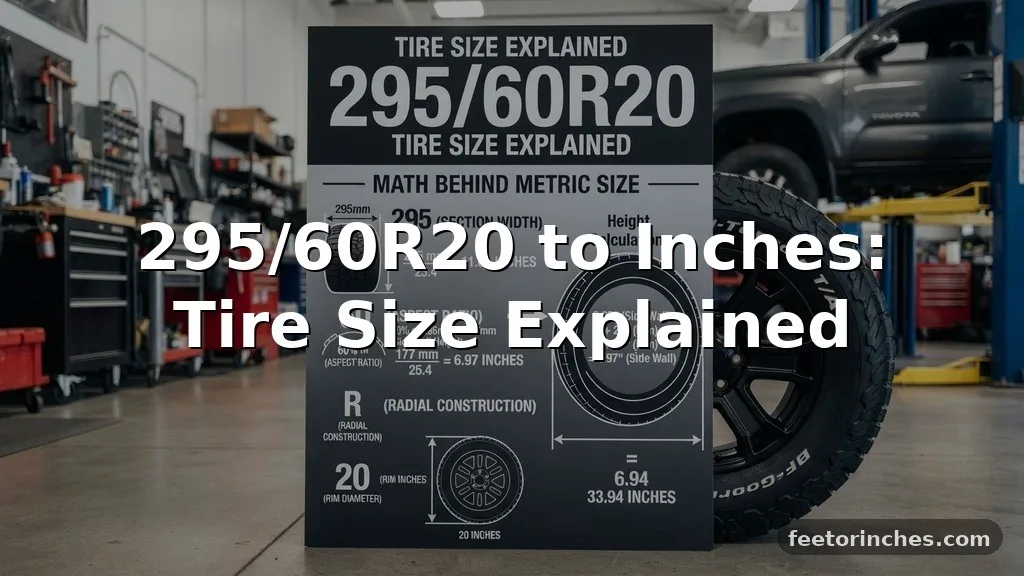
Calculating a 295/60R20 to inches conversion is essential for truck owners looking to upgrade their vehicle’s stance or off-road capability. This metric tire sizing format can be confusing, as it blends millimeters and percentages to define the physical dimensions of a tire. By breaking down the section width, aspect ratio, and rim diameter, you can determine exactly how much space your new rubber will occupy in your wheel wells.
Understanding these measurements ensures that your tire choice won’t cause rubbing or fitment issues during daily driving or heavy-duty use. This guide provides the math and context you need to confidently select your next set of tires.
The Math Behind the Metric Size
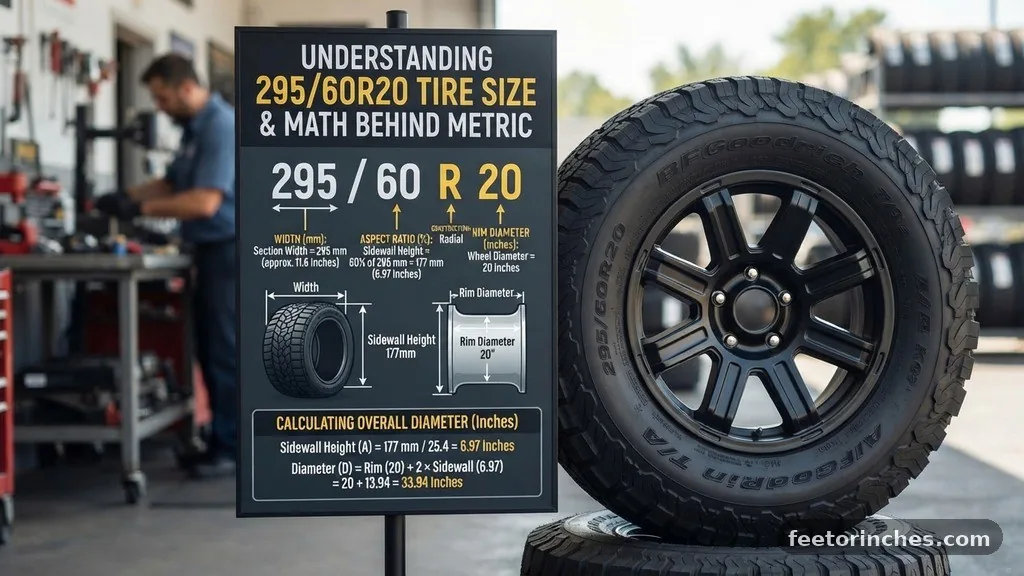
To find the height of a 295/60R20 tire in inches, you must first calculate the sidewall height. The number 295 represents the section width in millimeters, while the 60 indicates the aspect ratio. This ratio means the sidewall height is 60 percent of the width.
Multiply 295 by 0.60 to get 177 millimeters of sidewall height. Since a tire has a sidewall on both the top and bottom of the wheel, you double that figure to 354 millimeters. Next, add the 20-inch rim diameter, which is approximately 508 millimeters, to the total.
The sum is 862 millimeters. Dividing this by 25.4—the number of millimeters in an inch—reveals that a 295/60R20 tire is approximately 33.9 inches tall. For most practical purposes, enthusiasts refer to this as a 34-inch tire.
Tire Conversion Comparison Table
When performing a tire conversion, it is helpful to see how these numbers compare to standard sizes. The following table illustrates the approximate height in inches for common tire sizes found on modern trucks and SUVs.
| Tire Size | Approx. Height (Inches) | Rim Diameter |
|---|---|---|
| 275/60R20 | 33.0″ | 20″ |
| 285/60R20 | 33.5″ | 20″ |
| 295/60R20 | 33.9″ | 20″ |
| 305/60R20 | 34.4″ | 20″ |
| 35×12.50R20 | 35.0″ | 20″ |
Why Tire Fitment Matters
Proper tire fitment is about more than just aesthetics. When you move to a larger tire, you change the vehicle’s geometry, which impacts handling and speedometer accuracy. A 295/60R20 tire is wider and taller than many factory-installed tires.
If the tire is too large for your suspension setup, it may strike the frame or plastic fender liners during tight turns. This is often referred to as tire clearance. Always check your specific vehicle’s wheel well capacity before committing to a larger footprint.
Beyond physical space, consider the load index and ply rating. A higher ply rating typically indicates a stiffer sidewall, which is excellent for towing but can feel harsh on pavement. Balancing these factors is a core part of selecting the right tires for your vehicle.
Common Misconceptions in Sizing
Many drivers assume that all tires labeled with the same approximate inch size have identical dimensions. This is rarely true because different manufacturers build tires with variations in tread design and shoulder shape. A 295/60R20 from one brand might measure slightly wider or narrower than another.
Another frequent error involves confusing the rolling radius with the total diameter. The rolling radius is the distance from the center of the wheel to the ground, which is exactly half of the total diameter. When calculating clearance, the radius is the most critical figure for predicting potential interference with suspension components.
Finally, remember that tire tread width is not the same as section width. Section width is the widest point of the tire, including the sidewalls, while tread width is the surface area touching the road. Always verify the manufacturer’s specifications sheet for the most accurate data.
Estimating Tire Size Without Tools
You can estimate tire dimensions if you find yourself without a tape measure. A standard piece of legal-size paper is 14 inches long, which provides a useful visual reference for scale. If you hold a sheet of paper against the tire, you can quickly visualize how much of the tread or sidewall it covers.
Using body parts is another common, though less precise, method. The average adult hand span is roughly 8 to 9 inches wide.
By stacking two hand spans, you can approximate 16 to 18 inches. While this isn’t accurate enough for clearance measurements, it helps distinguish between a 33-inch tire and a 35-inch tire.
Always rely on a professional tire calculator or physical measurement for final decisions. Never guess when it comes to critical safety components like wheels and rubber. A small miscalculation can lead to rubbing that damages your vehicle’s components or affects your driving safety.
Key Factors in Tire Upgrades
When upgrading your tires, several variables influence how the vehicle performs on and off the road. These factors determine the longevity, comfort, and safety of your setup.
- Aspect Ratio: The percentage of the width that defines the sidewall height.
- Rim Diameter: The inner diameter of the tire that must match your wheels.
- Section Width: The total width of the tire measured from sidewall to sidewall.
- Tire Circumference: The total distance around the tire, which affects your speedometer reading.
- Load Index: The maximum weight capacity each tire can support.
Off-Road Performance Considerations
Choosing a 295/60R20 for off-road tires requires balancing traction with weight. These tires are typically heavier than stock options, which increases unsprung mass. This added weight can strain your brakes and suspension over time.
However, the benefit is a larger contact patch and improved ground clearance. A taller tire helps you traverse rocks and ruts that would otherwise hit your undercarriage. Ensure your vehicle’s gear ratio is sufficient to handle the increased rolling diameter, or you may notice a significant loss in acceleration.
Many off-road enthusiasts choose this size because it offers a rugged look without requiring a massive suspension lift. It strikes a middle ground that keeps the truck functional for daily commutes while providing enough capability for weekend trails. Always consult a local shop that specializes in truck modifications if you are unsure about your specific vehicle’s limits.
FAQ
Is a 295/60R20 considered a 34-inch tire?
Yes, mathematically the tire measures approximately 33.9 inches in diameter. Most tire shops and enthusiasts round this up to 34 inches when discussing fitment or lift requirements.
Will a 295/60R20 fit on a stock truck?
It depends on the vehicle make, model, and offset of your wheels. While some trucks can accommodate this size with minimal rubbing, others may require a leveling kit or wheel spacers to prevent contact with the frame.
How does this size affect my speedometer?
Because the tire has a larger diameter than the factory size, your tires will cover more distance with each rotation. Your speedometer will read slower than your actual speed, meaning you are moving faster than the gauge indicates.
Are 295/60R20 tires good for towing?
These tires are often available in load-range E or higher, which are suitable for towing. However, ensure the load index meets or exceeds the requirements set by your vehicle manufacturer to maintain safety under heavy loads.
Understanding Tire Dimensions
Navigating the transition from metric sizing to standard inches is a necessary skill for any truck owner. By mastering the conversion from 295/60R20 to inches, you gain the ability to accurately assess how new tires will change your vehicle’s performance and appearance. Always prioritize clearance and load capacity over pure aesthetics to ensure your truck remains safe and capable.
If you are planning to make the switch, take a moment to measure your current wheel well clearance and check your speedometer calibration needs. Feel free to reach out to local tire professionals for advice tailored to your specific vehicle model. Making an informed decision now will save you from costly fitment mistakes later and ensure you enjoy your new setup on every drive.
Explore more on FeetOrInches.