Deciphering tire dimensions can feel like learning a foreign language, especially when you are trying to visualize a metric size like a 285/60R20 in inches. Whether you are upgrading your truck for better clearance or simply replacing worn rubber, understanding what these numbers represent is essential for proper vehicle fitment.
By breaking down the individual components of the tire sidewall code, you can easily determine how these tires will change your vehicle’s stance and performance. This guide provides the calculations and context you need to confidently select your next set of tires without relying on guesswork.
Learning the true physical dimensions of your tires helps you avoid common clearance issues and speedometer inaccuracies. When you convert the metric 285/60R20 into standard measurements, you gain a clear picture of how much space these tires occupy in your wheel wells. We will examine the math behind the numbers so you can stop wondering if a specific size will rub against your suspension or frame.
Breaking Down the Metric Tire Code
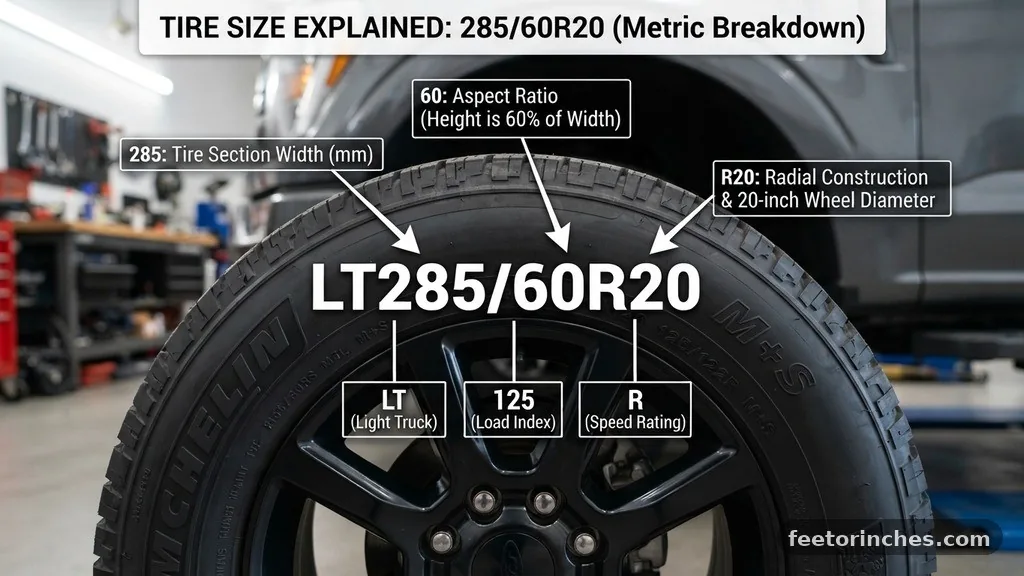
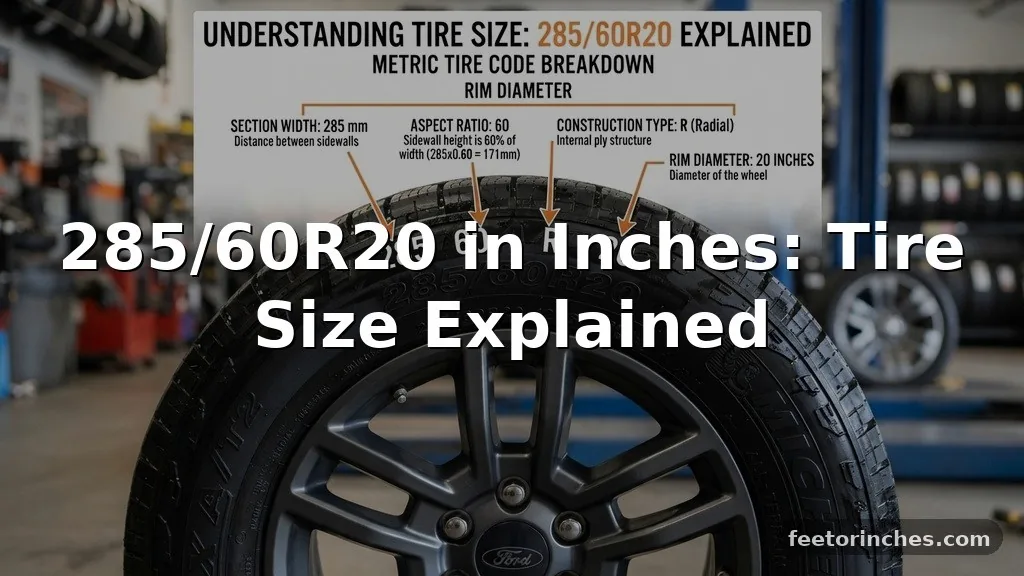
The tire size 285/60R20 follows the standard metric sizing system used by most manufacturers today. Each segment of this alphanumeric string serves a specific purpose in defining the tire’s overall geometry.
The first number, 285, represents the section width of the tire in millimeters. This is the measurement from sidewall to sidewall at the widest point.
The second number, 60, is the aspect ratio, which is a percentage of the width. Specifically, it means the sidewall height is 60% of the 285mm section width.
Finally, the R20 denotes the rim diameter, meaning this tire is designed to fit a wheel with a 20-inch diameter. Understanding these three components is the foundation of any accurate tire conversion.
Calculating the Tire Diameter in Inches
To find the total height of a 285/60R20 in inches, we must perform a series of conversions. First, we find the sidewall height by multiplying the section width (285mm) by the aspect ratio (0.60), which equals 171mm. Since a tire has a top and a bottom sidewall, we multiply 171mm by two to get 342mm of total sidewall height.
Next, we convert that 342mm into inches by dividing by 25.4, resulting in approximately 13.46 inches. We then add this to the 20-inch rim diameter to get the total tire diameter.
The final calculation shows that this tire stands at roughly 33.46 inches tall. Many enthusiasts simply refer to this as a 33-inch tire, though it is slightly larger than the nominal label suggests.
Comparison Table of Common Tire Sizes
Comparing the 285/60R20 to other popular sizes helps illustrate how these measurements stack up on your vehicle. The following table provides the approximate diameter for common 20-inch wheel setups.
| Tire Size | Approximate Diameter (Inches) |
|---|---|
| 275/60R20 | 33.0 inches |
| 285/60R20 | 33.5 inches |
| 295/60R20 | 33.9 inches |
| 305/60R20 | 34.4 inches |
Real-World Dimensions and Fitment
When you calculate the dimensions of a 285/60R20, you must consider that actual tire tread depth and manufacturer design variations can cause slight discrepancies. While the math provides a static number, the physical tire might measure slightly differently once mounted and inflated under the weight of a vehicle. Always check the manufacturer’s specifications on the National Highway Traffic Safety Administration website for precise engineering data.
Fitment issues often arise not from the diameter, but from the width. A 285mm tire is quite wide, and if you are using aftermarket wheels with a different offset, you may experience rubbing on the inner fender liner or the sway bar.
Before buying, check your truck’s specific wheel well clearance at full lock. Many drivers find that a leveling kit is necessary to accommodate a 33.5-inch tire without interference.
Why Aspect Ratio Matters
The aspect ratio is often misunderstood, yet it is the primary factor in how a tire behaves on the road. A 60-series tire provides a decent amount of sidewall, which is beneficial for ride comfort and off-road durability. If you were to drop to a 50-series or 45-series tire on the same 20-inch rim, the ride would become significantly harsher.
Conversely, a higher aspect ratio increases the tire’s ability to absorb impacts from potholes or rocks. This is why all-terrain tires often feature higher aspect ratios compared to performance street tires. When you choose a 285/60R20, you are striking a balance between a modern large-rim look and enough rubber to handle rougher surfaces.
Common Misconceptions About Tire Size
One of the most frequent errors is assuming that all tires labeled as “33-inch” have the same actual dimensions. A 285/60R20 is a 33.5-inch tire, but a 285/70R17 is also often called a “33-inch” tire. Despite the label, their actual heights and widths differ due to the rim size and construction differences.
Another misconception involves the relationship between tire diameter and circumference. People often confuse the two when calculating how a tire change will affect their speedometer.
Because a larger tire travels a greater distance in one rotation, your speedometer will read slower than your actual ground speed. Using a reliable tire calculator is the best way to determine if you need to recalibrate your vehicle’s computer after installation.
The Impact of Load Index and Speed Rating
Beyond the physical dimensions, you must pay attention to the load index and speed rating found on the sidewall. A 285/60R20 intended for a heavy-duty pickup truck will have a much higher load rating than one meant for a light crossover. The load index tells you the maximum weight each tire can support at maximum pressure.
The speed rating indicates the maximum speed the tire can safely handle for extended periods. While most all-terrain tires in this size are rated for standard highway speeds, it is vital to ensure your new tires meet or exceed the factory requirements for your specific vehicle. Never downgrade these ratings, as doing so can compromise your vehicle’s safety and handling characteristics.
Maintenance and Tread Life
Getting the most out of your tires requires consistent maintenance, especially with larger sizes. Because wider tires like the 285/60R20 have a larger contact patch, they are more susceptible to uneven wear if your alignment is off. You should rotate your tires every 5,000 to 7,000 miles to ensure the tread depth wears evenly across all four corners.
Monitoring your tire pressure is equally important. Large-diameter tires on 20-inch wheels can be sensitive to under-inflation, which increases heat buildup and accelerates tread wear.
Always use the pressure recommended on your vehicle’s door placard rather than the maximum pressure listed on the tire sidewall. This ensures the best balance of fuel economy, handling, and tire longevity.
FAQ
Are 285/60R20 tires considered 33-inch tires?
Yes, they are generally classified as 33-inch tires. With a calculated diameter of approximately 33.5 inches, they fit squarely into the “33-inch” category used by most off-road enthusiasts.
Will a 285/60R20 fit on a stock truck without a lift?
It depends on your vehicle’s specific suspension geometry. While some full-size trucks can clear this size, others may experience rubbing at full steering lock, necessitating a small leveling kit or wheel spacers.
How does this size affect my speedometer?
Since this tire is likely taller than your factory stock tires, your speedometer will read lower than your actual speed. You may need to use a programmer or a digital recalibration tool to correct the error after installation.
Can I use these tires for off-roading?
Absolutely, as many 285/60R20 models are designed as all-terrain tires. They offer a good balance of sidewall height for trail hazards and a wide footprint for traction on loose surfaces.
What is the difference between this and a 275/60R20?
The 285/60R20 is both wider and slightly taller than the 275/60R20. The 275 is about 33 inches tall, while the 285 is closer to 33.5 inches, offering a bit more ground clearance and a more aggressive stance.
Conclusion
Selecting the right tire size is a balancing act between aesthetics, performance, and clearance. By understanding the math behind a 285/60R20, you can move past the marketing labels and make an informed decision based on the actual height and width of the product. Whether you are aiming for a more rugged look or improved capability on loose terrain, knowing these dimensions prevents costly mistakes and ensures a safe fitment.
Always verify your vehicle’s clearance before making a purchase, and remember that tire pressure and alignment are the keys to long-term performance. If you have questions about your specific vehicle’s compatibility, consult your local tire shop or the manufacturer’s documentation.
Taking the time to research your upgrade now ensures you will be happy with your 285/60R20 tires for thousands of miles to come. Feel free to reach out if you need further help with your specific vehicle setup.
Related conversions: 285/65R20 in Inches: Tire Size Explained, 265/60R20 in Inches: Tire Size Explained, How Many Inches in a Foot? (Complete Guide with Real Examples & Visuals), How Many Inches in a Yard? Complete Conversion Guide With Examples.
Explore more on FeetOrInches.