
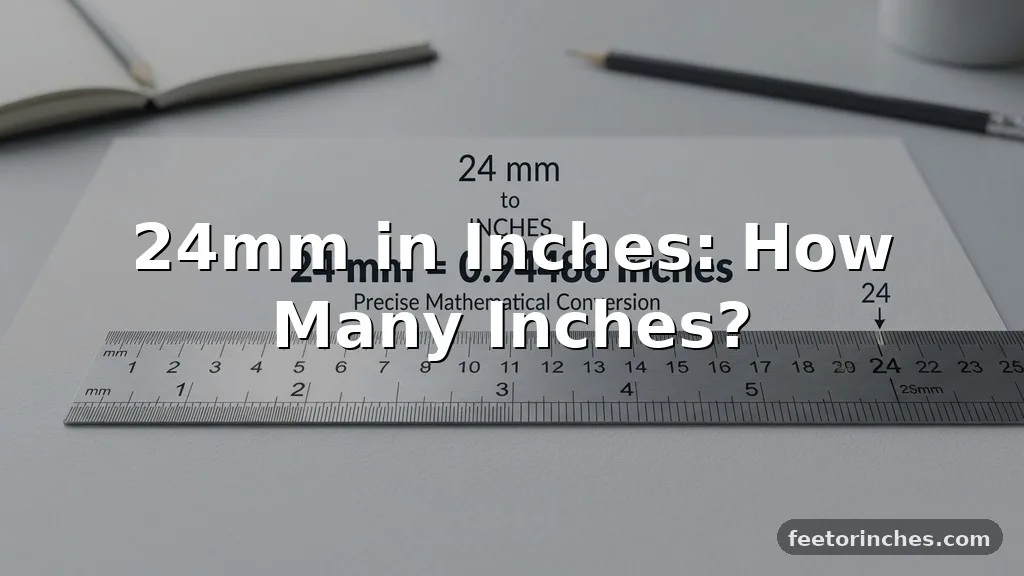
Calculating 24mm in inches is a frequent task for anyone working with precision hardware, photography equipment, or mechanical components. Understanding how these units relate ensures you select the correct parts for a project without needing to guess or waste materials. Because 24 millimeters is exactly 0.944882 inches, you can essentially treat it as slightly less than one full inch.
Whether you are selecting a camera lens, buying a new watch strap, or fitting a socket, knowing this conversion helps you avoid common sizing errors. This article provides the precise math you need to navigate these measurements with confidence.
The Precise Mathematical Conversion
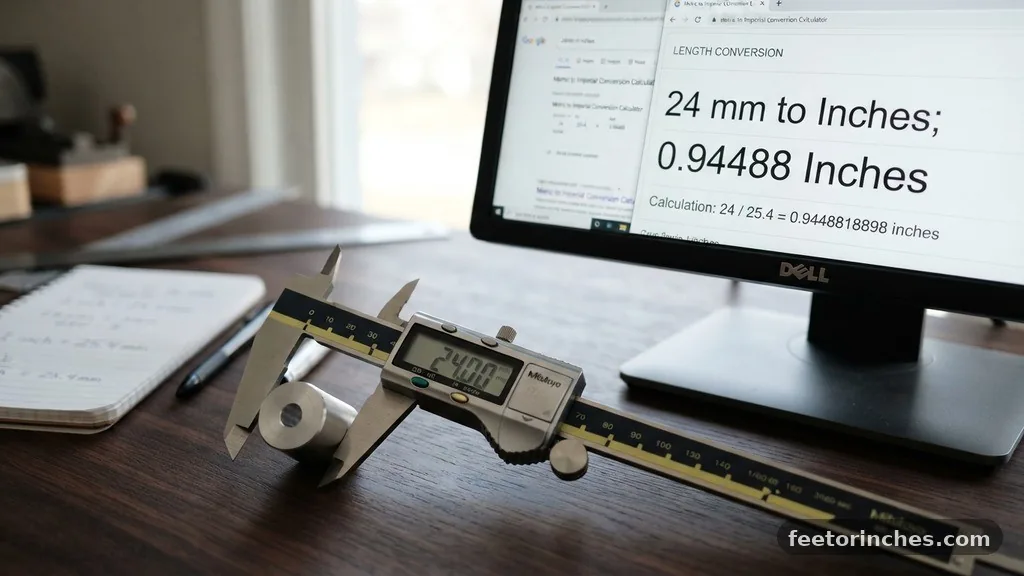
To convert from metric to imperial, you rely on the international standard where one inch is defined as exactly 25.4 millimeters. When you need to find the value of 24 millimeters in inches, you divide 24 by 25.4. This basic arithmetic operation yields a repeating decimal that rounds to 0.945 inches for most practical applications.
If you are working on a project that requires extreme precision, such as machining or watchmaking, you should carry the decimal further. The exact result is 0.9448818898 inches. Most standard rulers and calipers will not register this level of detail, but it remains the scientific truth for engineering calculations.
Using Conversion Tables for Accuracy
Having a quick-reference guide prevents errors during busy work sessions. Use the table below to see how 24mm compares to other common metric measurements in the same range.
| Millimeters (mm) | Inches (in) | Fractional Approximation |
|---|---|---|
| 20 mm | 0.787 in | ~25/32″ |
| 22 mm | 0.866 in | ~7/8″ |
| 24 mm | 0.945 in | ~15/16″ |
| 25.4 mm | 1.000 in | 1″ |
Why 24mm is Not Quite an Inch
A common mistake is assuming 24mm is a full inch or even a standard fractional equivalent like 7/8 or 15/16. While 24mm is extremely close to 15/16 of an inch, it is technically shorter. Specifically, 15/16 of an inch equals 0.9375 inches, which is 23.8125 millimeters.
Because 24mm is slightly larger than 15/16 of an inch, using the wrong measurement can cause issues with tight-tolerance mechanical parts. If you are fitting a bolt into a hole, a 24mm part will not slide into a 15/16-inch opening. Always double-check your specs against a standard length reference provided by the National Institute of Standards and Technology.
Practical Estimation Methods
You won’t always have a set of digital calipers in your pocket when you need to estimate a size. In these cases, using common objects can give you a “good enough” sense of how long 24mm is. Since 24mm is just under an inch, think of it as the approximate width of a standard adult thumb at the knuckle.
Another way to visualize this is by looking at a standard ruler. Most rulers display both millimeters and inches side-by-side on the same page or metal strip. You will notice that 24mm falls exactly one tick mark before the 25mm mark, which is just a hair shy of the 1-inch line.
- Use a standard US penny, which has a diameter of 19.05mm, to get a baseline for size.
- Compare the distance to the width of a standard pencil, which is often close to 7mm or 8mm.
- Place three standard pencils side-by-side to approximate the 24mm length.
- Check the width of your index finger, as many people have a width of roughly 20-25mm at the base.
Common Uses for 24mm Measurements
The 24mm measurement shows up frequently in specialized industries. Photography is perhaps the most notable, as 24mm is a classic wide-angle lens focal length. Photographers use this to capture expansive landscapes or tight architectural interiors where a standard 50mm lens would be too restrictive.
In the world of mechanical tools, you will often find a 24mm socket in a standard metric set. This size is commonly used for larger lug nuts on vehicles or heavy-duty plumbing fittings. If you are shopping for tools, ensure you are buying a metric set rather than an SAE (Society of Automotive Engineers) set to avoid stripping your hardware.
Converting Millimeters to Inches in Engineering
When you convert millimeters to inches for manufacturing, you must account for the difference between nominal and actual sizes. A part labeled as 24mm might have a tolerance of plus or minus a few hundredths of a millimeter. This is why engineers prefer to work in decimals rather than fractions.
If you are designing a product, you should convert your final dimensions to both systems. This ensures that a customer in a metric-dominant country can use your product just as easily as someone in the United States. Always use the exact conversion factor of 25.4 to maintain consistency across your documentation.
Standard Fractions vs. Metric Units
Confusion often arises because the imperial system relies heavily on fractions (1/8, 1/4, 1/2), while the metric system is decimal-based. When you need to convert 24mm to a fraction, you are essentially trying to map a base-10 system onto a base-2 or base-16 system. This rarely results in a clean, round number.
While 24mm is roughly 0.945 inches, expressing this as a fraction usually involves rounding to the nearest 16th or 32nd of an inch. For most home repair projects, 15/16 of an inch is a functional proxy. For any project involving precision electronics or engine parts, stick to decimal inches or millimeters to prevent costly mistakes.
Addressing Common Misconceptions
A frequent error involves confusing diameter with circumference. If you measure the diameter of a tube as 24mm, the circumference is much larger, calculated as 24 multiplied by pi (3.14159). Do not use the 24mm figure to estimate how much material you need to wrap around an object.
Another issue arises with screen sizes. A 14-inch laptop screen refers to the diagonal length, not the width or height of the screen.
Similarly, if you see a 24mm lens, it refers to the focal length, not the physical diameter of the glass. Always verify exactly what dimension is being measured before applying a conversion.
FAQ
Is 24mm bigger than one inch?
No, 24mm is slightly smaller than one inch. Because one inch is defined as 25.4mm, 24mm is approximately 1.4 millimeters shorter than a full inch.
What is the closest fraction to 24mm?
The closest standard fraction is 15/16 of an inch. 15/16 of an inch is 23.8125mm, making it just slightly smaller than 24mm.
How can I convert 24mm to inches quickly?
If you don’t have a calculator, simply remember that 25mm is almost exactly 1 inch. Since 24mm is 1mm less than 25mm, you are just a tiny bit under an inch.
Why do some people say 25mm is an inch?
25mm is a common, rough approximation for an inch used in casual carpentry or DIY. While it is close enough for rough framing, it is not accurate enough for machine work or precise engineering.
Final Thoughts
Getting comfortable with the relationship between millimeters and inches simplifies your workflow, whether you are shopping for hardware or drafting a design. Remembering that 24mm is just under an inch allows you to quickly estimate sizes without needing to pull up a conversion app every time. While precise engineering requires using the exact 25.4mm conversion factor, most daily tasks allow for the slight rounding to 0.945 inches.
Keep these figures in mind when you visit the store, and you will find it much easier to select the right components for your projects. If you frequently find yourself needing to convert measurements, keeping a small reference card in your toolbox or on your desk is a great way to save time. Feel free to reach out if you have more questions about specific metric conversions!
You may also like: 18 mm in Inches
You may also like: 225 mm to Inches
Explore more on FeetOrInches.