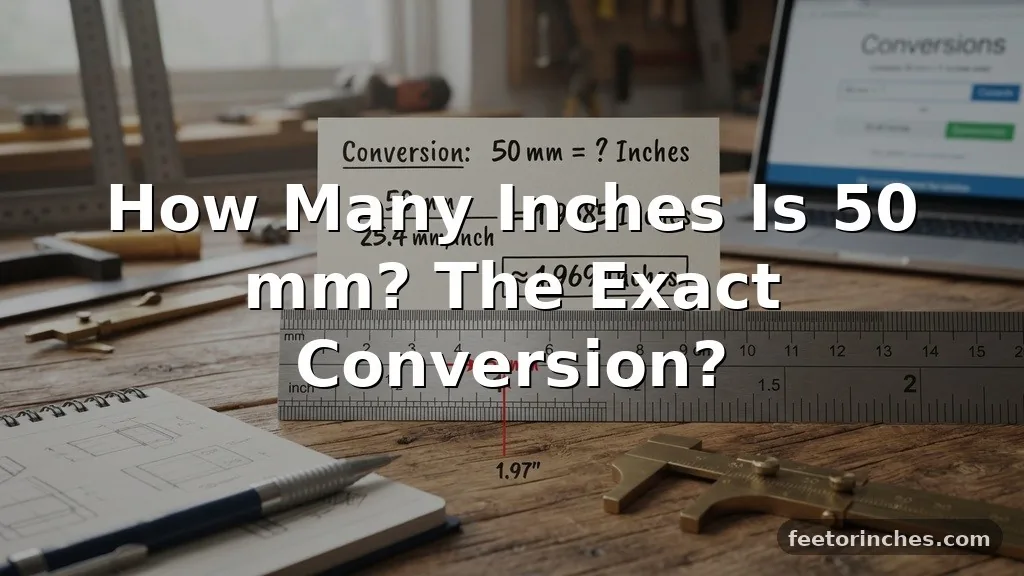
When you need to know how many inches is 50 mm, the answer is exactly 1.9685 inches. Many people round this figure to 2 inches for daily tasks, but precision often matters in engineering or design. Understanding this conversion helps you bridge the gap between the metric system used in most of the world and the imperial units common in the United States.
You’ll find that mastering these small increments makes reading blueprints, sewing patterns, or setting up camera gear much simpler. This guide provides the exact math and practical context you need to handle these measurements with confidence.
The Mathematical Conversion
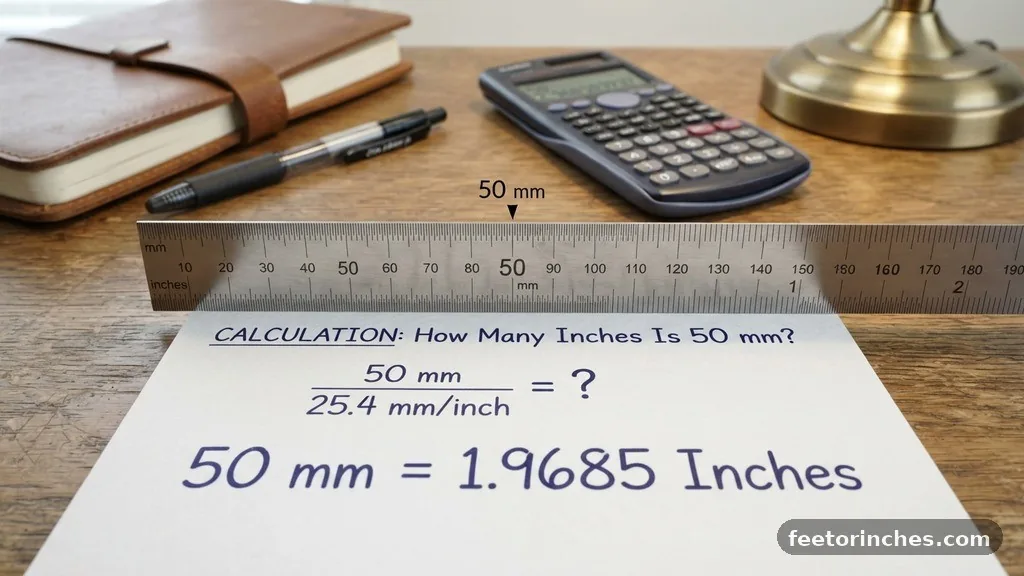
The relationship between these two units is fixed by international agreement. One inch is defined as exactly 25.4 millimeters. To find the inch equivalent for any metric value, you simply divide the number of millimeters by 25.4.
When you apply this to 50 millimeters, the calculation is 50 divided by 25.4. This results in a repeating decimal that truncates to 1.9685039. For almost all practical applications, you can safely use 1.97 inches as a reliable shorthand.
Why Precision Matters
In fields like manufacturing, the difference between 1.9685 inches and 2 inches can be significant. If you are fitting a mechanical part, a discrepancy of 0.03 inches might cause a component to fail. Precision machining relies on these exact decimal points to ensure parts fit together without gaps or friction.
If you are working with wood or fabric, however, you can usually stick to fractional approximations. A standard ruler won’t show you 0.9685, but it will show you 1 and 31/32 inches. Choosing the right level of precision for your specific project saves time and prevents material waste.
Conversion Table for Common Metric Measurements
The following table provides a quick reference for converting millimeters to inches. This helps you visualize how 50 mm fits into the broader scale of small, everyday measurements.
| Millimeters (mm) | Inches (in) | Common Usage |
|---|---|---|
| 10 mm | 0.39 in | Small hardware/screws |
| 25.4 mm | 1.00 in | Standard inch base |
| 50 mm | 1.97 in | Camera lens/small components |
| 75 mm | 2.95 in | Pipe diameters |
| 100 mm | 3.94 in | General material width |
Practical Estimation Techniques
You don’t always have a digital caliper or a precision ruler in your pocket. Estimating length using common objects is a skill that saves time during quick home improvements or shopping trips.
Knowing that 50 mm is just shy of 2 inches is your best mental shortcut. Since a standard U.S. quarter is about 24.26 mm in diameter, two quarters placed side-by-side will give you a very close approximation of 50 mm. If you have a piece of legal-size paper, the short edge is 8.5 inches, which is roughly 216 mm.
Using Your Body as a Tool
Your own body often provides the most accessible ruler. The average adult index finger is roughly 15 to 20 mm wide at the first knuckle. Placing three finger widths side-by-side will often land you right around that 50 mm mark.
While this isn’t scientific, it works for choosing the right size screw at a hardware store or checking if a small box will fit into a drawer. Always verify with a real tool if the fit needs to be tight. For more on the standardization of these units, you can consult the National Institute of Standards and Technology for official documentation.
Common Misconceptions
A frequent point of confusion involves the difference between diameter and circumference. If you have a pipe with a 50 mm diameter, its circumference will be significantly larger—roughly 157 mm or 6.18 inches. Always clarify whether you are measuring the width of an object or the distance around it.
Another common error is confusing 50 mm camera lenses with physical length. A “50 mm lens” refers to the focal length, which is the distance between the optical center of the lens and the image sensor. It does not mean the lens is 50 mm long or 50 mm wide.
Comparing 50 mm to Nearby Sizes
Understanding how 50 mm compares to other common sizes helps you build a better sense of scale. It sits right between the very small and the moderately sized.
- 12 mm (0.47 in): The size of a standard heavy-duty bolt.
- 25 mm (0.98 in): Nearly an inch, common for furniture legs.
- 50 mm (1.97 in): The benchmark for standard prime lenses in photography.
- 75 mm (2.95 in): Common for small pipe fittings and specialized hardware.
- 100 mm (3.94 in): The width of a standard wall stud or small hand tool.
Comparing these sizes helps you visualize the increment. Moving from 25 mm to 50 mm is effectively doubling your length. Moving from 50 mm to 75 mm is adding another 50% to that initial distance.
The Role of Fractions in Imperial Measurements
While the metric system uses decimals, the imperial system often relies on fractions. This creates a hurdle when you are trying to convert millimeters to inches for construction.
Most tapes are marked in 1/16th of an inch increments. Since 1/16 of an inch is approximately 1.5875 mm, you can calculate that 50 mm is just over 1 and 15/16 inches. Using this fraction is much easier when marking wood or metal with a pencil.
Why the 50 mm Standard Matters
The 50 mm measurement is a “gold standard” in several industries. In photography, the 50 mm prime lens is prized because it mimics the field of view of the human eye. This specific focal length provides a natural perspective, making it a staple for portrait and street photographers.
In the world of model building, 50 mm is a common scale for figurines. It allows for enough detail to be visible while keeping the model manageable for display. Recognizing this number helps you identify parts and accessories that are compatible with your existing collection.
Digital Measurement and Accuracy
In modern design, we often use CAD software to handle these conversions. When you input 50 mm into a program, it handles the decimal math instantly. However, you must ensure your project settings are consistent.
If you mix units within a single drawing, errors occur quickly. Always set your units to either metric or imperial at the start of your workflow. This prevents the “conversion creep” that happens when rounding errors accumulate over multiple calculations.
FAQ
Is 50 mm exactly 2 inches?
No, 50 mm is slightly less than 2 inches. Two inches is exactly 50.8 mm, meaning 50 mm is short by 0.8 mm.
How do I convert millimeters to inches quickly?
Divide your millimeter value by 25.4. If you need a quick mental estimate, divide by 25.
Does the conversion change based on the object?
No, the mathematical conversion remains constant regardless of the object. Whether you are measuring a lens, a bolt, or a piece of fabric, the math stays the same.
Why do people say 50 mm is 2 inches?
It is a common rounding practice used for convenience. In most casual scenarios, the difference of less than a millimeter is negligible and doesn’t affect the outcome.
Final Thoughts
Mastering the conversion of 50 mm to inches provides a foundation for better accuracy in both professional and hobbyist tasks. While 1.97 inches is the precise mathematical result, recognizing that it is essentially 2 inches allows for faster decision-making when you are away from your tools. By understanding the relationship between these systems, you gain the flexibility to work with equipment from anywhere in the world.
Whether you are calibrating a camera, building a model, or choosing the right hardware, these small details ensure your work remains consistent and reliable. Keep this conversion handy, and you will find that switching between units becomes a natural part of your process. If you have further questions about specific measurements or need help with other conversions, feel free to reach out.
You may also like: 18 mm in Inches
You may also like: 225 mm to Inches
Explore more on FeetOrInches.