Calculating a 255/80R17 in inches is essential for off-road enthusiasts looking to upgrade their vehicle’s stance without causing mechanical interference. This specific tire size is a popular choice for truck owners seeking a taller, narrower profile that improves ground clearance while maintaining manageable width. By breaking down the metric sizing system into imperial units, you gain a clear picture of how these tires will fit your wheel wells and impact your vehicle’s overall performance.
Understanding these dimensions ensures you select the right equipment for your specific build, avoiding costly mistakes during installation. Here is the technical breakdown you need to make an informed decision for your next set of tires.
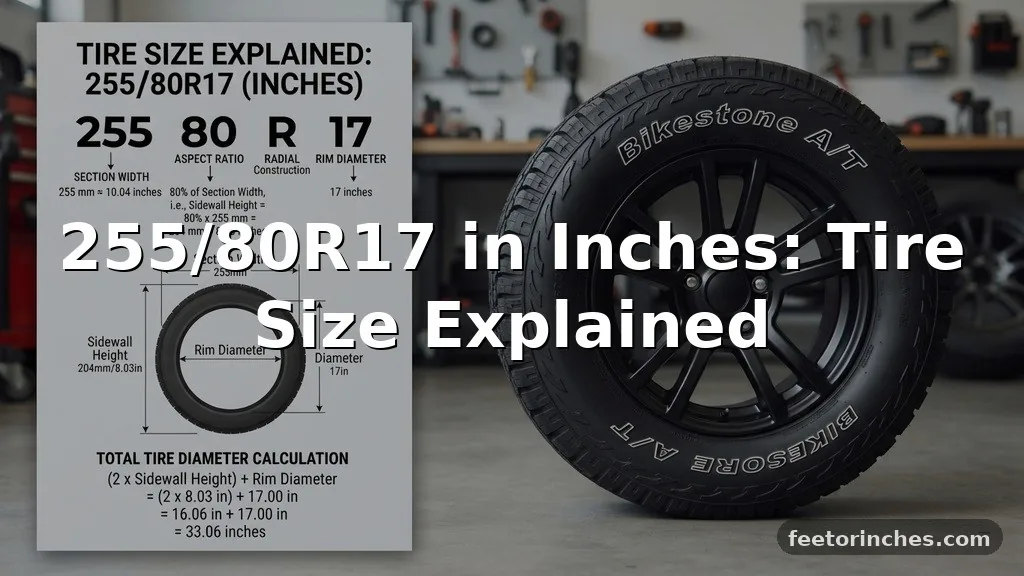
When you look at the sidewall of a 255/80R17 tire, the numbers represent a standard metric sizing convention. The first number, 255, denotes the section width in millimeters, while the 80 is the aspect ratio, representing the sidewall height as a percentage of the width. The R indicates radial construction, and the 17 refers to the rim diameter in inches.
By converting these values, we determine that a 255/80R17 is approximately 33.1 inches in total diameter. This makes it a preferred option for those who want a “33-inch tire” that fits on standard 17-inch wheels.
The Mathematical Breakdown of Tire Size
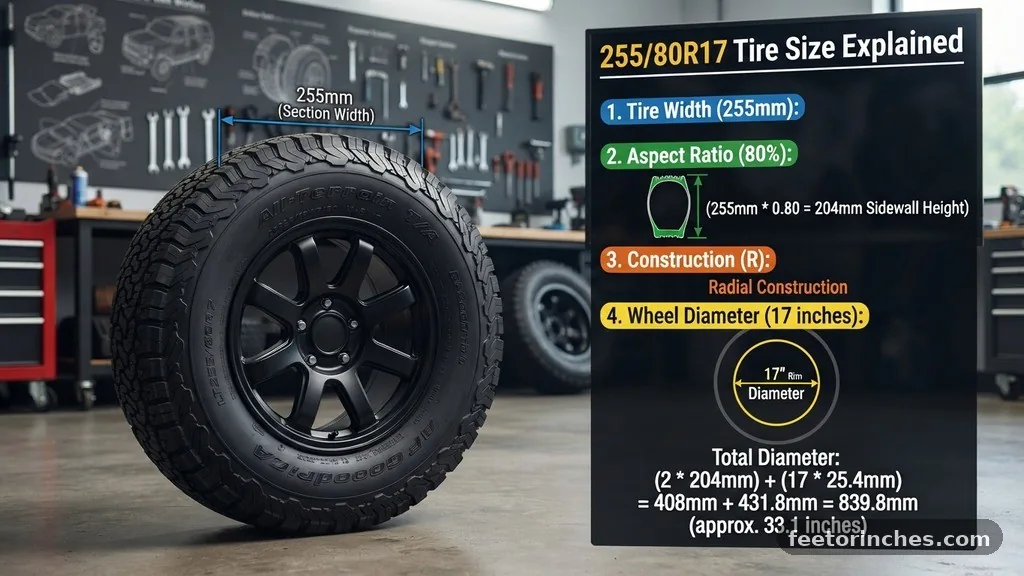
To convert a metric tire size into inches, you must apply a specific formula to each component. You start by converting the width from millimeters to inches by dividing by 25.4.
Then, you calculate the sidewall height by multiplying the width by the aspect ratio and dividing by 100. Because the tire has a top and bottom sidewall, you double that result and add the rim diameter to find the total height.
Step-by-Step Conversion
- Width: 255mm divided by 25.4 equals 10.04 inches.
- Sidewall: 10.04 inches multiplied by 0.80 equals 8.03 inches.
- Diameter: 8.03 inches plus 8.03 inches plus 17 inches equals 33.06 inches.
This calculation is the industry standard for determining tire diameter. It is important to note that these are theoretical dimensions based on the tire being mounted on a specific rim width. Real-world results can vary slightly depending on the tire manufacturer’s specifications and the actual tread pattern design.
Comparing 255/80R17 to Nearby Sizes
Choosing the right tire involves balancing your vehicle’s power, fuel efficiency, and clearance requirements. Many drivers compare the 255/80R17 to the more common 265/70R17 or 285/70R17.
While a 285-width tire provides a wider footprint, it may require significant fender trimming to prevent rubbing. The 255/80R17 offers a taller profile with a narrower contact patch, which is often better for cutting through mud and snow.
| Tire Size | Approximate Diameter | Approximate Width |
|---|---|---|
| 255/80R17 | 33.1 inches | 10.0 inches |
| 265/70R17 | 31.6 inches | 10.4 inches |
| 285/70R17 | 32.7 inches | 11.2 inches |
| 275/70R17 | 32.2 inches | 10.8 inches |
Off-Road Performance and Utility
The primary advantage of the 255/80R17 size is its ability to provide extra ground clearance without excessive weight. Because the tire is narrower than a typical 285-width tire, it exerts more pressure per square inch on the ground.
This increased ground pressure helps the tread bite into loose surfaces like gravel, mud, or snow. Many all-terrain tire manufacturers design this specific size for overlanders who prioritize efficiency and durability.
The taller sidewall also allows for a larger contact patch when the tire is aired down for off-road use. A taller sidewall provides more “give,” which cushions the impact of rocks and roots on the trail.
This reduces the strain on your vehicle’s suspension components and improves overall ride comfort. However, you must ensure that your gear ratios are appropriate for a 33-inch tire to maintain acceleration and highway drivability.
Clearing Common Misconceptions
A common myth is that all “33-inch” tires are exactly the same size. In reality, manufacturer tolerances and tread depth variations mean that a 255/80R17 from one brand might be slightly taller or shorter than another.
Always consult the technical data sheet provided by the tire manufacturer rather than relying solely on the sidewall markings. These data sheets provide the “revolutions per mile,” which is the most accurate way to determine the true rolling diameter of the tire.
Another confusion exists regarding the difference between width and section width. The number 255 represents the widest point of the tire, which is usually the sidewall, not the tread surface. The actual tread width is typically narrower than the section width.
Understanding this distinction helps when evaluating how a tire will sit within your wheel well. If you have limited tire clearance, the section width is the measurement that will likely cause rubbing against the frame or control arms.
Evaluating Load Range and Durability
When selecting a 255/80R17, you will often find options in Load Range C, D, or E. A higher load range generally means a stiffer sidewall and a higher tire ply rating, which increases resistance to punctures on sharp rocks.
However, a heavier tire with a higher load range can negatively impact fuel economy and ride quality. If you use your vehicle primarily for daily driving, a lower load range may provide a more compliant ride.
Off-roaders carrying heavy equipment or towing trailers should prioritize higher load ranges to ensure the tires can handle the added weight. You should also check your vehicle’s recommended tire pressure, as it may need to be adjusted to accommodate the specific load rating of your new tires.
Running the correct pressure is vital for even tread wear and safety. Never exceed the maximum pressure listed on the sidewall, and avoid running pressures that are too low for street use, as this can cause heat buildup.
Impact on Vehicle Geometry
Moving to a 33-inch tire changes the geometry of your truck in several ways. The most immediate change is the speedometer reading, which will likely be inaccurate because the tire covers more distance per revolution.
Most modern vehicles allow you to recalibrate the speedometer through the onboard computer, but this is a necessary step to avoid legal issues and ensure accurate odometer readings. You should also consider the effect on your transmission shift points.
Suspension geometry is also affected, as the larger tire may contact the wheel well during full articulation. Before installing these tires, check your suspension travel and consider whether a leveling kit or a small lift is required.
Some vehicles may require aftermarket control arms to provide adequate tire clearance. Always perform a full-lock turn test after installation to ensure there is no contact with the frame or sway bar.
Practical Estimation Methods
If you do not have a measuring tape, you can estimate the size of your tires using common reference points. A standard sheet of legal paper is 14 inches long, which provides a reliable baseline for visual estimation.
You can also use your own body parts; for instance, the distance from your wrist to your elbow is often close to 14 inches for an average adult. When looking at your vehicle, you can compare the tire diameter to known wheel sizes.
Since you know the rim is 17 inches, you can visually estimate the sidewall by comparing it to the rim itself. If the sidewall appears to be roughly half the height of the rim, you are looking at a significantly different aspect ratio than an 80-series tire.
These quick field estimates are useful for a rough check, but they should never replace precise measurements taken with a calibrated tool. Always measure from the ground to the top of the tire while the vehicle is parked on a level surface.
FAQ
Is a 255/80R17 considered a 33-inch tire?
Yes, a 255/80R17 is widely considered a 33-inch tire in the off-road community. While the exact mathematical calculation results in approximately 33.06 inches, variations in manufacturing and tread design mean the actual diameter can fluctuate slightly.
Will I need a lift kit to run these tires?
The need for a lift kit depends on your specific vehicle’s wheel well design. Many mid-size trucks can accommodate this size with minimal or no lift, but some may require a leveling kit to prevent rubbing during full suspension articulation.
How does the narrow width affect highway driving?
The narrower 255-millimeter width often improves tracking on the highway compared to wider tires, as they are less prone to “tramlining” or following grooves in the pavement. They also tend to be quieter and more fuel-efficient than wider, more aggressive tires.
Can I use these tires on my stock wheels?
You can typically mount these tires on stock wheels as long as the rim width falls within the manufacturer’s recommended range for that specific tire size. Check your owner’s manual or the tire manufacturer’s website for the approved rim width specifications.
Are these tires good for daily driving?
Many drivers find this size excellent for daily driving because it balances off-road capability with road manners. The 80-series aspect ratio provides enough sidewall to absorb road imperfections, making for a comfortable ride on paved surfaces.
Summary and Final Thoughts
Deciding on the right tire size is a significant investment in your vehicle’s performance and safety. A 255/80R17 in inches translates to a robust 33-inch diameter, offering a balanced profile that performs well both on the trail and the highway. By understanding how the math works behind these numbers, you can avoid the common pitfalls associated with tire upgrades, such as clearance issues and speedometer inaccuracies.
Whether you are prepping for a weekend expedition or simply want a more capable daily driver, the 255/80R17 is a versatile choice that rarely disappoints. Take the time to verify your vehicle’s specific requirements, and you will enjoy the improved traction and aesthetic appeal these tires provide for years to come. If you have questions about your specific vehicle setup, reach out to a local professional installer today.
Related conversions: How Many Inches in a Foot? (Complete Guide with Real Examples & Visuals), How Many Inches in a Yard? Complete Conversion Guide With Examples, What Is 6 mm in Inches? Complete Conversion Guide, How Many Cubic Inches in a Cubic Yard? Complete Conversion Guide.
Explore more on FeetOrInches.