
Converting 2.7 cm to inches is a common task for anyone working between metric and imperial measurement systems. To answer your question immediately, 2.7 centimeters is exactly 1.06299 inches. In most practical applications, you can safely round this to 1.06 inches without losing significant accuracy.
Understanding how these units relate helps you move between global standards, whether you are measuring small hardware, fabric, or technical components. By learning the conversion factor, you can handle these calculations on your own without needing an online calculator every single time.
Conversion Factors and Mathematical Constants
The relationship between centimeters and inches is fixed by international agreement. One inch is defined as exactly 2.54 centimeters.
To find the result for any centimeter value, you simply divide that number by 2.54. Because 2.7 is slightly larger than 2.54, it follows logically that the answer must be slightly more than one inch.
The Basic Formula
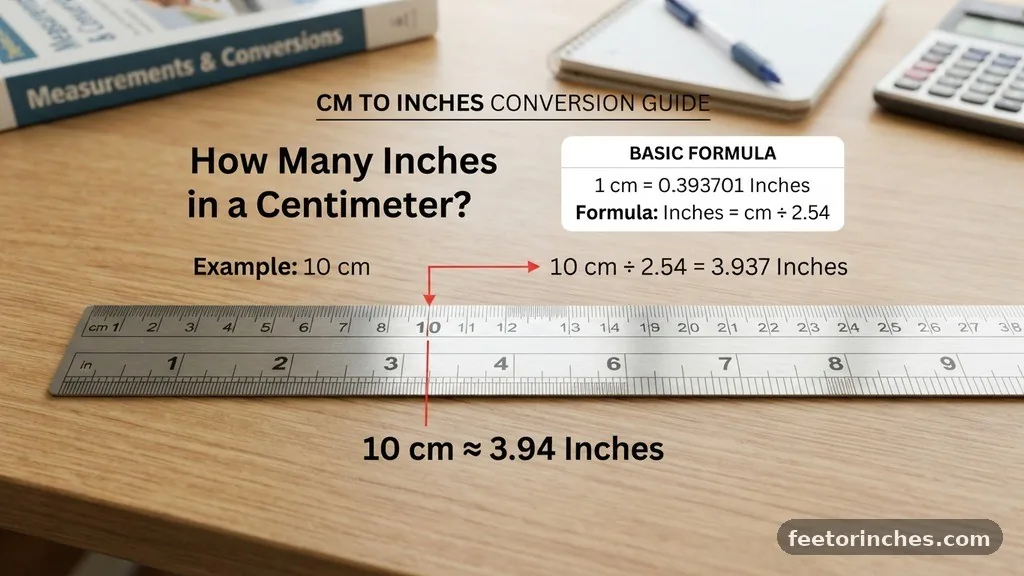
To perform the calculation manually, use the following equation: Centimeters / 2.54 = Inches. Applying this to 2.7 gives you 2.7 / 2.54, which equals approximately 1.062992126. You rarely need that level of precision for day-to-day tasks, so rounding to two or three decimal places is standard practice.
Conversion Table
The following table provides a quick reference for related lengths, helping you visualize how these measurements scale.
| Centimeters (cm) | Inches (in) | Millimeters (mm) |
|---|---|---|
| 1.0 cm | 0.394 in | 10 mm |
| 2.0 cm | 0.787 in | 20 mm |
| 2.54 cm | 1.000 in | 25.4 mm |
| 2.7 cm | 1.063 in | 27 mm |
| 5.0 cm | 1.969 in | 50 mm |
Understanding Fractional Inches
In many industries, especially construction and woodworking, measurements are expressed in fractions rather than decimals. Converting 2.7 cm to a common fraction requires looking at the closest 1/16th or 1/32nd of an inch. Since 1.063 inches is just slightly over 1 inch, the closest standard fractional representation is 1 1/16 inches.
Why Fractions Matter
Tape measures used in the United States and other regions often lack decimal markings. By using 1 1/16, you align your project with the tools already in your toolbox. This is particularly helpful when you are working with fasteners or lumber where specific tolerances are expected.
Precision vs. Approximation
If you are working on a high-precision engineering project, fractions might not be enough. Always check your specific requirements before rounding. If you are dealing with scientific data, stick to the decimal format provided by the National Institute of Standards and Technology to ensure your work remains within acceptable margins of error.
Real-World Objects Near 2.7 cm
Visualizing a measurement is often easier than calculating it. Several everyday items fall into the 2.7 cm or 1.06-inch range. Identifying these objects allows you to estimate lengths without reaching for a ruler.
- Standard Quarter Coin Diameter: The diameter of a US quarter is approximately 24.26 mm, making it very close to the 2.7 cm mark when accounting for the rim.
- AA Battery Width: The diameter of a standard AA battery is approximately 1.4 cm, meaning two batteries placed side-by-side are slightly wider than 2.7 cm.
- Standard Paperclip Width: A jumbo-sized paperclip often measures close to 2.7 cm in total length.
- Mechanical Pencil Lead: While the lead itself is thin, the diameter of the metal housing on many standard 0.5mm mechanical pencils is roughly 2.7 cm in circumference or slightly smaller in diameter.
- Computer Keycap Width: The standard width of a key on a desktop keyboard is often right around 1.8 to 2.0 cm, but the total footprint including the gap is often near our target measurement.
Common Measurement Misconceptions
Confusion often arises when people mix up diameter, circumference, and diagonal measurements. A screen described as 14 inches refers to the diagonal, not the width or height. Similarly, when you see a measurement of 2.7 cm, you must determine if it refers to a length, a width, or a thickness.
Diagonal vs. Linear Length
If you are measuring a screen or a display, you cannot use a simple linear conversion to find the width. You must use the Pythagorean theorem, which accounts for the aspect ratio of the display. A 14-inch screen has a specific width and height, but those dimensions depend entirely on the screen’s shape.
Diameter vs. Circumference
Another frequent error involves confusing the distance across a circle with the distance around it. If you measure a circular pipe and find it has a diameter of 2.7 cm, the circumference is significantly larger. Always specify which dimension you are measuring to avoid costly errors in manufacturing or DIY projects.
How to Estimate Without a Ruler
You don’t always have a calibrated tool available. When you need to estimate 2.7 cm on the fly, use your body or common office supplies. Most people find that the width of their thumb near the knuckle is a reliable, though rough, point of reference.
Using Paper as a Guide
A standard piece of printer paper is 8.5 inches wide. If you fold that paper into a specific number of sections, you can create a makeshift ruler. A quick way to find an inch is to fold the paper edge until you have a segment that looks roughly like your thumb width.
The Finger Method
Many adults have a fingernail or a distal finger joint that measures close to 1 inch. By knowing your own body measurements, you can perform quick field estimates. Test this by measuring your own thumb or finger against a ruler once, and you’ll have a permanent measurement tool with you at all times.
Comparing Nearby Measurements
Understanding where 2.7 cm sits in relation to other sizes provides valuable context. It is just over the 1-inch mark, which is a major threshold in many manufacturing processes. Comparing it to 12, 13, 15, and 16 inches helps you gauge the scale of larger objects.
Scale and Proportion
While 2.7 cm is a small unit, it represents the base unit for many modular components. When you scale up to 12 inches (one foot), you are dealing with a standard unit of measure in construction. Moving from 13 to 16 inches is common in laptop screen sizes, where every inch significantly changes the device’s portability.
Why Accuracy Matters
Small deviations at the 2.7 cm level can compound over larger projects. If you are building a shelf or a frame, an error of even 1 millimeter at the start can lead to a gap of several centimeters by the time you reach the end of the project. Always measure twice and cut once.
Frequently Asked Questions
Is 2.7 cm equal to 1 inch?
No, 2.7 cm is slightly larger than 1 inch. One inch is exactly 2.54 cm, so 2.7 cm is approximately 1.06 inches.
How do I convert centimeters to inches quickly?
Divide the centimeter value by 2.54. For a quick mental estimate, you can divide by 2.5 and then subtract a small fraction, though this is less accurate.
What is 2.7 cm in millimeters?
There are 10 millimeters in every centimeter. Therefore, 2.7 cm is equal to 27 millimeters.
Why is 2.54 the magic number for conversions?
The inch was internationally standardized to be exactly 25.4 millimeters in 1959. This agreement between English-speaking nations ensured that engineering and scientific measurements would be consistent across borders.
Can I use a ruler for these measurements?
Yes, most standard rulers have both metric (cm/mm) and imperial (inches) scales. Ensure you are looking at the correct side of the ruler, as the markings can sometimes be confusing if you are tired or working in low light.
Final Thoughts on Metric Conversions
Mastering the conversion of 2.7 cm to inches provides a foundation for more complex measurements in your daily life. Whether you are working with technical specifications or simple household tasks, knowing that 2.7 cm is slightly more than 1 inch allows you to visualize dimensions accurately. Precision in these small units prevents errors that can accumulate in larger projects.
Always keep the conversion factor of 2.54 in mind to ensure your work remains consistent and reliable. By using the methods outlined here, you can confidently estimate and calculate measurements without needing constant access to a calculator. If you have further questions about specific measurements or need help with other unit conversions, feel free to reach out and keep the conversation going.
Related conversions: What is 30 cm in inches · What Is 20 Centimeters in Inches · 157 cm to Inches
Explore more on FeetOrInches.