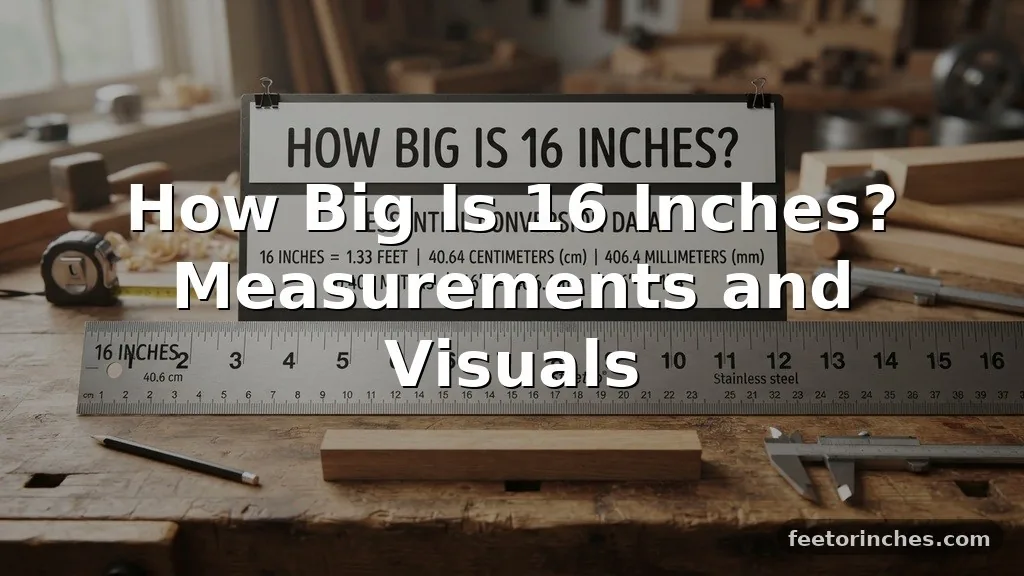
When you ask how big is 16 inches, you are looking for a clear sense of scale for a measurement that appears frequently in architecture, technology, and culinary arts. Whether you are sizing up a new laptop screen or planning a home renovation project, grasping this specific length helps you visualize space without needing a tape measure constantly in hand.
At its core, 16 inches represents a length that sits comfortably between a standard foot-long ruler and the span of a typical adult’s arm reach. Understanding this dimension allows you to make quick, accurate assessments of everyday objects. This guide provides the exact conversions and mental shortcuts you need to master this measurement in any situation.
Essential Conversion Data
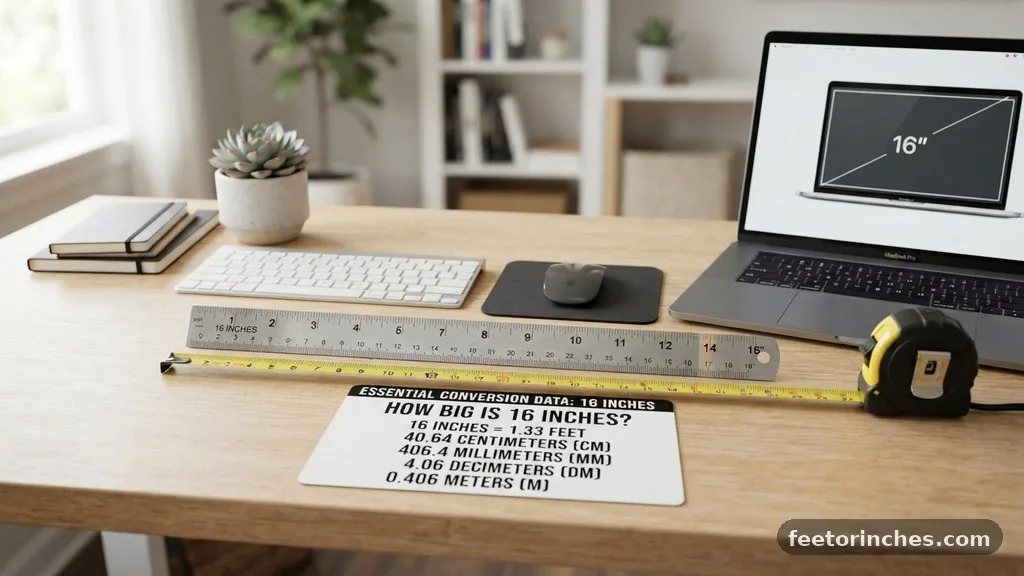
To understand the precise value of 16 inches, it is helpful to see how it translates into other standard units of measurement. Whether you are working with the imperial or metric system, having these figures ready ensures you maintain accuracy in your projects.
The following table provides the most common conversions for this specific length. Use these values as your reference point whenever you need to translate inches into more functional units for engineering or design tasks.
| Unit of Measure | Value for 16 Inches |
|---|---|
| Feet | 1.33 feet |
| Centimeters | 40.64 centimeters |
| Millimeters | 406.4 millimeters |
| Meters | 0.4064 meters |
These figures are standardized by the National Institute of Standards and Technology, which maintains the integrity of measurement systems used across the globe. Keeping these ratios in mind makes it much easier to convert between systems on the fly. You will find that 16 inches is just a bit over 40 centimeters, a useful mental anchor for quick estimates.
Visualizing the Scale
Visualizing a length of 16 inches can be tricky if you do not have a tool like a ruler nearby. Most people have an intuitive grasp of 12 inches because a standard ruler is exactly one foot long. To find 16 inches, you simply need to visualize that 12-inch ruler and add an extra four inches to the end.
Think of it as a foot plus the length of a common smartphone or the width of a standard sheet of paper. If you hold your thumb and pinky finger apart in a wide stretch, you might find that your hand span is roughly eight to nine inches wide. Doubling that span gives you a very close approximation of the 16-inch mark.
Common Everyday Objects
Many household and office items are manufactured with dimensions that align with this length, making them excellent reference points. If you ever find yourself needing to estimate a space, look for these objects to gauge the distance.
- A standard large pizza is typically 16 inches in diameter, serving as a perfect visual anchor for many people.
- Many laptop screens are measured diagonally at 16 inches, which represents a significant amount of workspace.
- Standard wall studs in many residential homes are placed exactly 16 inches apart on center to provide structural integrity.
- A piece of legal-sized paper is 14 inches long, meaning 16 inches is just slightly longer than that sheet.
These objects are not arbitrary; they reflect industry standards designed for human convenience and structural efficiency. Recognizing these items allows you to measure distances in your home without ever picking up a physical tool.
Laptop Screen Diagonals
When you see a 16-inch laptop advertised, that number refers specifically to the diagonal measurement of the screen. It does not mean the laptop is 16 inches wide or 16 inches tall. The actual width of the chassis is often closer to 14 inches, depending on the thickness of the screen bezels.
This is a common point of confusion for consumers buying new hardware. If you are trying to fit a laptop into a bag or a desk slot, you must look at the external dimensions rather than the screen size alone. The diagonal measurement is simply a way to describe the viewing area, not the physical footprint of the device.
Construction and Architecture
In the world of construction, 16 inches is a fundamental measurement. Framing a house requires precision, and the “16 inches on center” rule is the gold standard for wall studs. This spacing provides enough support for heavy drywall while leaving enough room for electrical wiring and plumbing pipes.
Builders rely on this distance to ensure that the weight of the roof and floors is distributed evenly across the frame. If you are renovating a room and need to locate a stud behind your drywall, you can start at a corner and measure out in 16-inch increments. You will almost always find a solid structural support member at those intervals.
Measuring Without Tools
You can estimate 16 inches with surprising accuracy using your own body as a reference. As mentioned earlier, a full hand span from the tip of your thumb to the tip of your pinky is often around eight or nine inches for an average adult. By placing two hand spans end to end, you create a makeshift measurement tool that gets you extremely close to the target length.
Another reliable method involves using common items you likely have in your pocket or bag. A standard credit card is roughly 3.37 inches long. If you lay five credit cards end to end, you will have a total length of about 16.85 inches, which is a fantastic approximation for most casual needs.
Comparing 16 Inches to Other Sizes
Understanding how 16 inches compares to nearby measurements helps refine your sense of scale. It is helpful to view these sizes in a relative context rather than in isolation. The difference between 12, 14, 15, and 16 inches is subtle but becomes significant when you are trying to fit items into tight spaces.
The Incremental Difference
Moving from 12 inches to 16 inches adds exactly one-third of a foot to your total length. While that sounds small, it is the difference between a standard ruler and a significant extension of workspace. A 14-inch object is noticeably shorter, while a 15-inch item sits right in the middle, often feeling like a “large” version of a standard size.
Why Precision Matters
When you are dealing with furniture or shelving, a one-inch difference can be the deciding factor in whether an item fits. Always check the exact specifications rather than relying on a loose visual guess if you are working with expensive materials. Using a proper measuring tool is always the safest path when the stakes are high.
Frequently Asked Questions
Is 16 inches the same as a foot?
No, 16 inches is longer than a foot. A foot is 12 inches, so 16 inches contains one full foot plus an additional four inches.
How do I measure 16 inches without a ruler?
You can use your hand span, which is typically eight to nine inches for adults. Two full hand spans laid end to end will give you a very close approximation of 16 inches.
Does a 16-inch screen mean the laptop is 16 inches wide?
No, the 16-inch figure refers to the diagonal measurement of the screen. The actual width of the laptop will be smaller, depending on the design of the frame around the display.
Why are wall studs placed 16 inches apart?
This spacing is an industry standard that balances structural strength with the need for space to install electrical boxes and insulation. It is the most common configuration for residential homes in North America.
Practical Applications
Knowing the reality of how big is 16 inches empowers you to handle everything from interior design to shopping for electronics with more confidence. You are no longer guessing at dimensions or relying on vague descriptions. By using the mental shortcuts provided—such as the hand span method or the 16-inch stud spacing rule—you can assess your environment quickly.
Whether you are measuring for a new piece of furniture or checking the technical specs of a screen, keep these reference points in mind. If you ever feel unsure, return to the basic conversion table to ground your estimates in hard data.
Understanding the scale of the world around you is a practical skill that simplifies many daily tasks. We invite you to test these estimation methods in your own home to see how accurate your intuition becomes with practice.
Explore more on FeetOrInches.