

Determining how many feet is 92 inches requires a simple division by 12, as there are exactly 12 inches in one foot. When you perform this calculation, you find that 92 inches is equal to 7.6667 feet, or more precisely, 7 feet and 8 inches.
Understanding this conversion is essential for tasks ranging from home improvement to selecting the right furniture for a specific room. Whether you are measuring a custom door frame or calculating the length of a piece of lumber, knowing how these units relate ensures accuracy in your projects.
Getting these measurements right prevents costly errors in construction and design. By grasping the relationship between the inch and the foot, you can easily translate standard measurements into the format that best fits your needs. This article provides the context you need to master these basic conversions and apply them effectively in real-world scenarios.
The Mathematical Breakdown
The standard conversion factor between inches and feet is rooted in the Imperial system of measurement. Since one foot is defined as 12 inches, any measurement in inches can be converted to feet by dividing the total number of inches by 12. For 92 inches, the math is 92 divided by 12, which results in 7 with a remainder of 8.
This remainder represents the additional inches beyond the whole feet. Therefore, 92 inches is expressed as 7 feet and 8 inches.
In decimal form, the 8 inches represent two-thirds of a foot, or approximately 0.6667 feet. Using a reliable measurement resource helps clarify these standard units for anyone working with architectural or industrial designs.
Understanding the Conversion Factor
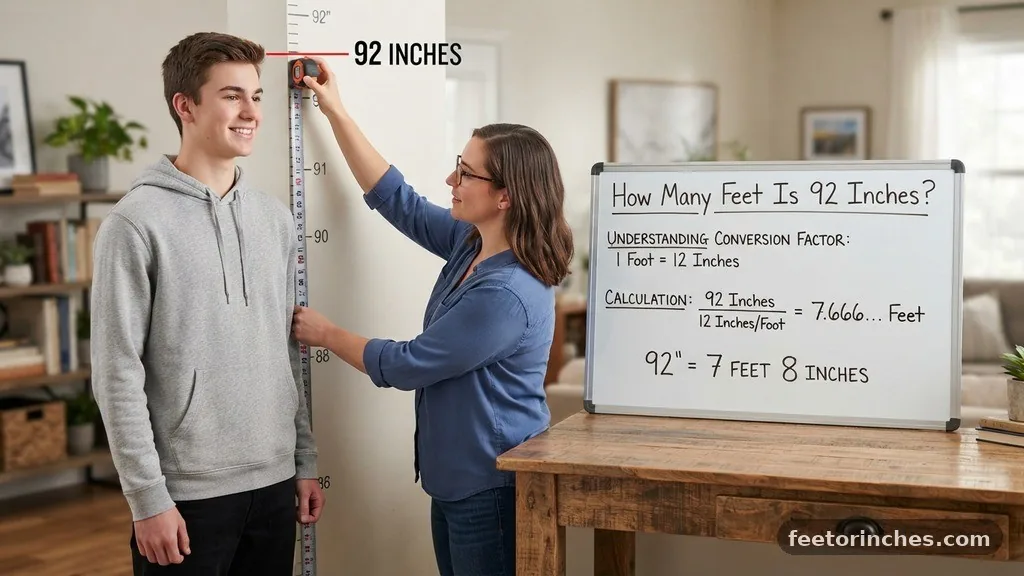
The conversion factor is always 12 when you want to move from a smaller unit to a larger one in this system. If you had 100 inches, for example, you would divide by 12 to get 8.333 feet. Recognizing this constant relationship allows you to perform mental math quickly without relying on a calculator for every minor adjustment.
Common Measurement Comparisons
To visualize how 92 inches stacks up against other standard measurements, consider the following table. This data helps you see the scale of these lengths in different units, providing a clear comparison for your planning needs.
| Measurement (Inches) | Feet and Inches | Decimal Feet | Centimeters |
|---|---|---|---|
| 72 inches | 6′ 0″ | 6.00′ | 182.88 cm |
| 84 inches | 7′ 0″ | 7.00′ | 213.36 cm |
| 92 inches | 7′ 8″ | 7.67′ | 233.68 cm |
| 96 inches | 8′ 0″ | 8.00′ | 243.84 cm |
Practical Applications of 92 Inches
In residential construction, 92 inches is a critical measurement. Many interior wall studs are pre-cut to 92 and 5/8 inches to accommodate a standard 8-foot ceiling height when you account for the bottom and double top plates. If you are framing a wall, hitting this specific length ensures your drywall sheets fit perfectly without excessive trimming.
Furniture design also relies on these specific increments. A standard sofa might be roughly 84 inches long, meaning a 92-inch space provides just enough room for a small end table or a floor lamp alongside the seating. Measuring your space accurately before purchasing items saves significant time and effort during the installation phase.
Key Considerations for Builders
- Always verify whether your measurement includes the trim or just the rough opening.
- Remember that wall thickness can vary based on the type of drywall used.
- Account for floor coverings like hardwood or tile, which raise the floor level and reduce vertical clearance.
- Use a high-quality tape measure to ensure the 92-inch mark is consistent across all points of your workspace.
Estimating Measurements Without Tools
Sometimes you find yourself without a tape measure and need to estimate 92 inches on the fly. You can use your own body as a rough guide, though it will never be as precise as a metal ruler. An average adult’s stride is often cited as being close to 3 feet, so two full strides get you to 6 feet, and a third partial stride brings you closer to the 7-foot, 8-inch mark.
Another approach is using standardized objects found in most offices or homes. A standard piece of legal-size paper is 14 inches long.
By lining up approximately 6.5 sheets of paper, you can approximate the 92-inch total. This method is helpful for rough spatial planning but should not be used for precision cutting or structural assembly.
Common Misconceptions in Measurement
A frequent error occurs when people confuse linear length with diagonal measurements. A 92-inch television, for example, is measured diagonally across the screen, not by its width or height. If you try to fit a 92-inch TV into a space that is only 92 inches wide, you will find it fits easily, but the screen itself is much smaller than the diagonal suggests.
Another common mistake is confusing diameter with circumference. If you are measuring a pipe that is 92 inches in circumference, its diameter is significantly smaller, roughly 29.3 inches. Always clarify whether you are measuring a straight line, a perimeter, or a diagonal space to avoid choosing the wrong materials for your project.
Comparing 92 Inches to Nearby Scales
Understanding how 92 inches relates to 84 or 96 inches is vital for modular projects. If you are working with standard lumber, you will notice that boards often come in 8-foot (96-inch) lengths. Knowing that 92 inches is exactly 4 inches shorter than a standard 8-foot board tells you exactly how much waste or off-cut you will have.
When you look at 12, 13, 15, and 16-inch increments, you start to see the modular nature of construction materials. Most floor joists are spaced 16 inches apart. If you need to span a 92-inch distance, you will need to plan your support structure carefully to ensure the load is distributed correctly across those joists.
Tool Accuracy and Calibration
Using an interactive calculator or a digital tool can simplify the process, but the accuracy of your result depends entirely on your initial measurement. If your tape measure is bent or the hook at the end is loose, you could be off by a fraction of an inch. A loose hook is actually designed to account for its own thickness, but it must be moved correctly to provide a true reading.
Always calibrate your tools periodically by comparing them against a known standard, such as a steel straightedge. In professional environments, tools are checked regularly to ensure that a reading of 92 inches is truly consistent across different tapes and lasers. Taking the time to verify your tools prevents the compounding errors that often lead to crooked installations or misaligned joints.
The Role of Metric Conversions
While the Imperial system remains common in the United States, global standards often rely on the metric system. Converting 92 inches to centimeters is a standard task in international manufacturing. Since one inch is exactly 2.54 centimeters, 92 inches equals 233.68 centimeters.
This conversion factor is a critical piece of data for anyone importing goods or working with international equipment. If you are ordering a part that is specified in millimeters, you would convert 92 inches to 2,336.8 millimeters. Keeping these conversion factors handy allows for a smooth transition between different regional standards, ensuring that your parts fit regardless of where they were manufactured.
FAQ
Is 92 inches equal to 8 feet?
No, 92 inches is not equal to 8 feet. Since 8 feet is 96 inches, 92 inches is exactly 4 inches shorter than 8 feet.
How can I convert 92 inches to feet quickly?
You can divide 92 by 12. This gives you 7 with a remainder of 8, meaning the measurement is 7 feet and 8 inches.
Does a 92-inch TV measure 92 inches in width?
No, TV sizes are determined by the diagonal distance from one corner to the opposite corner of the screen. The actual width of the device will be less than 92 inches.
Why do builders often use 92 and 5/8 inches?
This specific length is used for wall studs to reach a standard 8-foot ceiling height when accounting for the thickness of the floor and ceiling plates used in framing.
Conclusion
Mastering how many feet is 92 inches gives you a functional advantage when managing space or planning construction. By remembering that 92 inches converts to 7 feet and 8 inches, you can confidently navigate measurements without needing constant reference to a chart. Whether you are cutting materials for a home renovation or simply trying to visualize a room layout, this knowledge ensures your plans remain grounded in reality.
Always verify your measurements twice, especially when working with expensive materials or structural components. If you have any specific projects or further questions about these conversions, feel free to reach out and share your experiences with these measurements.
Related conversions: How Tall Is 78 Inches in Feet? (Exact Conversion Explained), How Tall Is 48 Inches in Feet? Complete Conversion Guide, How Tall Is 69 Inches in Feet? (Exact Conversion Explained), How Tall Is 71 Inches in Feet?.
Explore more on FeetOrInches.