
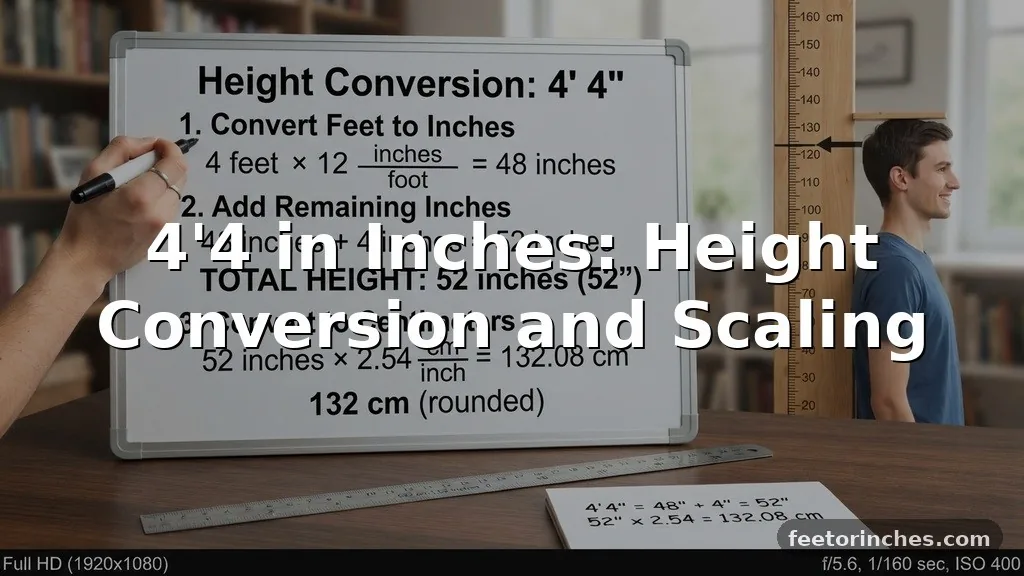
Calculating 4’4 in inches provides a straightforward conversion that is essential for everything from medical records to carpentry. Understanding how to break down feet and inches into a single unit of measurement ensures you can accurately describe height or dimensions in any setting. Whether you are checking a growth chart or measuring a space for furniture, knowing the exact math behind these conversions saves time and prevents errors.
By mastering the relationship between these units, you’ll be able to quickly process measurements without relying on a digital calculator. This article breaks down the math, offers real-world comparisons, and provides the context you need to handle height and spatial conversions with total confidence.
The Math Behind 4’4 in Inches
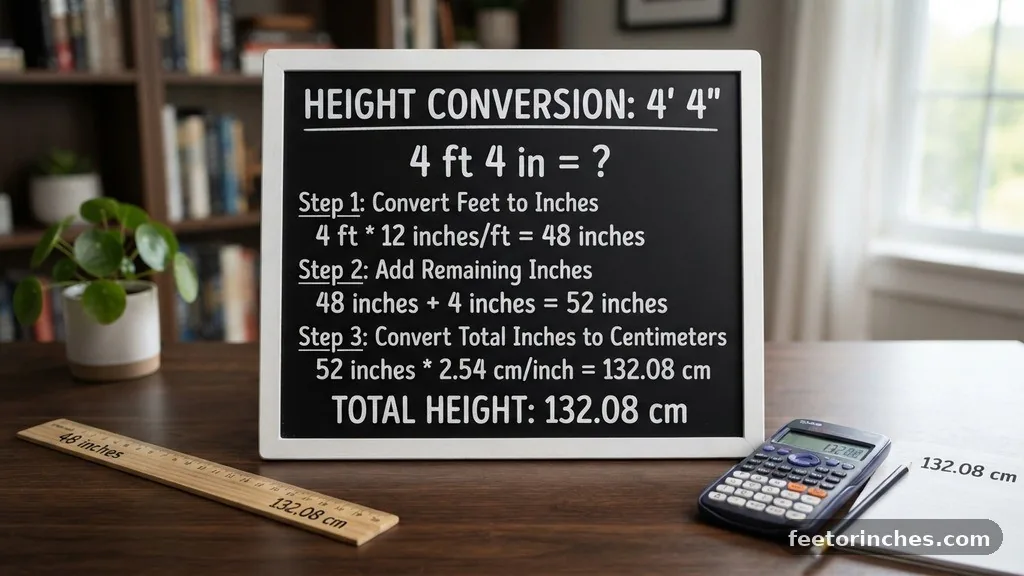
To determine the total number of inches in 4 feet and 4 inches, you start with the standard conversion factor. Since 1 foot equals 12 inches, you multiply the number of feet by 12 and then add the remaining inches. This simple arithmetic is the foundation for all height conversions.
The calculation is as follows: (4 feet × 12 inches/foot) + 4 inches = 52 total inches. This total of 52 inches represents the absolute length of the measurement. When you are looking at height, this figure is the standard metric used in the United States to track growth or physical stature.
| Unit | Equivalent in Inches |
|---|---|
| 1 Foot | 12 Inches |
| 4 Feet | 48 Inches |
| 4’4 (Total) | 52 Inches |
| 52 Inches (Metric) | 132.08 Centimeters |
| 52 Inches (Meters) | 1.32 Meters |
Standard Height Conversion Factors
When working with height, you are often moving between the imperial and metric systems. Understanding these conversions allows you to communicate across different international standards effectively. The National Institute of Standards and Technology provides the official guidelines for these unit relationships.
If you need to convert 52 inches into centimeters, you multiply by 2.54, which is the exact number of centimeters in one inch. For 4’4, the result is 132.08 centimeters. Knowing these constants allows you to perform conversions mentally or with a simple note on your phone.
Common Misconceptions in Measurement
People often confuse linear height with other types of measurements, such as screen diagonals or area. A common error is assuming that a “4 by 4” piece of wood or a 4-foot square area shares the same properties as a 4’4 height measurement. These are distinct concepts that require different mathematical approaches.
Another frequent point of confusion is the difference between a diagonal measurement and physical width. Laptop screens are measured diagonally, so a 14-inch screen is not 14 inches wide; it is 14 inches from corner to corner. Always clarify whether you are measuring a straight edge or a diagonal span to ensure your data remains accurate.
Real-World Objects at 14 Inches
Visualizing specific lengths helps you estimate sizes without needing a tape measure. When considering items that measure approximately 14 inches, it is helpful to categorize them by their primary use. The following list highlights objects that commonly fall into this size range.
- Household Items: A standard large dinner plate often has a diameter of 12 to 14 inches.
- Tech Hardware: Many laptop screens are categorized as 14-inch models, measured by their diagonal display size.
- Kitchen Tools: A standard baking sheet or rectangular pizza pan often measures 14 inches along its longest side.
- Office Supplies: A legal-size piece of paper is exactly 14 inches long, making it a perfect reference for this length.
Estimating Measurements Without Tools
You can often estimate 14 inches by using your own body or common stationery. Most people find that the distance from their elbow to their wrist is roughly 12 to 14 inches, depending on their physical build. Using your hand span is another effective way to gauge size, as an adult hand stretched wide can measure 8 to 9 inches.
If you are in an office, use a piece of legal paper as your standard. Since legal paper is 14 inches, placing it against an object gives you an immediate, precise visual reference. This method is far more reliable than guessing and works in any environment where paper is available.
Comparing 14 Inches to Nearby Scales
Understanding how 14 inches fits into a broader scale helps you visualize the increment of change. Below is a comparison of how this measurement sits relative to common sizes in furniture and construction.
- 12 Inches: This is exactly one foot, the standard unit for basic architectural measurements.
- 13 Inches: Often found in small laptop screens or specific shoe sizes.
- 14 Inches: A common length for legal documents and small-to-medium appliances.
- 15 Inches: A standard width for many computer monitors and some shelving units.
- 16 Inches: This is the standard spacing for wall studs in residential home construction.
Why Precision Matters in Height
In medical or athletic contexts, being off by even an inch can change how you view data. A difference between 4’4 and 4’5 might seem small, but in growth monitoring, it represents a specific percentile in a child’s development. Always use a wall-mounted stadiometer for the most accurate height readings.
When you record data, ensure you are using the correct notation. Writing 4’4″ is the standard way to denote feet and inches. If you are communicating with someone who uses the metric system, providing the measurement in centimeters is a professional courtesy that prevents misinterpretation.
FAQ
How tall is 4’4 in cm?
4’4 is equal to 132.08 centimeters. You arrive at this by multiplying the total of 52 inches by the conversion factor of 2.54.
What is the difference between 4’4 and 4.4 feet?
4’4 refers to 4 feet and 4 inches, which is 52 inches total. 4.4 feet is a decimal measurement of feet, which equals 52.8 inches (4 feet plus 0.4 of 12 inches).
Is 4’4 a common height for an adult?
4’4 is significantly shorter than the average height for an adult. It is a measurement often associated with pediatric growth charts or individuals with specific medical conditions regarding skeletal growth.
How do I convert inches back to feet?
To convert inches to feet, divide the total number of inches by 12. For example, 52 divided by 12 is 4 with a remainder of 4, or 4’4.
Final Considerations
Mastering the conversion of 4’4 in inches provides a reliable foundation for understanding physical scale and growth metrics. By knowing that 4 feet and 4 inches equals 52 inches, you can easily translate these figures into metric units or compare them against other objects.
Whether you are working with construction materials or tracking health data, accuracy remains the priority. Keep these conversion factors in mind to ensure your measurements are always precise and easy to verify.
Practice these conversions by identifying objects around your home or office that match these dimensions. As you become more familiar with these units, you will find that estimating size becomes a natural part of your daily routine. If you have any specific questions about height conversion or other measurements, feel free to share your thoughts or reach out for further clarification on these standards.
Explore more on FeetOrInches.