

When you need to know exactly how many inches is 42 cm, the answer is 16.5354 inches. This conversion is a standard calculation used by engineers, designers, and anyone working across the metric and imperial systems. Because the metric system is the global standard for science, while the United States remains firmly rooted in the customary system, understanding this relationship is vital for accuracy in everything from woodworking to garment sizing.
Knowing this specific figure helps you avoid costly errors in projects where precision is non-negotiable. Whether you are ordering furniture, checking the dimensions of a screen, or measuring a piece of fabric, having the exact decimal point ensures your work aligns with your requirements. We will break down how this measurement fits into broader contexts and how you can manage these conversions effectively.
The Mathematical Foundation of the Conversion
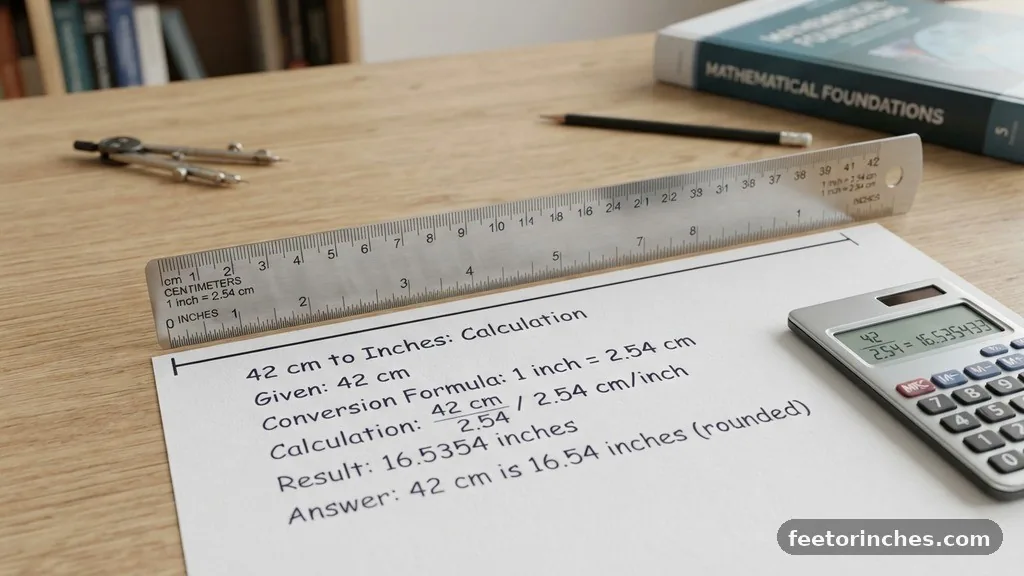
To understand the relationship between these units, you must start with the fixed ratio defined by international agreement. One inch is defined as exactly 2.54 centimeters. This constant is the bedrock of all engineering and manufacturing standards that bridge the divide between the metric and imperial worlds.
When you perform a system convert operation, you are essentially dividing your centimeter value by 2.54. In the case of 42 centimeters, the math is 42 divided by 2.54, which yields approximately 16.535433. For most practical applications, rounding to two decimal places—16.54 inches—is more than sufficient for everyday tasks.
If you are working with high-precision instruments, such as CNC machines or architectural drafting tools, you might need to maintain more decimal places. However, for standard household tools like tape measures or rulers, the difference between 16.535 and 16.54 is negligible. Always define your required tolerance before starting your project to ensure you aren’t over-calculating for a job that doesn’t demand sub-millimeter accuracy.
Standard Conversion Data Table
This table provides a quick reference for common lengths near your target measurement. Using a structured table allows you to visualize how these units scale relative to one another, which is helpful if you are measuring objects that fall slightly above or below your initial target.
| Centimeters (cm) | Inches (in) | Contextual Example |
|---|---|---|
| 40 cm | 15.75 in | Small laptop width |
| 41 cm | 16.14 in | Standard shelf depth |
| 42 cm | 16.54 in | Target measurement |
| 43 cm | 16.93 in | Mid-sized kitchen tray |
| 44 cm | 17.32 in | Large carry-on luggage |
Practical Estimation Without Tools
Sometimes you are away from your workshop and need to gauge a length without an official measurement standard like a ruler. You can estimate 16.5 inches using objects you likely have in your office or home. A standard piece of legal-size paper is 14 inches long; if you add about 2.5 inches—roughly the width of your thumb—you arrive very close to the target.
Another reliable method involves using the span of your hand. For many adults, the distance from the tip of the thumb to the tip of the pinky finger when fully stretched is between 8 and 9 inches. By placing two hand spans end-to-end, you can approximate the 16.5-inch mark with surprising accuracy.
Visualizing 42 Centimeters
- It is roughly the width of a standard 17-inch laptop monitor housing.
- It matches the height of a typical medium-sized office wastebasket.
- It is slightly longer than the length of a standard keyboard without a number pad.
Understanding Measurement Differences
Confusion often arises when people mistake diagonal measurements for physical width. In consumer electronics, a screen size is measured by its diagonal, whereas the physical chassis width is a separate dimension entirely. If you see a monitor listed as 42 cm, verify if the manufacturer is referring to the screen’s diagonal or the total frame width, as these numbers will never be the same.
Another common point of friction is the difference between diameter and circumference. If you are measuring a circular object, 42 cm across is the diameter, but the distance around the edge—the circumference—will be significantly larger. Always clarify which dimension you are measuring before you begin your calculations or material cuts.
Comparing 14 to 16 Inches
It is helpful to see how 16.5 inches sits in the context of nearby standard measurements. Many objects are manufactured to specific imperial increments, and understanding these “steps” helps you identify if your 42 cm item is standard or custom.
Scale Comparison
- 12 inches: The standard foot, often used for floor tiles and basic rulers.
- 13 inches: A common size for ultralight laptop screens.
- 15 inches: A frequent measurement for standard laptop chassis and kitchen platters.
- 16.5 inches: The conversion of 42 cm, often found in specialized furniture components.
When you compare these, you see that 16.5 inches is slightly larger than the common 15-inch standard. This often puts items of this size in the “large” category for portable devices or the “medium” category for home furniture. Knowing this helps you predict whether an item will fit into a standard bag or a specific storage space.
Common Misconceptions in Unit Conversion
A frequent error is assuming that the metric and imperial systems are interchangeable without conversion. This is not the case, as the systems are based on different foundations—the metric system is decimal-based, whereas the customary system relies on fractions. When you convert, you are translating between two different ways of perceiving physical space.
Another issue is the “inch part” versus the “centimeter part.” In the customary system, you often see measurements broken down into 1/8th or 1/16th of an inch.
In the metric system, you rarely use fractions, preferring decimal points. If you are working on a project that uses both, pick one system and stick to it throughout the entire process to prevent “drift” in your measurements.
Why Accuracy Matters in Manufacturing
In professional manufacturing, a discrepancy of even a few millimeters can lead to a failed assembly. If a component is designed at 42 cm, the machine tools are set to 420 millimeters. If the worker attempts to convert this to inches and rounds off too early, the resulting part will be too small or too large to fit the housing.
Always work with the highest precision your tools allow. If you are using an interactive tool to perform your calculations, ensure it provides at least four decimal places. This level of precision is the industry standard for ensuring that components produced in different countries can still be assembled into a single, functional product.
Frequently Asked Questions
Is 42 cm exactly 16.5 inches?
Not exactly. 42 cm is 16.5354 inches. While 16.5 is a close approximation, the extra 0.0354 inches can be critical in high-precision work.
How do I convert inches to centimeters?
To go the other direction, multiply your inch value by 2.54. For instance, 10 inches multiplied by 2.54 equals 25.4 centimeters.
Does the 42 cm measurement include the bezel on a screen?
Usually, no. Screen size measurements almost always refer to the viewable diagonal area of the display panel itself, not the plastic or metal bezel surrounding it.
Why do some rulers show both inches and centimeters?
Most modern rulers are dual-scale to provide utility for international users. This allows you to measure an object in one system and immediately verify the length in the other, simplifying the process of working with diverse technical plans.
Conclusion
Mastering the conversion of 42 cm into 16.5354 inches gives you the confidence to navigate projects that require both metric and imperial measurements. By understanding the underlying math and the practical ways to estimate these lengths, you eliminate the guesswork that often leads to errors in construction or design. Remember that precision remains the primary goal; whenever you are dealing with critical dimensions, keep your calculations as accurate as possible to ensure your results meet your expectations.
If you find yourself frequently working with these conversions, consider keeping a reference chart or using an online calculator to maintain efficiency. Whether you are measuring a screen or a custom furniture piece, knowing how many inches is 42 cm provides the clarity you need to succeed. Feel free to reach out if you have further questions on unit conversions or need help with other measurement challenges.
Related conversions: How Many Inches in a Foot? (Complete Guide with Real Examples & Visuals), How Many Inches in a Yard? Complete Conversion Guide With Examples, What Is 6 mm in Inches? Complete Conversion Guide, How Many Cubic Inches in a Cubic Yard? Complete Conversion Guide.
Explore more on FeetOrInches.