
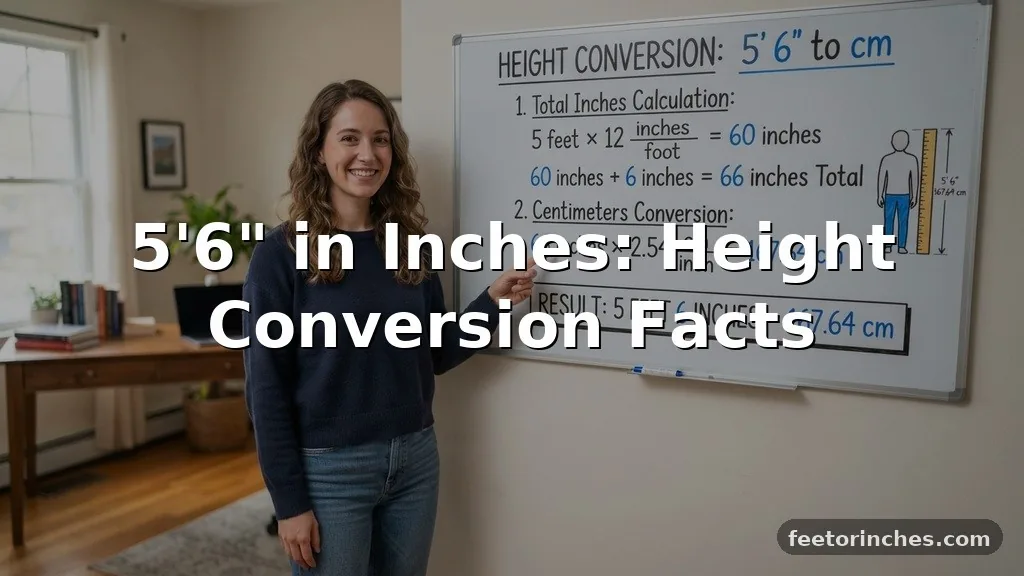
Calculating 5’6″ in inches is a straightforward mathematical task that frequently arises when filling out medical forms, updating fitness profiles, or purchasing custom apparel. Because the imperial measurement system relies on a base-12 unit structure, many people find it helpful to see the breakdown clearly. You are essentially adding two distinct values—five feet and six inches—to reach a final total in inches.
Knowing exactly how to convert these figures ensures accuracy during physical assessments or when using a digital height calculator. This guide provides the precise math behind the measurement, helpful reference tables, and practical ways to visualize this specific height in everyday life.
The Math Behind the Conversion
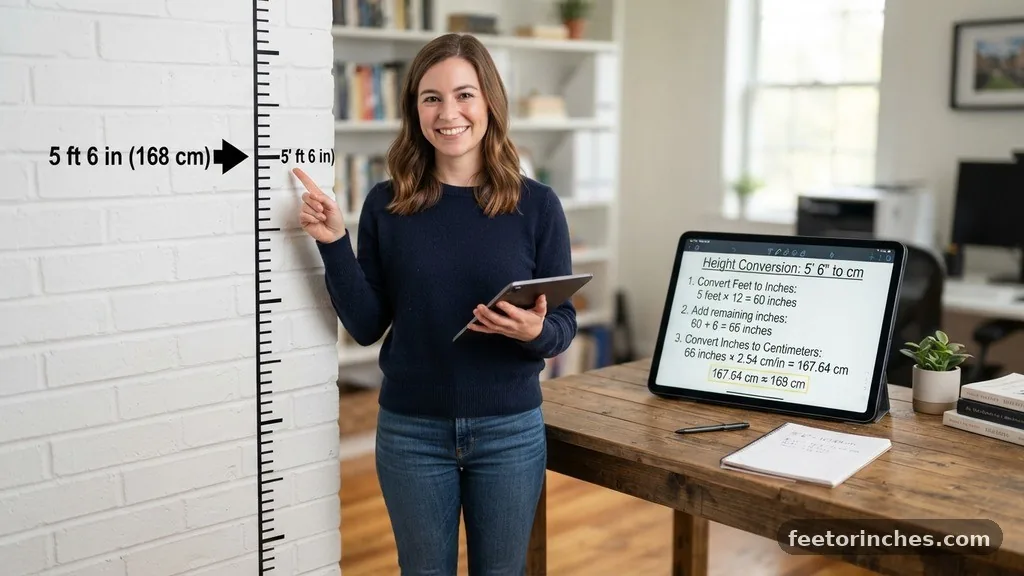
To determine the total number of inches in 5’6″, you must first convert the feet component into its equivalent in inches. Since each foot contains exactly 12 inches, you multiply the number of feet by 12. For this specific measurement, 5 multiplied by 12 equals 60 inches.
Once you have that base number, you simply add the remaining inches to the total. By taking the 60 inches derived from the feet and adding the additional 6 inches, you reach a final result of 66 inches. This simple two-step process is the standard method for any height conversion involving feet and inches.
Height Conversion Reference Table
Having a quick reference chart is useful when you need to compare different heights or perform multiple conversions rapidly. The following table illustrates how 5’6″ sits in relation to surrounding measurements, including conversions for centimeters to provide a more global perspective.
| Height (Feet & Inches) | Total Inches | Centimeters (Approx.) |
|---|---|---|
| 5’4″ | 64 | 162.5 |
| 5’5″ | 65 | 165.1 |
| 5’6″ | 66 | 167.6 |
| 5’7″ | 67 | 170.2 |
| 5’8″ | 68 | 172.7 |
Why Precision Matters in Measurement
Using a standardized measurement system is vital for health tracking and athletic performance metrics. When you input your height into a National Institute of Standards and Technology resource or medical database, small errors in calculation can lead to inaccurate Body Mass Index (BMI) readings. A difference of just one or two inches can shift your calculated category.
Consistency is equally important when you are dealing with equipment settings. Whether you are adjusting a bicycle seat or setting up a home gym, knowing your exact height in inches ensures you follow manufacturer guidelines correctly. Relying on an accurate conversion keeps your data reliable across all personal health platforms.
Visualizing 14 Inches in Daily Life
While 5’6″ is a human height, understanding smaller segments like 14 inches helps in gauging spatial dimensions in your home or office. If you need to estimate length without a tape measure, comparing objects to common standards is a reliable technique. The following items typically measure close to 14 inches in one of their primary dimensions.
- Standard laptop bag width (often designed for 14-inch screen devices).
- The length of a legal-size piece of paper, which is 14 inches long.
- A standard kitchen baking sheet pan along its shorter side.
- The height of many medium-sized desktop computer towers.
- A large pizza box diameter, which frequently measures 14 inches.
Common Misconceptions in Height
One major point of confusion involves the difference between screen diagonal measurements and physical width. When a monitor is listed as 14 inches, that is the diagonal distance from corner to corner, not the horizontal width. Always check product specifications if you are trying to fit an object into a specific space.
Another frequent error involves confusing diameter with circumference. If you are measuring a circular object, remember that the diameter is the straight line across the center, whereas the circumference is the distance around the outside. If you have a diameter of 14 inches, the circumference is significantly larger, approximately 44 inches.
Estimating Height Without Tools
You can estimate 14 inches or other measurements using your own body as a temporary ruler. Most adults have a hand span—the distance from the tip of the thumb to the tip of the pinky when fully extended—of about 8 to 9 inches. Using this as a rough guide allows you to make quick estimations when you don’t have a converter handy.
Another reliable method involves using standard office supplies. A piece of standard letter-sized paper is 11 inches long, while legal-sized paper is 14 inches. If you need a quick reference for 14 inches, keeping a single sheet of legal paper nearby acts as a perfect physical template for that specific length.
Comparing 5’6″ to Nearby Heights
Understanding where 5’6″ stands in relation to other heights provides a better sense of scale. The difference between 5’6″ and 5’4″ is only two inches, yet that gap can feel significant in terms of clothing fit or ergonomics. Every inch represents a distinct shift in how you interact with your physical environment.
When you move from 5’6″ to 5’8″, you are adding four total inches. This comparison helps clarify why precise measurement is so helpful in tailoring or custom design. Even small increments change the way you occupy space, making it essential to know your exact height in inches rather than relying on estimates.
FAQ: Common Questions About Height
Is 68 inches considered 5’6″ or 5’8″?
68 inches is equal to 5’8″. Since 5 feet equals 60 inches, you are left with 8 additional inches, making the total 5’8″.
How do I convert centimeters to inches?
To convert centimeters to inches, divide your centimeter value by 2.54. This constant is the globally accepted standard for these conversions.
Why does my height change throughout the day?
Your height can fluctuate by as much as half an inch due to spinal compression. You are typically tallest in the morning after lying flat for several hours.
Does 5’6″ convert to 167 centimeters?
Yes, 5’6″ is exactly 66 inches, and when you multiply that by 2.54, you get 167.64 centimeters. Most charts round this to 167 or 168 centimeters.
Final Thoughts on Height Conversions
Mastering the conversion of 5’6″ in inches allows you to navigate everything from health records to furniture assembly with confidence. By understanding that 5 feet equals 60 inches, the math becomes intuitive and easy to replicate whenever you need to check your height or measure a space. Whether you are using a digital converter or a simple mental calculation, accuracy remains the priority for any professional or personal application.
Keep these base figures in mind to streamline your daily tasks and ensure your data remains precise. If you find yourself frequently needing to switch between imperial and metric systems, bookmarking a standard conversion chart will save you time in the long run. Feel free to reach out if you have further questions about specific unit measurements or if you need help with other common height conversions.
Explore more on FeetOrInches.