
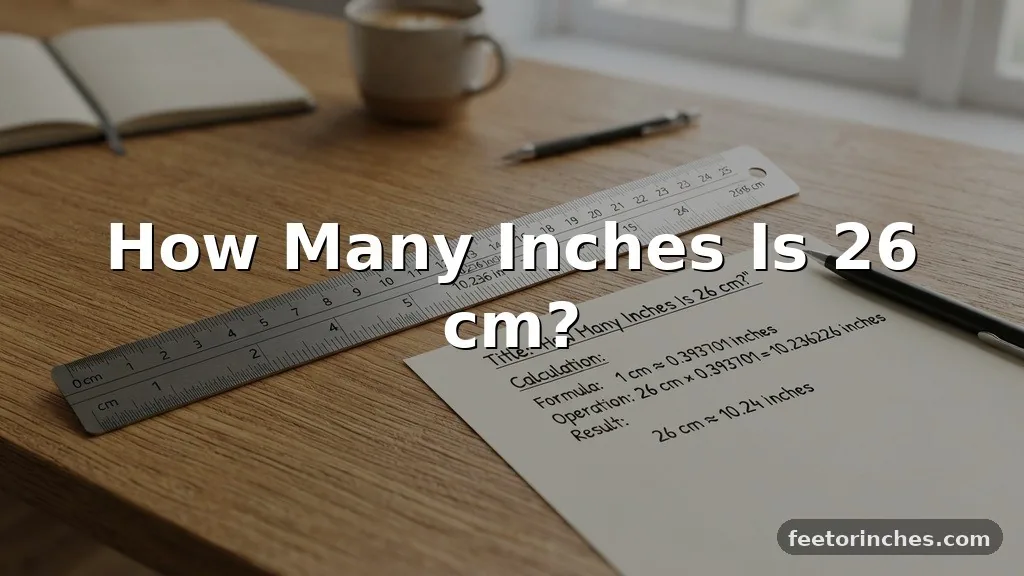
When you need to know how many inches is 26 cm, the quick answer is approximately 10.24 inches. This conversion is a standard task when moving between the metric system and the United States customary system. Whether you are measuring a piece of fabric, checking the length of a small object, or sizing up a household item, this figure provides the necessary precision for most day-to-day activities.
Understanding the relationship between these two units is straightforward once you know the core ratio. Because one inch is defined as exactly 2.54 centimeters, you can arrive at any conversion by dividing the centimeter value by this constant. This guide will help you visualize this measurement and apply it across various practical scenarios.
The Mathematical Conversion
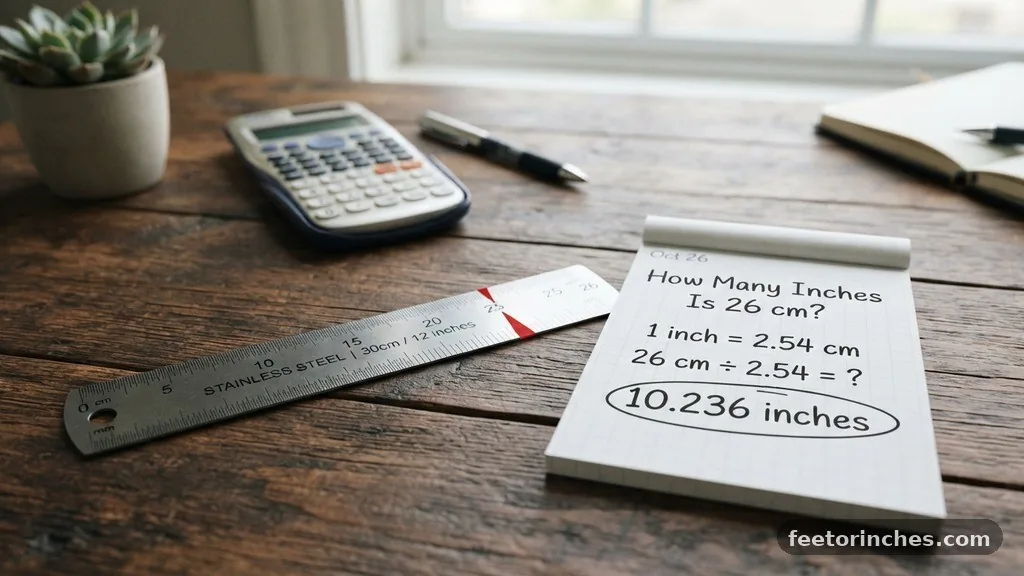
To convert centimeters to inches, you must divide the length in centimeters by 2.54. This constant is the foundation of the international yard and pound agreement established in 1959. By applying this simple division, you can accurately determine the equivalent length in the customary system.
For 26 centimeters, the math is 26 divided by 2.54, which equals approximately 10.2362 inches. In practical settings, rounding this to 10.24 inches is sufficient for almost all construction, tailoring, or general measuring tasks. If you require higher precision, such as in engineering or scientific contexts, you might extend the decimal further.
Why 2.54 Matters
The number 2.54 is not arbitrary. It represents the fixed ratio that allows the metric system to align with the inch-based system used in the United States. Without this standardized bridge, international trade and engineering would face significant hurdles in manufacturing and design.
When you look at a ruler that displays both centimeters and inches, you are seeing this ratio in action. The marks for 2.54 centimeters on the metric side will always line up perfectly with the one-inch mark on the imperial side. This consistent alignment ensures that tools remain reliable regardless of the system they are designed for.
Conversion Reference Table
Having a quick reference guide helps when you are working with measurements near the 26-centimeter mark. The following table provides the conversion for several values surrounding this length, allowing you to see how the scale shifts as you move up or down.
| Centimeters (cm) | Inches (in) | Measurement Context |
|---|---|---|
| 24 cm | 9.45 in | Small tablet width |
| 25 cm | 9.84 in | Standard paper height (approx) |
| 26 cm | 10.24 in | Length of a standard chef’s knife |
| 27 cm | 10.63 in | Laptop sleeve dimension |
| 28 cm | 11.02 in | Large dinner plate diameter |
Visualizing 10.24 Inches
It is helpful to compare 26 centimeters to everyday items to get a better sense of scale. When you do not have a measuring tape handy, you can often estimate the length by looking for common objects that share this dimension. This approach is useful for quick assessments at home or in the shop.
- Standard US Legal Paper: The width is 8.5 inches, but the length is 14 inches, meaning 26 cm is about three-quarters of the way down the page.
- Footwear: A size 9 men’s shoe is often around 26 to 27 centimeters in length, providing a very reliable reference point for most people.
- Kitchen Tools: Many standard chef’s knives have a blade length that sits right in the 25 to 26-centimeter range.
- Electronic Peripherals: A standard keyboard without a number pad is often close to this width, making it a familiar sight on most desks.
Estimating Without a Tool
When you lack a ruler, you can use your body or nearby common items to estimate 10.24 inches. A common trick is to use the length of your hand or the span between your thumb and pinky finger. For most adults, the distance from the wrist to the tip of the middle finger is roughly 18 to 20 centimeters, which means you can add a thumb’s width to get closer to 26 centimeters.
Another method involves using a standard sheet of printer paper. A US letter-size sheet is 11 inches long.
Since 10.24 inches is just slightly shorter than the length of this paper, you can simply subtract about three-quarters of an inch from the total length to visualize the target distance. This mental shortcut is surprisingly accurate for rough estimates.
Metric and Customary Systems
The centimeters inch relationship is a classic example of how two different systems of measurement coexist. The metric system is a base-10 system, making it highly logical for scientific work, whereas the customary system is deeply embedded in American history and building trades. Understanding the difference between these systems is essential for anyone working on international projects.
Whereas the centimeter is a part of the metric system, the inch is a part of the customary system. People often use an easy-to-use interactive tool to handle these conversions, especially when purchasing goods from countries that use different standards. To learn more about the formal definitions of these units, visit the National Institute of Standards and Technology for official documentation.
Common Misconceptions
Confusion often arises when people mix up diameter and circumference. If you are measuring a circular object, 26 centimeters refers to the distance across the center, not the distance around the outer edge. Always identify if you need to measure the diameter or the perimeter before performing your conversion.
Another frequent error involves screen sizes for electronics. When a screen is advertised as 14 inches, that measurement refers to the diagonal distance from corner to corner.
It does not represent the physical width or height of the device. Confusing diagonal measurements with linear dimensions is a common mistake that can lead to buying the wrong size of equipment or furniture.
Scale Comparison
Understanding how 26 centimeters fits into the broader spectrum of lengths is helpful for visualization. Moving from 12 inches up to 16 inches, you can see how incremental changes impact the size of the objects involved.
Comparing 12, 13, 14, 15, and 16 Inches
Twelve inches is exactly one foot, or roughly 30.48 centimeters. Thirteen inches sits at 33 centimeters, while 14 inches is approximately 35.5 centimeters.
By the time you reach 16 inches, you are looking at over 40 centimeters. Recognizing these intervals helps you quickly identify whether a measurement is smaller or larger than your target of 10.24 inches.
FAQ
Is 26 cm the same as 10 inches?
No, 26 centimeters is slightly more than 10 inches. It is exactly 10.24 inches, so it is just a quarter of an inch longer than the 10-inch mark.
How do I convert centimeters to inches quickly?
The fastest way to convert is to divide the number of centimeters by 2.54. If you need a rough estimate, you can divide by 2.5, which will give you a close approximation.
Why is the conversion factor 2.54?
This factor was established by international agreement to create a precise, standardized link between the metric system and the imperial system. It ensures that measurements are consistent across all global manufacturing industries.
Does 26 cm refer to the length or width?
It can refer to either. A centimeter is a unit of length, so it can describe any linear dimension, whether it is the width of a box, the length of a shoe, or the depth of a shelf.
Conclusion
Knowing how many inches is 26 cm provides a reliable reference for everyday measurements. By remembering the 2.54 conversion factor, you can easily translate metric values into the customary system whenever necessary. Whether you are using a standard sheet of paper to estimate or relying on precise mathematical division, you now have the tools to handle this conversion with confidence.
Applying these measurements correctly ensures that your projects, purchases, and designs fit exactly as intended. If you frequently work with both systems, keep a small reference card or a digital tool handy to save time.
Mastering these basic conversions makes it much easier to interact with the global marketplace and handle technical specifications in your daily life. Feel free to reach out if you have more questions about unit conversions or need help with other measurement tasks.
Related conversions: What Is 15/32 in Inches · How Many Inches in a Meter · How to Read a Ruler in Inches
Explore more on FeetOrInches.