Quick Answer
Quick Answer:
1 meter equals 39.3701 inches exactly. To convert meters to inches, multiply the number of meters by 39.3701.Formula:
Meters × 39.3701 = Inches
If you’ve ever wondered how many inches in a meter really looks like in everyday life, you’re not alone. Most people struggle to picture metric-to-imperial conversions without a ruler or measuring tape nearby. A meter is commonly used worldwide, but inches are still widely used in construction, design, clothing, and daily measurements in countries like the United States.
In this guide, you’ll learn exactly what how many inches in a meter means through real-world comparisons, practical examples, conversion charts, and easy visualization tricks. By the end, you’ll be able to instantly “see” a meter in inches without needing a calculator.
See Also:How Many Inches in a Yard? Complete Conversion Guide With Examples
Conversion Table: Meters to Inches
| Meters | Inches (approx.) | Real-Life Comparison |
|---|---|---|
| 0.5 m | 19.69 in | Half a small table height |
| 1 m | 39.37 in | About waist height of an adult |
| 1.5 m | 59.06 in | Tall child / short adult |
| 2 m | 78.74 in | Average door height range |
| 3 m | 118.11 in | Small room width |
| 5 m | 196.85 in | Long hallway section |
What Does a Meter Mean in Inches?
A meter is a standard unit of length in the metric system used globally in science, engineering, and everyday measurement. When converted into inches (part of the imperial system), it becomes easier to understand for people familiar with rulers, tape measures, or feet-based measurements.
One meter equals 100 centimeters, and since each inch equals 2.54 centimeters, we derive the conversion:
1 meter = 100 ÷ 2.54 = 39.3701 inches
This exact conversion is widely used in construction, manufacturing, tailoring, and international trade.
Why This Conversion Matters
Understanding how many inches in a meter is important because different countries use different measurement systems:
- The metric system (meters) is used in most countries worldwide.
- The imperial system (inches, feet) is used mainly in the United States.
This creates the need for quick and accurate conversion, especially in:
- Home improvement projects
- Furniture shopping
- Clothing size conversions
- Engineering and design work
- Sports field measurements
Knowing this conversion helps you avoid mistakes when dealing with international specifications.
How to Convert Meters to Inches
The conversion is simple:
Step-by-step method:
- Take the number of meters
- Multiply by 39.3701
- The result is in inches
Example:
- 2 meters × 39.3701 = 78.7402 inches
- 0.75 meters × 39.3701 = 29.5276 inches
This formula works for any measurement, large or small.
See Also:How Tall Is 78 Inches in Feet? (Exact Conversion Explained)
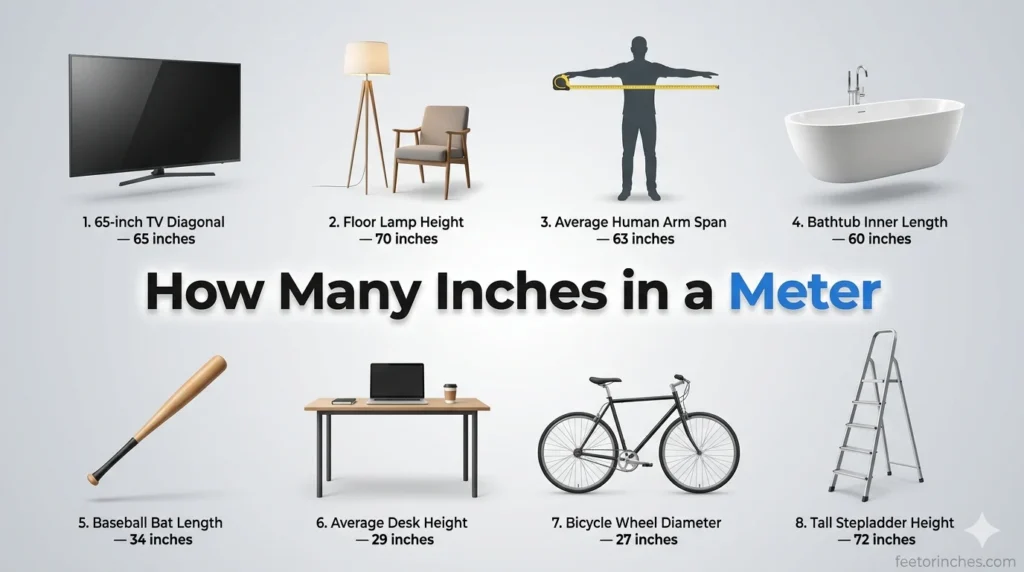
Real-Life Examples of 1 Meter in Inches
Example 1: Kitchen Counter Height
- Measurement: ~1 meter
- In inches: 39.37 inches
- Visualization: Slightly below waist level on most adults
- Insight: Standard countertop heights are close to this range
Example 2: Guitar Length
- Measurement: ~1 meter
- In inches: 39.37 inches
- Visualization: A full-sized acoustic guitar is close to this length
- Insight: Easy to carry under one arm
Example 3: Walking Stick or Cane
- Measurement: 1 meter
- In inches: 39.37 inches
- Visualization: About the height of a walking cane
- Insight: Designed for balance and support
Example 4: Office Desk Width
- Measurement: 1 meter
- In inches: 39.37 inches
- Visualization: Small compact workstation
- Insight: Fits laptops and basic work setup
Example 5: Small Dining Table Width
- Measurement: 1 meter
- In inches: 39.37 inches
- Visualization: Seats 2 people comfortably
- Insight: Common in small apartments
Example 6: Baseball Bat Length (Adult Short Bat)
- Measurement: ~1 meter
- In inches: 39.37 inches
- Visualization: Long sports bat
- Insight: Easy to swing for practice use
Example 7: Tall Floor Lamp
- Measurement: ~1 meter
- In inches: 39.37 inches
- Visualization: Reaches chest to shoulder height
- Insight: Common in living rooms
Example 8: Refrigerator Width (Compact Models)
- Measurement: ~1 meter
- In inches: 39.37 inches
- Visualization: Slim kitchen appliance
- Insight: Ideal for small households
Example 9: Child’s Height (Average 4–5 years old)
- Measurement: ~1 meter
- In inches: 39.37 inches
- Visualization: Waist-high adult comparison
- Insight: Helps parents estimate growth
Example 10: TV Screen Width (50-inch class TV)
- Measurement: ~1 meter wide
- In inches: 39.37 inches
- Visualization: Large wall-mounted screen
- Insight: Popular living room size
Comparison With Other Measurements
Smaller than 1 meter:
- 30 cm ruler ≈ 11.8 inches
- Smartphone height ≈ 6 inches
- A sheet of paper ≈ 11 inches
Equal to 1 meter:
- Waist height of an adult
- Medium-sized table height
- Large guitar length
Larger than 1 meter:
- Door height ≈ 80 inches (2 meters)
- Room height ≈ 96 inches (2.4 meters)
- Car length ≈ 150–180 inches
Human comparison:
- Knee height ≈ 1 meter
- Shoulder width span is less than 1 meter
- Arm span is slightly more than 1 meter
How 1 Meter Feels in Real Life
A meter is a very “human-scaled” measurement. If you stretch your arms slightly outward, you’re close to covering about a meter. It’s also roughly the height from the floor to your waist.
When you walk 1 meter, it feels like a single short step. When you place objects side by side, a meter is about the length of a small desk or a medium guitar.
This makes it one of the easiest metric units to visualize once you get familiar with it.
Practical Uses of Meter-to-Inch Conversion
You’ll commonly need to know how many inches in a meter in:
- Construction: Measuring walls, beams, and materials
- Interior design: Furniture layout and spacing
- Shopping online: Converting product dimensions
- DIY projects: Cutting wood, fabric, or metal
- Sports: Field dimensions and equipment sizing
- Education: Science and math problem-solving
Frequently Asked Questions
1. How many inches are exactly in 1 meter?
1 meter equals exactly 39.3701 inches. This is the standard international conversion used in science, engineering, and everyday calculations.
2. Is 1 meter bigger than 36 inches?
Yes, 1 meter is slightly bigger. 36 inches equals 0.9144 meters, while 1 meter equals 39.37 inches.
3. How do you quickly convert meters to inches?
Multiply the number of meters by 39.3701. This gives you the measurement in inches instantly.
4. What is half a meter in inches?
Half a meter equals 19.685 inches. It’s roughly the length of a large laptop or small cushion.
5. Is 2 meters equal to 72 inches?
No, 2 meters equals 78.74 inches, which is taller than 6 feet 6 inches.
6. Why is a meter equal to 39.37 inches?
Because 1 inch equals 2.54 cm, and 1 meter equals 100 cm. Dividing gives 39.3701 inches.
7. How many inches is a 10-meter room?
10 meters equals 393.701 inches, which is about 32.8 feet.
8. What is easier to use, meters or inches?
Meters are easier for scientific calculations, while inches are more practical for everyday measurements in the U.S.
9. How many inches is 1.5 meters?
1.5 meters equals 59.055 inches, commonly used for height comparisons.
10. Can I estimate meters in inches without a calculator?
Yes. Multiply meters by 40 for a quick estimate, then subtract about 2–3% for accuracy.
Conclusion
Understanding how many inches in a meter helps you move easily between metric and imperial systems. With 1 meter equal to 39.37 inches, you can quickly estimate sizes for furniture, height, rooms, and everyday objects. Once you visualize a meter as roughly waist height or a medium-sized desk, conversions become much easier and more intuitive in real life.
Related conversions: How Many Inches Are in a Meter? (Exact Conversion Explained), How Many Inches in a Foot? (Complete Guide with Real Examples & Visuals), How Many Cubic Inches in a Cubic Yard? Complete Conversion Guide.