
Quick Answer
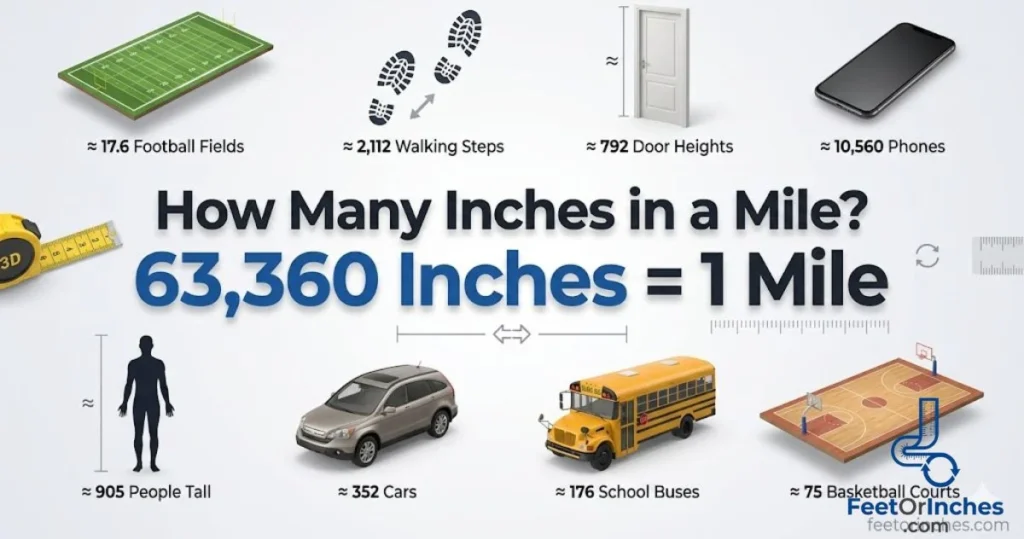
1 mile = 63,360 inches exactly
Formula:
Miles × 63,360 = Inches
Since 1 mile = 5,280 feet and 1 foot = 12 inches, multiply:
5,280 × 12 = 63,360 inches
If you’ve ever wondered how many inches in a mile really looks like in everyday life, you’re not alone. Large distance conversions are hard to picture without breaking them down into smaller, familiar units like feet or inches. Most people can easily imagine a ruler or a measuring tape, but a mile in inches feels almost impossible to visualize.
In this guide, you’ll learn exactly what this conversion means through simple breakdowns, real-world comparisons, visual examples, and practical uses. Whether you’re studying math, working in construction, or just curious, understanding how inches scale up to a mile will make large-distance measurements much easier to grasp in everyday situations.
Conversion Table: Miles to Inches
| Miles | Inches |
|---|---|
| 0.1 mile | 6,336 inches |
| 0.25 mile | 15,840 inches |
| 0.5 mile | 31,680 inches |
| 1 mile | 63,360 inches |
| 2 miles | 126,720 inches |
| 5 miles | 316,800 inches |
| 10 miles | 633,600 inches |
This table helps you quickly estimate distances when working with large-scale measurements.
What Does “Inches in a Mile” Mean?
To understand the conversion, you need to break it into smaller steps:
- 1 mile = 5,280 feet
- 1 foot = 12 inches
So, converting miles to inches means multiplying both values together:
1 mile = 5,280 × 12 = 63,360 inches
This conversion is exact in the imperial system, which is still widely used in the United States for road distances, construction, and mapping.
Why This Conversion Matters
Knowing how many inches are in a mile is useful in several real-world situations:
- Engineering and construction projects
- Map scaling and geographic modeling
- Scientific calculations involving distance scaling
- Sports track measurements
- Teaching and learning unit conversions
- DIY home or land measurement projects
Even though miles are used for long distances, inches help when precision and scaling are needed.
Real-Life Examples (8–15 Practical Comparisons)
Example 1: Standard Ruler Line-Up
Measurement: 1 mile = 63,360 inches
Visualization: Imagine lining up 63,360 standard 1-inch marks in a straight line.
Insight: This shows how small an inch is compared to a mile.
Example 2: Football Field Length
Measurement: 1 football field ≈ 3,600 inches (100 yards)
Visualization: A mile equals about 17.6 football fields placed end-to-end.
Insight: Sports fields help make large distances easier to imagine.
Example 3: Average Walking Step
Measurement: 1 step ≈ 30 inches
Visualization: A mile equals about 2,112 steps.
Insight: You’d take thousands of steps to cover just one mile.
Example 4: Standard Door Height
Measurement: 80 inches (typical door height)
Visualization: A mile equals about 792 stacked doors.
Insight: Vertical stacking shows scale differences clearly.
Example 5: Smartphone Length
Measurement: 6 inches average phone
Visualization: A mile equals 10,560 smartphones lined up.
Insight: Everyday tech helps visualize extreme length.
Example 6: Human Height Comparison
Measurement: 70 inches (average adult height)
Visualization: A mile equals about 905 people standing head-to-toe.
Insight: Human scale makes abstract math relatable.
Example 7: Car Length
Measurement: 180 inches (average car)
Visualization: A mile equals about 352 cars in a row.
Insight: Great for understanding highway spacing.
Example 8: School Bus Length
Measurement: 360 inches (30 feet)
Visualization: A mile equals about 176 school buses.
Insight: Transportation examples are easy to picture.
Example 9: Basketball Court
Measurement: 840 inches long
Visualization: A mile equals about 75 basketball courts end-to-end.
Insight: Sports courts are useful measurement tools.
Example 10: City Block
Measurement: ~12,000 inches (average city block)
Visualization: A mile equals about 5.3 city blocks.
Insight: Useful for urban navigation.
Example 11: Paper Sheets Stack
Measurement: 0.004 inches per sheet
Visualization: You’d need about 15.8 million sheets to equal a mile.
Insight: Shows how tiny an inch truly is.
Comparison Section: Understanding the Scale
Smaller than a mile:
- Inches (tiny unit for precision)
- Feet (walking-scale measurement)
- Yards (short-distance measurement)
Larger context:
- Miles (long-distance travel unit)
Everyday comparison:
- 1 inch = thickness of a phone or finger segment
- 1 mile = long driving distance across a town or city area
Human scale:
- A person is ~70 inches tall
- A mile equals 905 people stacked vertically
This comparison highlights just how massive a mile becomes when broken into inches.
How It Feels: Visualizing a Mile in Inches
Imagine standing on a straight road and placing a small 1-inch marker every step forward. You keep going, repeating this motion thousands of times without stopping. Eventually, you realize you’ve placed more than 63,000 tiny markers just to complete one mile.
It doesn’t feel like a single distance anymore—it feels like repetition. A mile in inches transforms a long walk into thousands of tiny, almost invisible units stacked together.
Practical Uses of This Conversion
Construction
Builders convert miles into inches when scaling blueprints or working with detailed measurements.
Mapping & Geography
Map scaling often requires converting large distances into smaller units for accuracy.
Engineering
Precision design systems use inches for exact calculations even at large distances.
Education
Students learn unit conversion to understand relationships between measurement systems.
Sports & Fitness
Track distances and running metrics sometimes require unit breakdowns.
DIY Projects
Home projects may involve scaling measurements from large layouts into precise inch values.
FAQ: How Many Inches in a Mile
What is the exact number of inches in a mile?
1 mile equals exactly 63,360 inches. This comes from multiplying 5,280 feet by 12 inches per foot, making it a fixed and precise conversion in the imperial system.
Why are there 63,360 inches in a mile?
Because the imperial system defines 1 mile as 5,280 feet and each foot contains 12 inches. Multiplying these gives 63,360 inches in one mile.
How many inches are in half a mile?
Half a mile equals 31,680 inches. You simply divide 63,360 by 2 to get the correct value.
How many inches are in a quarter mile?
A quarter mile equals 15,840 inches. This is useful in racing and engineering measurements.
How many steps are in a mile in inches?
Since an average step is about 30 inches, a mile equals roughly 2,112 steps depending on stride length.
Is a mile always the same in inches?
Yes, in the imperial system, 1 mile is always exactly 63,360 inches. It does not change.
Why convert miles into inches?
Converting miles into inches helps in precise calculations for engineering, mapping, construction, and scaling diagrams.
Which is bigger: an inch or a mile?
A mile is significantly larger. In fact, it equals 63,360 inches.
Can inches be used for long distances?
Technically yes, but it becomes impractical because the numbers are extremely large. Miles are preferred for long distances.
How do I quickly convert miles to inches?
Multiply the number of miles by 63,360. This gives you the total inches.
Conclusion
Understanding how many inches in a mile helps you see just how dramatically measurement scales change. While an inch is small and precise, a mile expands into 63,360 inches—showing the power of unit conversion in everyday math, science, and real-world applications. Once you understand this relationship, converting distances becomes faster, clearer, and much more intuitive.
You may also like: How Tall Is 62 Inches in Feet
You may also like: How Tall Is 66 Inches in Feet