
Quick Answer
There are 63,360 inches in one mile.
Formula:
- 1 mile = 5,280 feet
- 1 foot = 12 inches
- Therefore: Miles × 63,360 = Inches
So, 1 mile × 63,360 = 63,360 inches
If you’ve ever wondered how many inches are in a mile in real-world terms, you’re not alone. Large distance conversions like miles into inches can feel abstract because we rarely think in such small units for long distances. Yet, this conversion is extremely useful in construction, mapping, engineering, and education.
In this guide, you’ll learn exactly how many inches are in a mile translates into everyday understanding through simple explanations, conversion steps, real-life examples, and visual comparisons. By the end, you’ll be able to mentally break down miles into inches without needing a calculator.
See Also:How Many Inches in 5 Feet? (Exact Conversion Explained Clearly)
Conversion Breakdown: Inches in a Mile
To understand the conversion clearly, we break it into two simple steps:
Step 1: Miles to Feet
- 1 mile = 5,280 feet
Step 2: Feet to Inches
- 1 foot = 12 inches
Final Calculation
- 5,280 × 12 = 63,360 inches
Final Answer:
👉 1 mile = 63,360 inches
Conversion Table (Quick Reference)
| Miles | Feet | Inches |
|---|---|---|
| 0.1 mile | 528 ft | 6,336 in |
| 0.25 mile | 1,320 ft | 15,840 in |
| 0.5 mile | 2,640 ft | 31,680 in |
| 1 mile | 5,280 ft | 63,360 in |
| 2 miles | 10,560 ft | 126,720 in |
| 5 miles | 26,400 ft | 316,800 in |
This table helps you quickly estimate inches for common mile distances.
What Does “63,360 Inches in a Mile” Really Mean?
A mile is a large unit used to measure long distances like roads, highways, or running tracks. Inches, on the other hand, are extremely small units used for precision work like carpentry or product design.
When you convert miles into inches, you’re essentially breaking a long walking distance into tiny, precise segments.
Why this matters:
- Engineers use it for precise layouts
- Map scaling requires small-unit conversions
- Manufacturing uses inch-level accuracy
- Construction planning often switches between units
Even though you would never walk a mile in inches, this conversion is essential for accuracy in technical fields.
Real-Life Examples of 63,360 Inches
Let’s break this large number into something you can actually imagine.
Example 1: Running Track
- Measurement: 1 mile = 63,360 inches
- Visualization: A standard 400-meter track is about 0.25 miles
- Insight: You’d need 4 laps to equal one mile
Example 2: School Walking Distance
- Measurement: 1 mile walk to school
- Visualization: That equals 63,360 inches of walking
- Insight: It’s about a 15–20 minute walk for most people
Example 3: City Block Walk
- Measurement: 0.1 mile = 6,336 inches
- Visualization: Around 1–2 city blocks in many cities
- Insight: Short daily errands often stay under this range
Example 4: Football Field Length
- Measurement: 1 football field ≈ 0.057 miles
- Visualization: About 3,620 inches long
- Insight: You’d need ~17 football fields to reach 1 mile
See Also:How Tall Is 67 Inches in Feet? (Exact Conversion Explained)
Example 5: Average Car Length
- Measurement: 1 car ≈ 180 inches
- Visualization: 63,360 inches ÷ 180 ≈ 352 cars
- Insight: A mile equals the length of over 350 parked cars
Example 6: Human Walking Steps
- Measurement: 1 mile ≈ 2,000–2,500 steps
- Visualization: Each step averages 25–30 inches
- Insight: That’s tens of thousands of inches covered just walking
Example 7: Basketball Court
- Measurement: 1 court = 94 feet = 1,128 inches
- Visualization: A mile equals about 56 basketball courts end-to-end
- Insight: Great for sports-based scaling
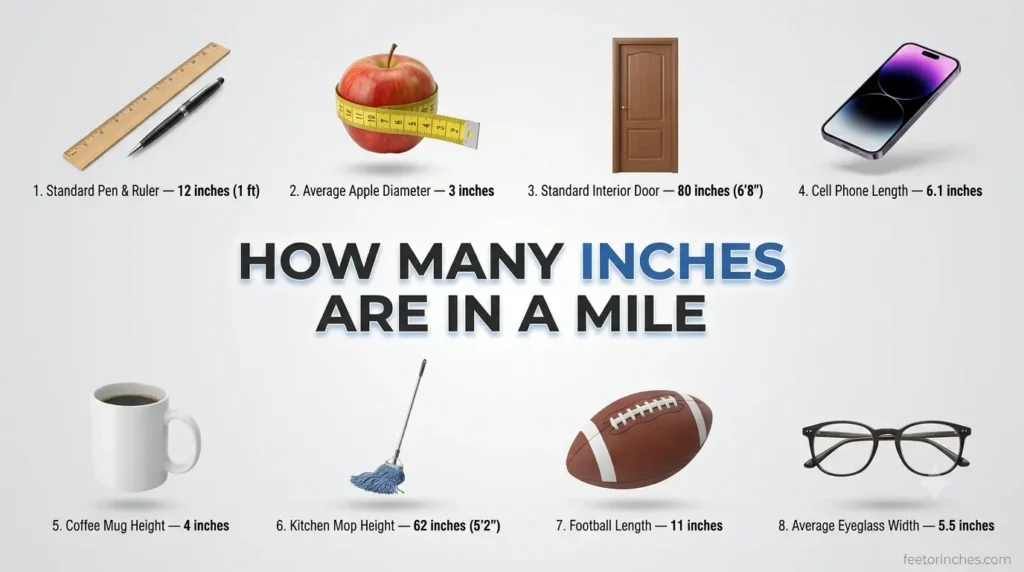
Example 8: Smartphone Length
- Measurement: 1 smartphone ≈ 6 inches
- Visualization: 63,360 ÷ 6 = 10,560 phones
- Insight: A mile is incredibly long when broken into small objects
Example 9: Human Height Comparison
- Measurement: Average adult height ≈ 66–70 inches
- Visualization: A mile equals ~900–960 adult heights stacked
- Insight: Shows how small inches are compared to miles
Example 10: School Bus Length
- Measurement: 1 bus ≈ 360 inches
- Visualization: A mile ≈ 176 school buses
- Insight: Perfect for visual transportation comparison
Scale Comparison: Inches in Context
Smaller Units
- 1 inch = extremely small (finger width)
- 12 inches = 1 foot (shoe length)
Larger Units
- 63,360 inches = 1 mile
- 528,000 inches = 10 miles
Everyday Perspective
- 1 inch: tiny object measurement
- 12 inches: ruler length
- 36 inches: door width
- 63,360 inches: full mile distance
How It Feels: Visualizing a Mile in Inches
Imagine standing at the start of a long straight road.
Now imagine breaking that road into:
- thousands of rulers placed end-to-end
- or more than ten thousand smartphones lined up
- or hundreds of school buses parked bumper-to-bumper
That entire stretch equals 63,360 inches.
You wouldn’t feel it as “inches” while walking, but in engineering terms, every step is measured in these tiny units adding up to a mile.
See Also:How Many Inches Does Hair Grow in a Year? (Complete Guide + Real Examples)
Practical Uses of This Conversion
Understanding how many inches are in a mile is useful in several real-world areas:
Construction
- Blueprint scaling
- Material measurements
- Site layout precision
Engineering
- Infrastructure design
- Road and bridge calculations
- Mechanical layouts
Mapping & GIS
- Scale conversions
- Distance modeling
- Terrain measurements
Education
- Teaching unit conversion
- Math problem solving
- Measurement visualization
Sports & Fitness
- Tracking running distances
- Step count analysis
- Performance mapping
FAQ: Inches in a Mile
How many inches are in a mile exactly?
There are exactly 63,360 inches in 1 mile. This is based on 5,280 feet per mile and 12 inches per foot. It is a fixed conversion used in the imperial measurement system.
Why is there 63,360 inches in a mile?
A mile is defined as 5,280 feet. Since each foot contains 12 inches, multiplying them gives 63,360 inches. This historical measurement comes from older English surveying systems.
How do you convert miles to inches quickly?
To convert miles to inches, multiply the number of miles by 63,360. For example, 2 miles × 63,360 = 126,720 inches. This shortcut avoids step-by-step conversion.
Is a mile always 63,360 inches?
Yes, in the imperial system, a mile is always equal to 63,360 inches. It does not change unless using a different measurement system like metric units.
How many inches are in half a mile?
Half a mile equals 31,680 inches. You get this by dividing 63,360 by 2.
How many inches are in a quarter mile?
A quarter mile equals 15,840 inches. This is commonly used in track and racing measurements.
Why do we use inches for such a large distance?
Inches are used for precision. While miles measure long distances, inches help in engineering, mapping, and technical fields where exact detail matters.
How many feet are in a mile and how does it relate to inches?
There are 5,280 feet in a mile. Since each foot has 12 inches, multiplying gives 63,360 inches in a mile.
Which is bigger: miles or inches?
A mile is much larger. One mile contains 63,360 inches, making it a far bigger unit of measurement.
Conclusion
A mile may feel like a simple long-distance unit, but when broken down, it becomes a precise measurement of 63,360 inches. This conversion connects large-scale travel distances with small-scale precision units used in science, engineering, and everyday problem-solving.
Once you understand this relationship, you can easily convert miles into inches and visualize distances in a much more detailed and practical way.