
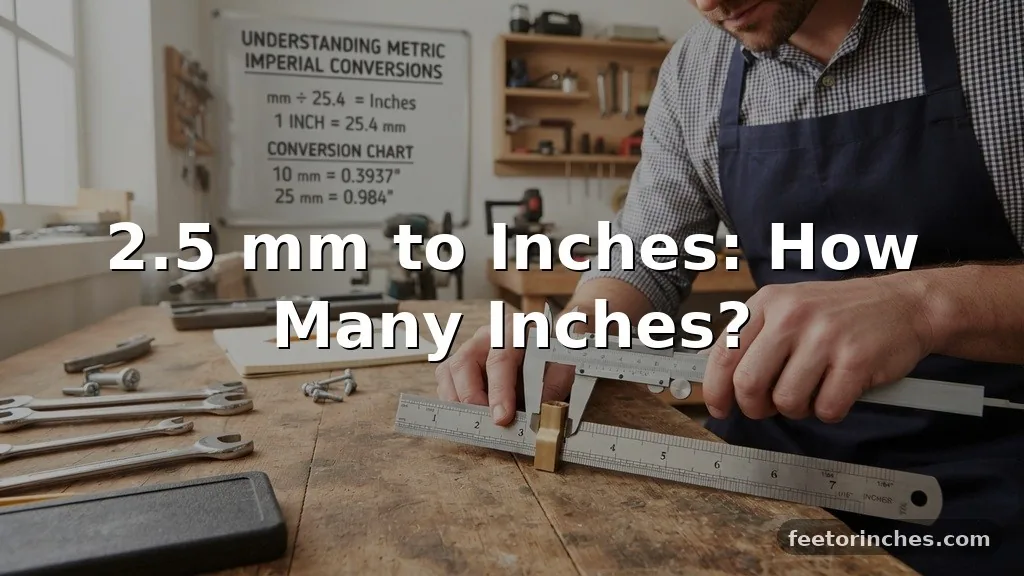
Converting 2.5 mm to inches is a common task when working with small mechanical parts or precise hardware components. To put it simply, 2.5 millimeters is equal to approximately 0.0984 inches.
If you are looking for a fraction for quick reference on a standard ruler, it is just slightly less than 1/10 of an inch. Understanding these small-scale measurements helps you select the right fasteners, drill bits, or electronic connectors without guesswork.
Understanding Metric to Imperial Conversions
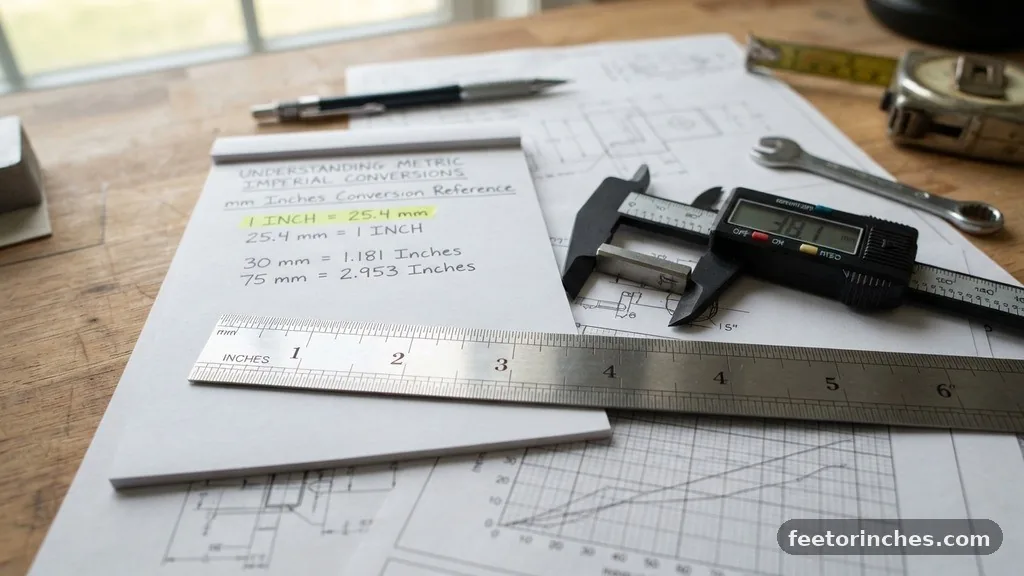
The metric system relies on the base-10 structure, making calculations simple within its own framework. However, shifting from the millimeter to the United States customary system often causes confusion because of the different base units. One inch is officially defined as exactly 25.4 millimeters.
When you need to convert millimeters to inches, you must divide the millimeter value by 25.4. This mathematical relationship is the foundation for every measurement tool used in manufacturing and engineering. You can find more detailed information on these standards through the National Institute of Standards and Technology.
The Math Behind the Calculation
To find the value of 2.5 mm in inches, the equation is 2.5 divided by 25.4. This results in 0.09842519685. In most practical applications, rounding this to 0.098 or 0.1 inches is sufficient for general work.
Precision requirements change depending on the industry. A machinist working on aerospace components needs exact decimals, while a carpenter might only care that the measurement is roughly a tenth of an inch. Always verify the required tolerance of your specific project before cutting or drilling.
Conversion Table for Small Measurements
Using a conversion table is the fastest way to avoid errors when working with small dimensions. This table provides common metric values and their corresponding imperial equivalents to help you visualize the scale.
| Millimeters (mm) | Inches (in) | Fractional Approximation |
|---|---|---|
| 1.0 mm | 0.0394 in | ~1/25 in |
| 2.0 mm | 0.0787 in | ~5/64 in |
| 2.5 mm | 0.0984 in | ~3/32 in |
| 5.0 mm | 0.1969 in | ~13/64 in |
| 10.0 mm | 0.3937 in | ~25/64 in |
Common Uses for 2.5 mm Measurements
You will frequently encounter 2.5 mm measurements in electronics and specialized hardware. It is a standard size for specific types of internal components that require a compact footprint. Understanding this size helps when identifying parts during repair or assembly.
- Electronic Connectors: Many PCB headers and small plug-in components use a 2.5 mm pitch.
- Hardware Fasteners: Small machine screws often come in 2.5 mm diameters for precision devices.
- Medical Equipment: Certain surgical tools and small-scale sensors rely on this precise dimension.
- Jewelry Making: Small beads or wire components often fall into the 2.5 mm range.
- Model Building: Scale model parts frequently use metric sizing for structural accuracy.
Estimating Measurements Without Tools
Sometimes you need an estimate when you do not have a digital caliper or a ruler nearby. While 2.5 mm is too small for most body-part estimations, you can use common objects as a reference. A standard credit card, for instance, is approximately 0.76 mm thick.
Stacking three credit cards gives you a total thickness of about 2.28 mm, which is very close to your target. Alternatively, a standard sheet of paper is roughly 0.1 mm thick. If you have a stack of 25 sheets of paper, you have a physical representation of 2.5 mm.
Comparing 2.5 mm to Nearby Sizes
Understanding how 2.5 mm sits in relation to other common sizes is helpful for spatial awareness. If you are comparing it to a 2 mm part, the 2.5 mm item is noticeably larger to the naked eye. Moving up to 3 mm represents a more significant jump in volume or width.
The customary system often uses 1/8 of an inch, which is 3.175 mm. Because 2.5 mm is smaller than 3.175 mm, it is essentially a “sub-eighth” measurement. Keeping these benchmarks in mind prevents you from buying parts that are slightly too loose or too tight for your needs.
Common Misconceptions and Errors
Many people assume that 2.5 mm is equivalent to 1/4 of an inch, but this is a major error. One quarter of an inch is equal to 6.35 mm, which is significantly larger than 2.5 mm. Confusing these two measurements can lead to expensive mistakes in hardware procurement.
Another common issue is failing to distinguish between diameter and circumference. If a manufacturer lists a 2.5 mm diameter for a wire, the circumference will be much larger—roughly 7.85 mm. Always check if the documentation specifies the diameter, length, or cross-section to ensure you get the right part.
The Importance of Precision in Manufacturing
In modern manufacturing, the shift between millimeters and inches is handled by automated systems. CNC machines and 3D printers interpret these values with extreme accuracy. When you are performing manual work, however, you must be more careful with your rounding.
Using a high-quality converter tool or a reliable reference chart is essential for professional results. If you are working on a project that requires high-stress load-bearing, even a small discrepancy of 0.5 mm can lead to structural failure. Always double-check your conversions against a verified standard.
FAQ
Is 2.5 mm the same as 1/4 inch?
No, 2.5 mm is much smaller than 1/4 inch. While 2.5 mm is roughly 0.1 inches, 1/4 inch is equal to 6.35 mm.
How can I measure 2.5 mm on a standard ruler?
On a metric ruler, 2.5 mm is exactly halfway between the 2 mm and 3 mm marks. On an imperial ruler, it is just slightly less than the 1/10 inch mark, making it difficult to read accurately without a magnifying glass.
Why is 2.5 mm a common size in electronics?
It is a standard spacing interval for pins on integrated circuits and connectors. This allows for standardized layouts on circuit boards that are compatible with global manufacturing equipment.
Should I use fractions or decimals for 2.5 mm?
Decimals are much more common when working with 2.5 mm because it is a metric measurement. Fractions are typically reserved for imperial measurements, and converting 2.5 mm to a fraction often results in awkward, non-standard numbers.
Final Thoughts on Metric Conversions
Mastering the conversion of 2.5 mm to inches is an essential skill for anyone working with hardware, electronics, or small-scale design. By understanding that this measurement is roughly 0.1 inches, you can make better decisions when selecting parts or materials. Remember that precision is key, and using a conversion table is always safer than relying on mental math for critical projects.
Whether you are a hobbyist or a professional, keeping these relationships clear will save you time and prevent costly mistakes. As you continue to work with these dimensions, you will find that the relationship between the metric and customary systems becomes second nature, allowing you to move between them with total confidence.
You may also like: 18 mm in Inches
You may also like: 225 mm to Inches
Explore more on FeetOrInches.