Quick Answer
Quick Answer:
A ruler in inches is read by counting the numbered marks, where each long line equals 1 inch, and smaller lines represent fractions of an inch (like 1/2, 1/4, 1/8, and 1/16).
To measure an object, align it with 0 and count the inches plus fractional marks.Formula:
Total length = Whole inches + Fractional inches
If you’ve ever wondered how how to read a ruler in inches really looks in everyday life, you’re not alone. Most people struggle to picture measurements without a ruler or tape measure in hand. In this guide, you’ll learn exactly how inch markings work through simple explanations, visual comparisons, real-world objects, and practical examples you can relate to instantly.
Understanding a ruler isn’t just about numbers—it’s about recognizing patterns. Once you know how the inch system is divided, you can measure almost anything around you with confidence, whether it’s a book, a phone, or a piece of furniture. Let’s break it down in the easiest way possible.
Reag Also:How Tall Is 48 Inches in Feet? Complete Conversion Guide
Conversion or Core Data Table: Inch Ruler Breakdown
| Mark Type | Value | What It Means |
|---|---|---|
| Long line with number | 1 inch | Full inch |
| Medium line | 1/2 inch | Half inch |
| Smaller line | 1/4 inch | Quarter inch |
| Tiny lines | 1/8 inch | Fine division |
| Very tiny lines | 1/16 inch | Precise measurement |
Key Tip:
Most standard school rulers use 1/16 inch precision, especially in the United States.
What Does It Mean to Read a Ruler in Inches?
Reading a ruler in inches means understanding how distance is broken into equal parts. Each inch is a fixed unit of length used mainly in the United States, Canada, and the UK for informal measurement.
A standard ruler is 12 inches long, and each inch is subdivided into smaller parts to allow precise measurement.
Why It Matters:
- Helps in school math and geometry
- Essential for DIY projects
- Used in construction and crafting
- Important for sewing and tailoring
- Useful in everyday object measurement
How to Read a Ruler Step by Step
Step 1: Start at Zero
Always align the object with the 0 mark, not the edge of the ruler.
Step 2: Identify Whole Inches
Count the large numbered lines: 1, 2, 3, 4, etc.
Step 3: Look at Fraction Marks
Between whole numbers, identify:
- Half (1/2)
- Quarter (1/4)
- Eighth (1/8)
- Sixteenth (1/16)
Step 4: Combine Values
Add the whole inches and fractional parts together.
Example:
If an object ends at 2 inches and 1/4 mark → 2.25 inches
Real-Life Examples of Reading a Ruler in Inches
Example 1: Pencil Length
- Measurement: 7 inches
- Visualization: About the length of a standard pencil
- Insight: Most pencils range from 6–8 inches
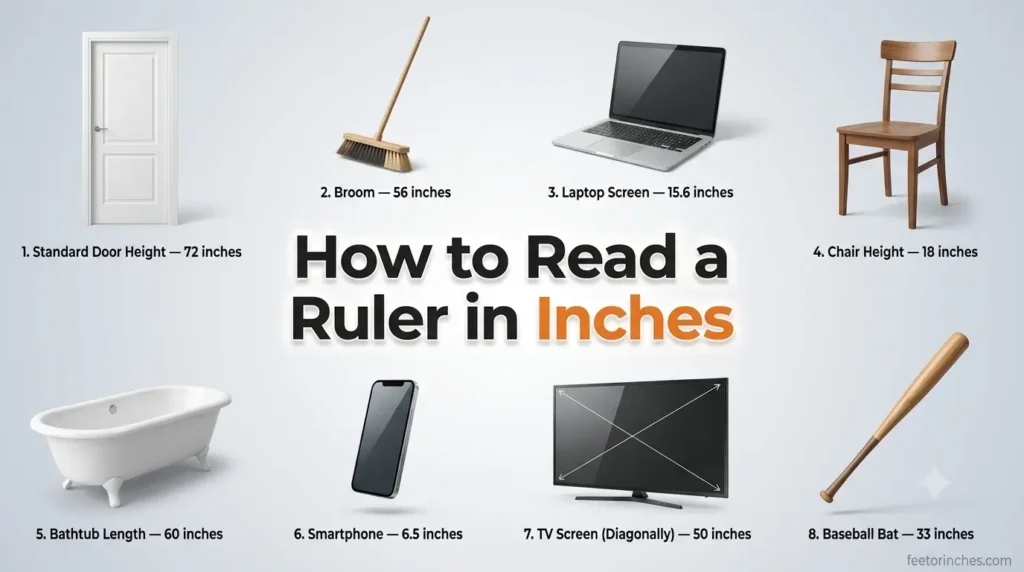
Example 2: Smartphone Height
- Measurement: 6.5 inches
- Visualization: Slightly longer than your palm
- Insight: Modern phones fall between 5.5–7 inches
Example 3: Notebook Width
- Measurement: 8.5 inches
- Visualization: Standard letter-size paper width
- Insight: Common in school supplies
Example 4: TV Remote
- Measurement: 7–9 inches
- Visualization: Fits comfortably in one hand
- Insight: Designed for easy grip
Example 5: Water Bottle Height
- Measurement: 10 inches
- Visualization: About the length of a forearm
- Insight: Standard 500ml bottles
Example 6: Tablet Device
- Measurement: 10–12 inches
- Visualization: Roughly a small book
- Insight: Measured diagonally in tech specs
Example 7: Dinner Plate Diameter
- Measurement: 10–11 inches
- Visualization: Covers most of your hand span
- Insight: Standard dining size
Example 8: Laptop Screen
- Measurement: 13–15 inches
- Visualization: Larger than a school notebook
- Insight: Measured diagonally
See Also:How Many Inches Are in a Yard? (Complete Conversion Guide)
Example 9: Hand Span
- Measurement: 7–9 inches
- Visualization: From thumb to pinky stretch
- Insight: Personal measurement reference
Example 10: Shoe Length
- Measurement: 9–12 inches
- Visualization: Roughly forearm length
- Insight: Varies by shoe size
Comparison Section: Understanding Scale
Smaller than 1 inch
- Pencil eraser tip
- Button size
- Small screws
Around 1 inch
- Paperclip length
- Bottle cap diameter
6–12 inches range
- Smartphone
- Notebook
- Sandwich length
Larger than 12 inches (1 foot)
- Laptop width
- Ruler itself
- Small backpack height
Human Comparisons
- Fingernail width ≈ 0.5 inch
- Thumb width ≈ 1 inch
- Hand span ≈ 7–9 inches
- Forearm ≈ 10–12 inches
How It Feels: Visualization in Real Life
Understanding inches becomes easier when you connect it to movement and daily experience.
- 1 inch feels like the width of your thumb
- 6 inches feels like holding a medium sandwich
- 12 inches (1 foot) feels like a ruler or a large notebook
- 24 inches feels like carrying a small box under your arm
Think of it as stacking everyday objects instead of memorizing numbers.
See Also:How Many Inches in a Meter? (Complete Conversion Guide)
Practical Uses of Reading a Ruler in Inches
Construction
Used for measuring wood, walls, and fixtures.
Interior Design
Helps determine furniture spacing and room layout.
DIY Projects
Essential for cutting, fitting, and assembling materials.
Education
Used in math classes and geometry exercises.
Fashion & Sewing
Important for fabric measurement and tailoring.
Online Shopping
Helps understand product dimensions before buying.
FAQ: How to Read a Ruler in Inches
What is the easiest way to read a ruler in inches?
Start at the zero mark and count whole inches using large numbers, then identify smaller fractional marks like 1/2 or 1/4 for precision. Combine both values to get the final measurement.
Why does a ruler have so many small lines?
The small lines represent fractions of an inch, allowing precise measurement. These divisions help measure objects accurately in crafts, engineering, and everyday tasks.
How many lines are in one inch on a ruler?
Most standard rulers divide one inch into 16 small segments, meaning there are 16 lines representing 1/16-inch increments.
What is 1/2 inch on a ruler?
1/2 inch is the middle mark between two whole numbers. It represents half the distance of one full inch.
How do I measure without starting at zero?
If you don’t start at zero, subtract the starting point from the ending point to get the correct measurement.
What is the difference between inches and centimeters?
Inches are part of the imperial system, while centimeters belong to the metric system. 1 inch equals 2.54 centimeters.
Why is reading a ruler important in daily life?
It helps with schoolwork, DIY projects, shopping decisions, and understanding object sizes without guessing.
How can I quickly estimate inches without a ruler?
Use body parts: thumb ≈ 1 inch, hand span ≈ 7–9 inches, forearm ≈ 10–12 inches.
What is the most common ruler size?
The most common ruler is 12 inches long, also known as a foot-long ruler.
Is reading a ruler difficult for beginners?
No, once you understand fractions of an inch, it becomes simple and intuitive with practice.
Conclusion
Learning how to read a ruler in inches is a foundational skill that becomes easy once you understand the structure of inch divisions. From whole numbers to fractional marks, every line has a purpose. With real-world comparisons and simple visualization, you can now confidently measure everyday objects without confusion.
The more you practice, the more natural it becomes—turning measurements into quick visual judgments rather than guesswork.
Related conversions: How Many Inches in a Foot? (Complete Guide with Real Examples & Visuals), How Many Inches in a Yard? Complete Conversion Guide With Examples, What Is 6 mm in Inches? Complete Conversion Guide, How Many Cubic Inches in a Cubic Yard? Complete Conversion Guide.