
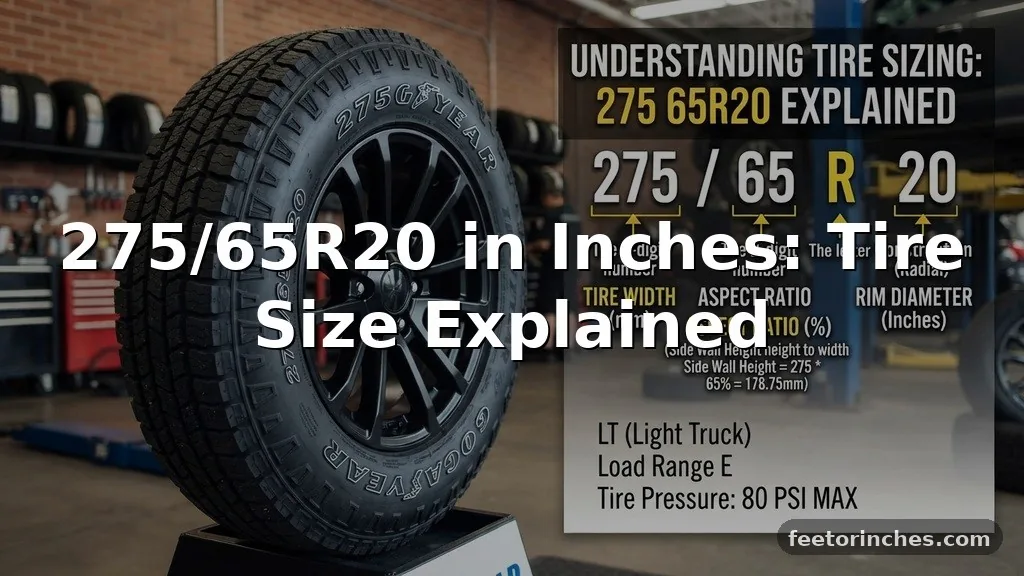
When you look at the sidewall of a truck tire and see the code 275/65R20, it can feel like reading a foreign language. Many drivers want to know what this string of numbers translates to in standard inches, especially when planning for a suspension lift or a new set of all-terrain tires.
Understanding the actual tire diameter and width is essential for ensuring your wheels fit properly without rubbing against your fenders. By breaking down these metric figures, you can make informed decisions about your vehicle’s performance and appearance.
A 275/65R20 tire has an overall diameter of approximately 34.1 inches. This calculation is a vital starting point for any automotive enthusiast upgrading their truck. We will explore how these specific dimensions impact your speedometer calibration, wheel fitment, and overall road handling.
Decoding the Metric Tire Sizing System
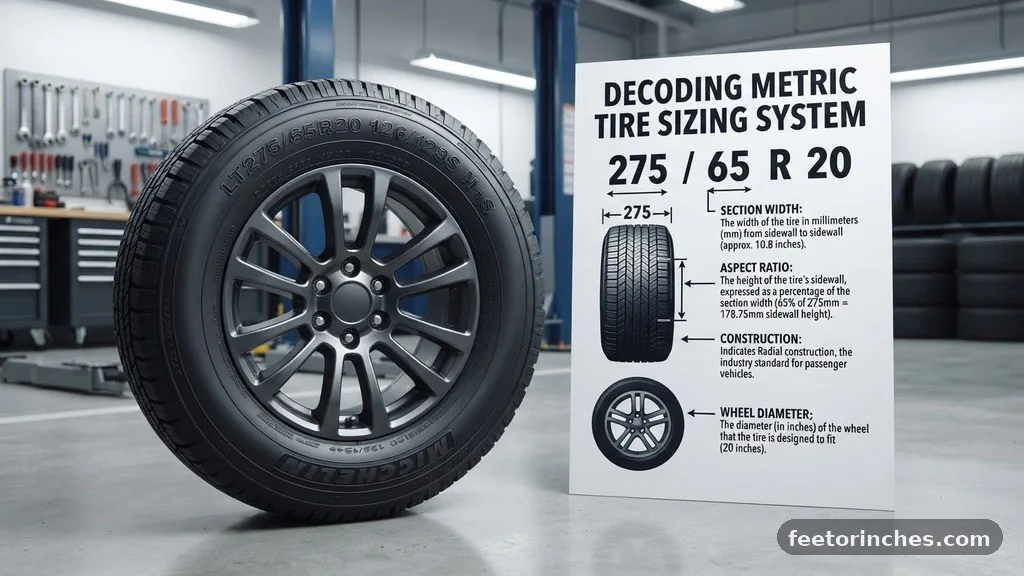
The metric system used for tires can be intimidating, but it follows a logical sequence. Each number tells a specific story about the physical dimensions of the rubber wrapped around your wheels.
The first number, 275, represents the section width in millimeters. This is the widest point of the tire from sidewall to sidewall when mounted on the recommended rim width.
The second number, 65, is the aspect ratio. This is not a measurement in inches or millimeters, but a percentage. It indicates that the height of the sidewall is 65% of the tire’s section width.
Finally, the R20 indicates the construction type—radial—and the rim diameter in inches. Combining these figures allows us to calculate the total size.
Calculating Total Diameter in Inches
To find the total tire diameter, we first calculate the sidewall height. We multiply the section width (275 mm) by the aspect ratio (0.65) to get 178.75 mm.
Since there is a sidewall on both the top and bottom of the wheel, we multiply this by two, resulting in 357.5 mm. Converting this figure to inches by dividing by 25.4 gives us 14.07 inches of rubber height.
Adding the 20-inch rim diameter to this rubber height gives us a total of 34.07 inches. In the real world, tread depth and tire pressure can slightly alter this number.
Most manufacturers will list this size as a 34-inch tire for simplicity in marketing and fitment guides. You can find more technical specifications on tire safety and sizing standards provided by the National Highway Traffic Safety Administration.
Comparison with Nearby Tire Sizes
Choosing between tire sizes often comes down to a matter of millimeters. If you are comparing your current setup to a slightly larger or smaller option, the math changes quickly. A common point of confusion is how the aspect ratio affects the final height when the width remains constant.
| Tire Size | Approximate Diameter (Inches) | Primary Difference |
|---|---|---|
| 275/60R20 | 33.0 inches | 1 inch shorter than 275/65R20 |
| 275/65R20 | 34.1 inches | Standard baseline |
| 285/65R20 | 34.6 inches | Wider and slightly taller |
| 275/70R20 | 35.2 inches | Over 1 inch taller than 275/65R20 |
The jump from a 60-series to a 65-series tire adds roughly one full inch of height. This might seem minor, but it can be the difference between a clean fit and needing to trim your plastic wheel liners. Always check your clearance at full steering lock before committing to a larger size.
Impact on Speedometer Calibration
Changing your tire diameter directly affects how your vehicle measures speed and distance. Your truck’s computer is programmed for a specific rolling radius, which is essentially the distance from the center of the wheel to the road.
When you install a 34-inch tire, it covers more ground per revolution than a smaller stock tire. This means your tires rotate fewer times per mile than the factory settings expected.
As a result, your speedometer will read slower than your actual speed. If you are traveling at an indicated 60 mph, you might actually be moving at 62 or 63 mph.
This discrepancy can also throw off your odometer reading over time. Recalibrating your speedometer through an electronic tuner or dealer software is a standard step when upgrading to larger tires.
Understanding Load Index and Ply Rating
Physical dimensions are only half the story when shopping for new tires. The load index and ply rating tell you how much weight the tire can safely handle.
A 275/65R20 tire often comes in different load ranges, such as Load Range E, which is a 10-ply rated tire. These tires have stiffer sidewalls to support heavier cargo and towing tasks.
However, the trade-off for a higher ply rating is a harsher ride quality. Because the sidewalls are reinforced, they don’t flex as much over bumps or potholes.
If you rarely tow or haul heavy loads, a lower load index tire might offer a more comfortable daily driving experience. Balance your need for durability with the reality of how you use your truck.
The Role of Tire Footprint and Traction
The tire footprint is the area of rubber actually touching the road surface. A 275 mm wide tire provides a substantial contact patch, which is beneficial for stability on pavement.
When you move to all-terrain tires in this size, the tread pattern becomes a major factor. Deeper grooves and wider voids improve off-road grip but can increase road noise at highway speeds.
Tread depth is also a critical metric. Most new tires in this category start with about 12/32 to 16/32 of an inch of tread.
As the tire wears down, the rolling radius changes, which can subtly affect your speedometer reading again. Monitoring your tread depth isn’t just about safety; it’s about maintaining the consistent performance you expect from your truck.
Common Misconceptions in Tire Sizing
One of the most persistent myths is that all tires marked with the same size will measure exactly the same. In reality, different manufacturers have variations in how they mold their rubber.
A 275/65R20 from one brand might measure slightly wider or taller than the same size from another brand. This is due to differences in shoulder design and tread block shape.
Another common mistake is confusing tire diameter with the diameter of the wheel itself. You cannot use a 20-inch tire on an 18-inch wheel, regardless of the other numbers.
Always verify that the rim diameter listed on the tire matches the wheel you currently have installed. Mixing up these dimensions leads to costly returns and installation headaches.
Practical Tips for Wheel Fitment
Before buying a new set, check your current wheel offset. Offset determines how far the wheel sits inward or outward from the mounting hub.
A 34-inch tire that fits perfectly with factory wheels might rub if you switch to wheels with a deep negative offset. This pushes the tire further out, causing the edge to swing into the fender when you turn.
Consider the following list of factors when planning a fitment change:
- Check the distance between the tire and the upper control arm.
- Ensure there is enough clearance for the tire to turn without hitting the frame.
- Verify that your suspension travel won’t cause the tire to hit the top of the wheel well.
- Use a digital tire calculator to see the exact change in gear ratio and speedometer error.
- Consult your owner’s manual for recommended tire pressures to ensure even wear.
Frequently Asked Questions
Is a 275/65R20 considered a 35-inch tire?
No, it is generally classified as a 34-inch tire. While it is very close to the mark, it usually measures closer to 34.1 inches, whereas a true 35-inch tire is significantly larger in both width and height.
Can I put 275/65R20 tires on a stock truck?
It depends on the specific make and model of your vehicle. Many modern half-ton trucks can accommodate this size without modifications, but others may require a small leveling kit to prevent rubbing during tight turns.
How much does a 275/65R20 tire weigh?
The weight varies significantly based on the tread pattern and construction. A standard highway-terrain tire might weigh around 45 pounds, while a heavy-duty all-terrain tire with high ply ratings can weigh 60 pounds or more.
Do I need to re-gear my truck for this tire size?
Usually, no. Going from a stock size to a 34-inch tire is a relatively small change that most modern truck transmissions can handle without a gear swap. However, you will notice a slight decrease in acceleration and a change in shift points.
Final Considerations for Your Setup
Navigating the technical specifications of your vehicle is the best way to ensure safety and performance. When you understand exactly what your tire dimensions mean, you move from guessing to making precise upgrades that suit your driving style.
A 275/65R20 setup strikes a popular balance for many truck owners, offering a beefy look and improved ground clearance without requiring extreme modifications. Always double-check your specific vehicle’s clearance limits and consult with a professional installer if you are unsure about a new fitment.
Taking the time to research your tire size will save you from frustration and ensure your truck remains reliable on and off the road. Whether you are looking for better traction on dirt trails or a more aggressive stance for the street, knowing the math behind your tires is the first step toward a successful build. If you have questions about your specific vehicle’s compatibility, feel free to reach out to local experts or check your truck’s dedicated enthusiast forums for real-world testing results.
Related conversions: 285/65R20 in Inches · 265/60R20 in Inches · 295/65R20 in Inches
Explore more on FeetOrInches.




