
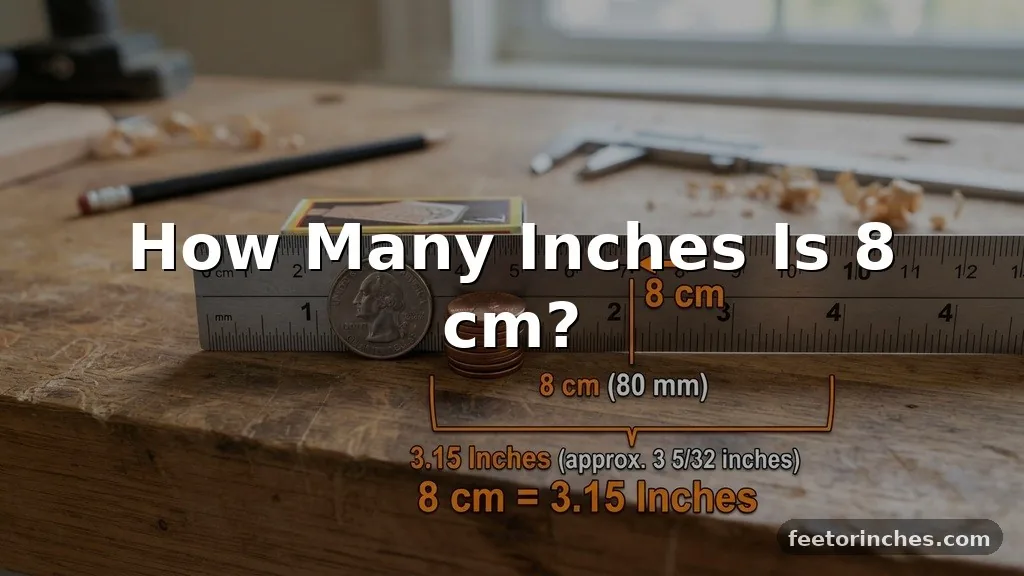
Determining how many inches is 8 cm is a common task when you are bridging the gap between the metric system and the imperial system. Because we frequently encounter products manufactured in different countries, knowing how to quickly translate these units is an essential skill for everyday life.
If you have ever wondered about the precise conversion or simply want a mental benchmark for this length, you have come to the right place. Understanding how 8 centimeters translates into inches provides clarity for everything from home improvement projects to checking the dimensions of small household items or even medical measurements.
The exact value you need is 3.1496 inches. Most people find it easiest to round this to 3.15 inches for general purposes.
This conversion is based on the international standard where one inch is defined as exactly 2.54 centimeters. To perform the calculation yourself, you simply divide the number of centimeters by 2.54.
Using this constant, you can easily shift between systems. Whether you are dealing with small mechanical parts or fabric lengths, the math remains consistent.
Precision matters in engineering, but for most daily tasks, a decimal value of 3.15 is more than sufficient. You can find detailed technical standards regarding these units at the National Institute of Standards and Technology.
Conversion Reference Table
Having a quick reference table helps you visualize how centimeters compare to inches across a range of common values. This table uses the standard 2.54 divisor to ensure accuracy for your projects.
| Centimeters (cm) | Inches (in) |
|---|---|
| 2 cm | 0.79 in |
| 5 cm | 1.97 in |
| 8 cm | 3.15 in |
| 10 cm | 3.94 in |
| 15 cm | 5.91 in |
Visualizing 8 Centimeters
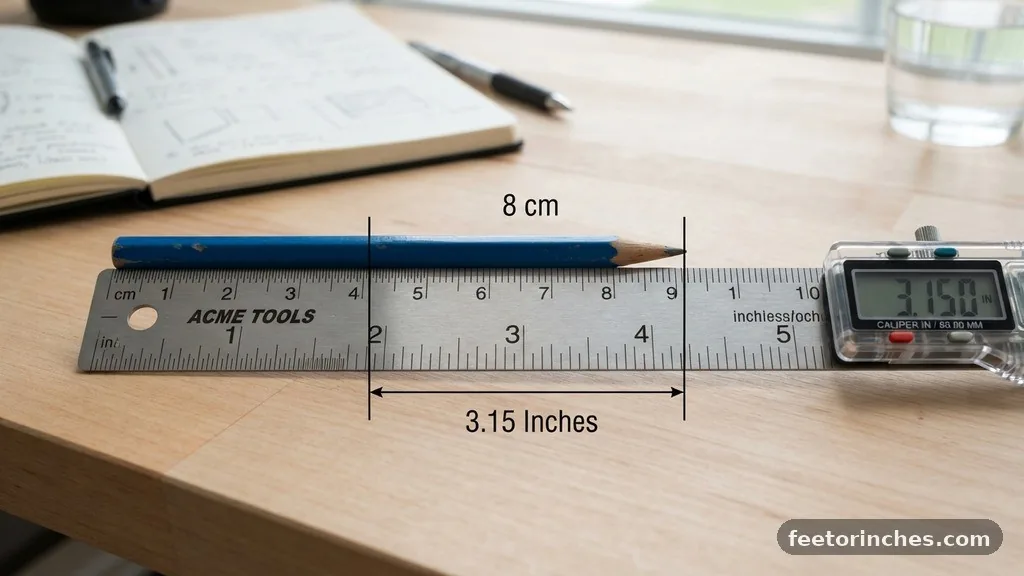
Visualizing 8 centimeters is easier when you relate it to objects you interact with daily. Since 8 cm is approximately 3.15 inches, think of the length of a standard credit card. A credit card is roughly 8.5 cm long, meaning 8 cm is just slightly shorter than the long edge of your card.
You might also consider common office supplies. A standard paperclip is usually about 3 cm to 4 cm long.
If you place two and a half large paperclips end-to-end, you reach the 8 cm mark. This method of using familiar objects is a great way to estimate measurements when a ruler is not nearby.
Estimating Without Tools
When you do not have a ruler, you can use your own body to estimate length. The width of a typical adult index finger is roughly 2 cm. By placing four fingers side-by-side, you can estimate a span of about 8 cm.
* Index finger width: Approximately 2 cm.
* Four fingers combined: Roughly 8 cm.
* Legal paper width: 8.5 inches (about 21.6 cm).
* Quarter coin diameter: Approximately 2.4 cm.
Using your hand as a rough guide is surprisingly effective for quick checks. While it won’t replace a precision tool, it prevents major errors when buying items or assessing space. Always remember that individual finger widths vary, so calibrate your “hand-ruler” against a known object first.
Common Measurement Misconceptions
Confusion often arises between diameter and circumference. If you are measuring a circular object, 8 cm of diameter will result in a much larger circumference. The circumference is calculated by multiplying the diameter by pi, which is approximately 3.14.
Another common issue is confusing screen measurements with physical dimensions. A device described as having an 8 cm screen usually refers to the diagonal length.
This does not tell you the width or height of the screen itself. Always check if the manufacturer is providing the diagonal, the width, or the total surface area.
Scale Comparisons
Understanding 8 cm becomes much clearer when you look at it in relation to other nearby measurements. It sits in a range that is often used for small hardware, jewelry, or medical samples.
* 6 cm: About 2.36 inches. This is noticeably smaller than 8 cm.
* 8 cm: Approximately 3.15 inches.
This is the target length.
* 10 cm: About 3.94 inches. This is roughly 25% longer than 8 cm.
When you look at these numbers side-by-side, you can see how incremental changes affect the total. A 2 cm difference between 6 cm and 8 cm is quite significant when you are working on a small scale. Precision is easier to maintain when you visualize these gaps clearly.
Applications in Daily Life
You will frequently encounter the 8 cm measurement in product packaging and health contexts. For instance, many small storage containers are sized in centimeters to fit standard shelving units. If a box is 8 cm tall, it is just over 3 inches, which is perfect for holding pens or small cables.
Medical contexts also rely on these measurements. Doctors or nurses might use centimeters to describe the size of a bandage or the depth of a minor wound. Because the metric system is the global standard for science, understanding how to convert it to the imperial system used in the United States is vital for interpreting health information.
Accuracy and Precision
When you convert units, the level of precision depends on your goal. In a casual conversation, saying “a little over 3 inches” is perfectly fine for 8 cm. However, in carpentry or electronics, you need to be exact.
Always use a reliable conversion factor of 2.54. If you use a rounded number like 2.5, you will introduce errors that accumulate over longer distances.
For example, over a meter, that small discrepancy grows into several millimeters. Stick to the 2.54 standard to ensure your work remains professional and accurate.
Frequently Asked Questions
Is 8 cm the same as 3 inches?
Not exactly. 8 cm is approximately 3.15 inches. While 3 inches is a close approximation, the extra 0.15 inches can matter in high-precision work.
How do I convert centimeters to inches quickly?
Divide the number of centimeters by 2.54. If you need a quick mental estimate, dividing by 2.5 is usually close enough for non-critical measurements.
What is 8 cm in millimeters?
8 cm is exactly 80 millimeters. Since there are 10 millimeters in every centimeter, you simply multiply by 10.
Is 8 cm a standard size for anything?
Yes, it is common in manufacturing for small items like decorative tiles, specific hardware screws, or the diameter of small circular items like coasters.
Does the conversion change if I am measuring length versus width?
No, the conversion factor of 2.54 remains the same regardless of whether you are measuring length, width, or diagonal.
Final Thoughts on Measurement
Knowing how many inches is 8 cm allows you to navigate both metric and imperial environments with confidence. Whether you are ordering parts from an international supplier or simply trying to visualize a measurement mentioned in a recipe or manual, you now have the tools to handle the conversion. Remember that 3.15 inches is your reliable target for this specific distance.
By using the conversion factor of 2.54 and practicing with everyday objects, you can keep your measurements accurate and avoid common mistakes. This small bit of knowledge makes a big difference in the precision of your work.
We hope this breakdown helps you feel more comfortable with these units in your daily tasks. If you have other measurements you are curious about, feel free to explore further or reach out with specific questions.
Related conversions: What Is 15/32 in Inches · How Many Inches in a Meter · How to Read a Ruler in Inches




