

Converting a measurement like 127cm to inches is a common task when bridging the gap between the metric system and the United States customary system. Whether you are measuring furniture, assessing height, or checking dimensions for a television, knowing the precise mathematical relationship between these units ensures you get the right fit. A length of 127 centimeters is exactly 50 inches.
This conversion is straightforward once you understand that one inch is defined as 2.54 centimeters. By dividing the metric figure by this constant, you arrive at the imperial equivalent quickly. Understanding how these units interact helps you navigate global product specifications and personal measurements with complete confidence and accuracy.
The Math Behind the Conversion
The relationship between the metric system and the imperial system is fixed by international agreement. To find how many inches are in 127 centimeters, you simply divide 127 by 2.54. Because 2.54 is the exact number of centimeters in one inch, the math is precise.
Mathematics in measurement relies on these fixed ratios to maintain consistency across borders. When you perform this calculation, you are utilizing the standard defined by the National Institute of Standards and Technology for international unit harmonization. This ensures that a part manufactured in a metric-dominant country fits perfectly into a product designed with customary system dimensions.
Why 2.54 is the Key
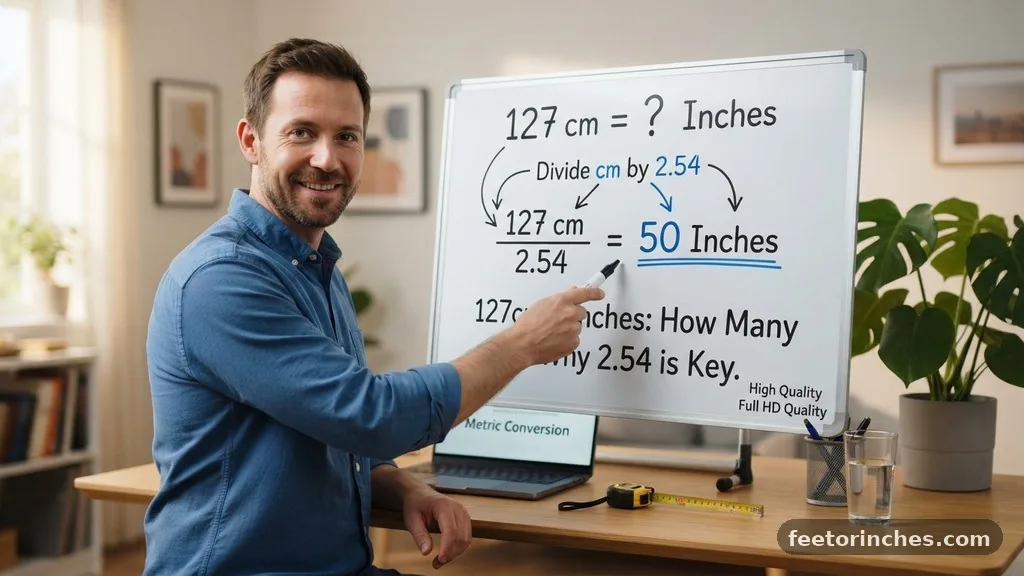
The number 2.54 acts as the anchor for every conversion between these two standards. Before 1959, the inch varied slightly depending on the country, but the international yard and pound agreement standardized it. Using this specific constant prevents rounding errors that could cause significant issues in precision engineering or construction.
Calculating Other Values
If you need to move beyond 127cm, the same logic applies. You can build a mental shortcut by remembering that 100cm is roughly 39.37 inches. From there, adding the remaining 27cm brings you to the 50-inch total.
Conversion Table for Common Units
When dealing with a 127cm measurement, it is helpful to see how that distance translates into other common units of length. The following table provides a quick reference for these conversions to help you visualize the scale.
| Unit | Value |
|---|---|
| Centimeters | 127 cm |
| Inches | 50 inches |
| Feet | 4.17 feet |
| Millimeters | 1,270 mm |
| Meters | 1.27 meters |
Visualizing 50 Inches Without Tools
Estimating 50 inches without a tape measure is a useful skill when you are shopping for appliances or planning a space. You can use standard objects found in most homes or offices to create a reliable mental yardstick.
Using Standardized Objects
- Legal-size paper: A standard legal sheet is 14 inches long. Using three and a half sheets placed end-to-end gets you very close to 50 inches.
- Floor tiles: Most residential floor tiles are 12 inches square. Four tiles plus a tiny bit more will equal 50 inches.
- Your own reach: For many adults, the distance from the center of the chest to the tip of the middle finger is roughly 25 to 30 inches. Stretching both arms out wide often covers 50 inches or more.
Body-Based Estimation
Most people can pace off distance by walking. If you know your stride length, you can estimate 127cm by walking two average steps. While not as precise as a ruler, this is usually enough for rough spatial planning.
Common Misconceptions in Measurement
Confusion often arises when people mix up linear measurements with diagonal ones. A 50-inch television, for example, is measured diagonally from corner to corner, not by its width. If you assume the width is 50 inches, you will be surprised when the actual physical unit is significantly smaller.
Diagonal vs. Linear
When you see a screen size, always remember that the 127cm figure represents the hypotenuse of the screen’s rectangle. The actual width of a 50-inch screen is typically around 43 to 44 inches. Always check the manufacturer’s specifications for the physical footprint rather than relying on the diagonal screen measurement alone.
Diameter vs. Circumference
Another common error involves circular objects. If you have a round table with a diameter of 127cm, that is the distance across the widest point. However, the circumference—the distance around the edge—is significantly longer, calculated by multiplying the diameter by pi (approximately 3.14).
Comparing 127cm to Nearby Measurements
Understanding how 127cm fits into the broader spectrum of lengths helps you maintain a better sense of scale. Comparing it to 12, 13, 15, and 16 inches shows how different systems of measurement stack up.
Scale and Proportions
When you look at 127cm, you are looking at a length that is just over four feet. This is a common height for a young child or the length of a small dining table. By contrast, a 16-inch measurement is relatively short, often used for laptop screens or small bicycle frames.
Practical Scaling
Keeping these differences in mind prevents mistakes when ordering parts or materials. If you are replacing a 12-inch component, assuming it is anywhere near 127cm would be a catastrophic error. Always double-check your units before finalizing any order.
Measurement Systems in Daily Life
The coexistence of the metric system and the customary system creates a unique environment for consumers. While science and medicine rely heavily on metric units, residential construction and retail in the United States often stick to inches and feet.
The Metric Advantage
The metric system is a base-10 system, which makes it much easier to scale up or down. Moving from centimeters to meters is as simple as shifting a decimal point. This is why global industries prefer metric for manufacturing and shipping.
The Customary System
The customary system persists because of historical inertia and the sheer volume of existing infrastructure. Most people in the U.S. have a better intuitive grasp of how long an inch is compared to a centimeter. Learning to convert between the two is an essential bridge for anyone working in global markets.
Precision in Engineering and Design
When professionals work with a measurement like 127cm, they must account for tolerance. In high-stakes fields like aerospace or medical device manufacturing, even a fraction of an inch matters.
The Role of Tolerances
Every physical measurement has an inherent margin of error. When a design calls for 127cm, there is usually an acceptable range, such as plus or minus 0.1cm. Understanding that 50 inches is exactly 127cm allows for consistent quality control across international teams.
Digital Tools for Accuracy
Many people use interactive tools to handle these conversions. These calculators remove the human element of error, especially when dealing with complex fractions or multiple unit types. If you are doing professional work, always rely on verified calculation software rather than manual mental math.
FAQ: Common Questions
How tall is 127 cm?
127 cm is exactly 50 inches, which is 4 feet and 2 inches. This is a height commonly seen in children between the ages of 7 and 9, depending on growth patterns.
Is 127 cm the same as 1.27 meters?
Yes, it is. Since there are 100 centimeters in one meter, you simply divide 127 by 100 to get 1.27 meters.
What is the easiest way to convert centimeters to inches?
The easiest way is to divide the centimeter value by 2.54. If you need a quick estimate, you can divide by 2.5 and then subtract a small amount, though this is less accurate.
Does 127 cm refer to the width of a TV?
No, in the context of electronics, 127 cm or 50 inches almost always refers to the diagonal measurement of the screen. The physical width of the TV will be smaller than 50 inches.
Summary and Final Thoughts
Mastering the conversion of 127cm to inches provides a foundation for accurate measurement in both domestic and international contexts. By recognizing that 127 centimeters is equal to 50 inches, you gain a reliable benchmark for estimating everything from screen sizes to physical heights. Whether you are using a quick mental trick or relying on precise mathematical constants, the ability to switch between these units is an invaluable skill.
As you continue to encounter metric and imperial measurements in your daily life, remember to check whether you are looking at linear, diagonal, or circumference dimensions. Small errors in this distinction can lead to significant frustration during assembly or installation. Keep these conversion tips handy for your next project, and feel free to reach out if you need further clarification on any specific unit transitions.
Explore more on FeetOrInches.