When you look at a metric ruler, understanding how 100mm in inches translates helps bridge the gap between two different worlds of measurement. Whether you are working on a DIY project, buying hardware, or simply trying to visualize a size, knowing the exact conversion prevents costly mistakes.
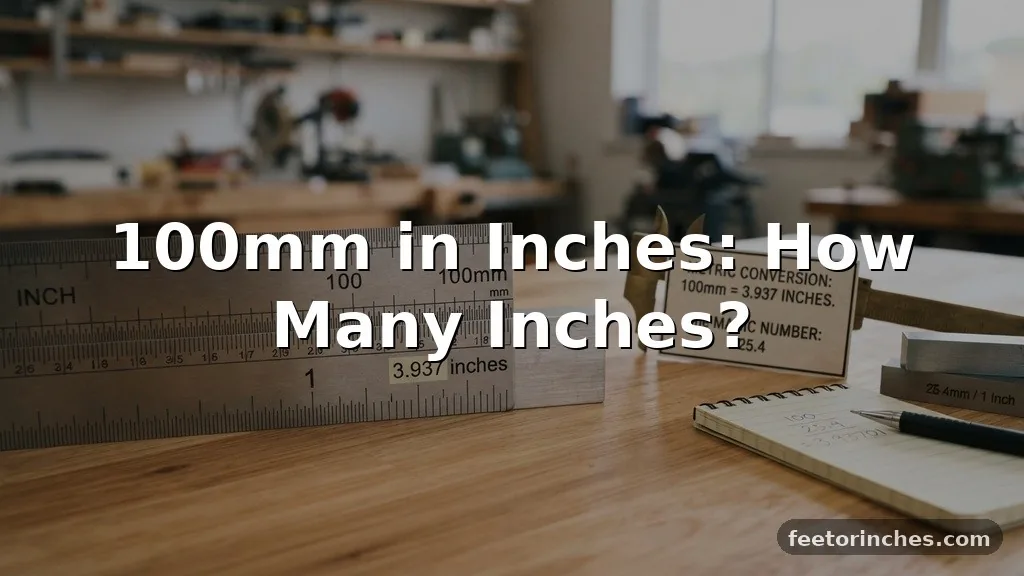
The short answer is that 100 millimeters is exactly 3.937 inches. Most people round this to roughly 4 inches for quick mental math, but precision matters in engineering and construction. This article provides the context you need to master these conversions and stop guessing during your daily tasks.
The Math Behind the Conversion
The metric system functions on powers of ten, while the imperial system uses units like the inch. To find the value of 100mm in inches, you divide the number of millimeters by 25.4. This is the internationally accepted conversion factor because one inch is defined as exactly 25.4 millimeters.
Why 25.4 is the Magic Number
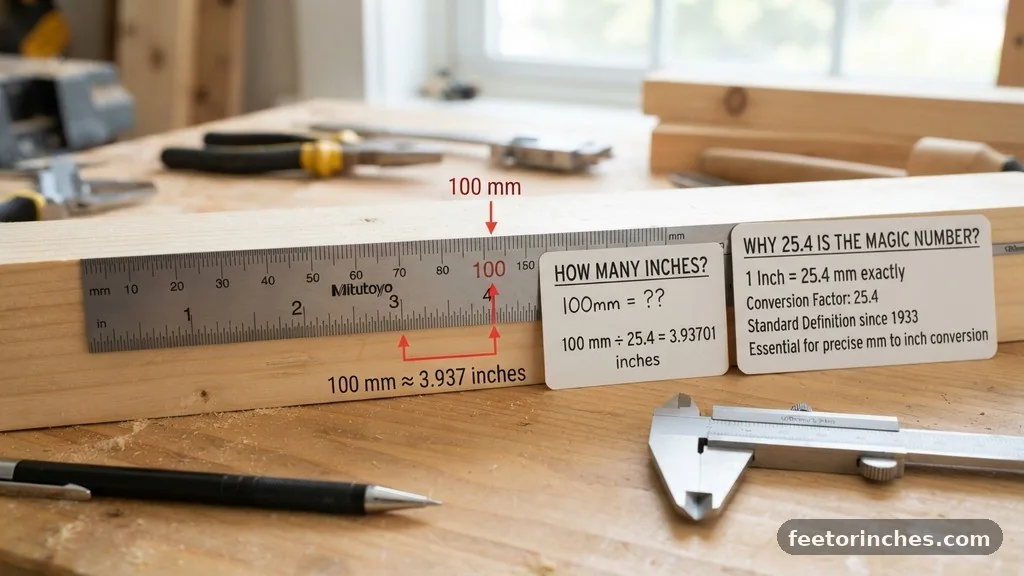
Since the late 1950s, international agreements standardized the inch to ensure consistency across manufacturing. Before this, slight variations between countries caused massive headaches for engineers. By using 25.4 as your divisor, you guarantee that your measurements remain accurate regardless of your location.
Quick Conversion Reference
If you need to move beyond 100mm, keep this table handy for common conversions. It helps you see the relationship between millimeters, inches, and other standard units of length.
| Millimeters (mm) | Inches (in) | Feet (ft) |
|---|---|---|
| 25.4 mm | 1.00 in | 0.083 ft |
| 50.8 mm | 2.00 in | 0.166 ft |
| 100 mm | 3.937 in | 0.328 ft |
| 200 mm | 7.874 in | 0.656 ft |
Common Misconceptions
Many people assume 100mm is exactly 4 inches because it is very close. While the difference is only about 0.063 inches, that gap can be critical in tight assembly work or woodworking. If you are drilling a hole for a 100mm pipe, a 4-inch hole might be slightly too loose.
Diameter vs. Circumference
Another common mistake involves confusing linear length with circular measurements. If you have a pipe with a 100mm diameter, its circumference is significantly larger. Always verify if your measurement tool is measuring the straight-line distance across an object or the distance around its perimeter.
Visualizing the Scale
To visualize 100mm, think of a standard credit card. A credit card is approximately 85.6mm long. If you add about 14.4mm to that length, you reach 100mm. This mental anchor is often easier than trying to imagine 3.937 inches in thin air.
Tools for Precise Measurement
Using a reliable National Institute of Standards and Technology conversion reference ensures your data remains professional. Relying on digital tools is often safer than doing manual math, especially when dealing with complex projects.
- Digital Calipers: These provide the most accurate reading for small parts.
- Metric/Imperial Rulers: Look for a dual-scale ruler to see both units side-by-side.
- Conversion Apps: Use these for quick, on-the-go math without needing a calculator.
- Tape Measures: Most modern tapes include both systems printed on the blade.
Estimating Without Tools
Sometimes you are away from your workshop and need to know the size of an object immediately. You can use your body or common household items to estimate 100mm without a specialized tool.
Using Your Hand
The width of an average adult’s four fingers held together is often close to 75mm to 80mm. Adding your thumb to that grouping usually brings you very close to the 100mm mark. While not perfect, this is a fast way to gauge size before you reach for a tape measure.
Standardized Paper
A standard sheet of letter-size paper is 8.5 inches wide. If you fold that paper in half twice, you are left with a width of approximately 2.125 inches. This isn’t quite 4 inches, but it provides a physical reference point you can manipulate to estimate larger dimensions.
Comparing 100mm to Other Lengths
Understanding how 100mm relates to other common measurements helps you build a mental map of the metric system. When you compare 100mm to 12, 13, 15, or 16 inches, the scale becomes clearer.
The 100mm vs. 12-inch Gap
12 inches is exactly one foot, which is approximately 304.8mm. 100mm is roughly one-third of a foot. If you are buying lumber or metal stock, remembering this ratio helps you estimate how many pieces you can cut from a standard length.
Scaling Upwards
As you increase the measurement, the error margin in rounding to inches grows. If you mistakenly round 100mm to 4 inches, you have an error of about 1.5%. If you round 1000mm (1 meter) to 40 inches, you have an error of over 1.5%, which can ruin a large framing project.
Global Standards and Industry Usage
The metric system is the standard for scientific and international trade. Understanding how to convert millimeters to inches is essential for anyone dealing with parts manufactured in different countries.
Why Industries Use Both
Many American industries still rely on the customary system for legacy reasons. However, they often manufacture parts using metric specifications to comply with global standards. This results in products that are labeled in inches but designed in millimeters.
The Importance of Precision
In high-end manufacturing, a 100mm part must fit perfectly into an assembly designed for 3.937 inches. If you use the rounded 4-inch figure, the part will likely fail. Always check the engineering drawings for the specific tolerance levels required.
Common FAQ
Is 100mm equal to 4 inches?
Not exactly. 100mm is 3.937 inches. While 4 inches is a very close estimate for casual use, it is technically 101.6mm.
How do I convert millimeters to inches quickly?
Divide your millimeter value by 25.4. If you do not have a calculator, dividing by 25 gives a rough estimate, but it will be slightly inaccurate for large numbers.
What is 100mm in feet?
100mm is approximately 0.328 feet. Since there are 12 inches in a foot, you take your 3.937 inches and divide by 12 to reach this result.
Can I use an app to measure 100mm?
Yes, many smartphone apps use the camera to estimate lengths. However, these are often less accurate than a physical ruler or digital calipers for professional work.
Why is the conversion factor 25.4?
The inch was officially redefined in 1959 to be exactly 25.4 millimeters. This standardized measurement was adopted by the United States, the United Kingdom, and other Commonwealth nations to simplify international trade.
Practical Next Steps
Mastering the conversion of 100mm in inches is a foundational skill for any professional or hobbyist. By relying on the 25.4 conversion factor rather than rough estimations, you ensure your work remains accurate and professional. Whether you are adjusting a camera lens, cutting a piece of trim, or ordering hardware, precision saves time and money.
If you frequently work with these units, consider keeping a conversion chart posted in your workspace. You might also find that using digital calipers instead of a standard ruler eliminates the need for manual calculations entirely. For more complex conversions, keep a trusted calculator nearby.
We hope this explanation makes your next project much easier to manage. If you have a specific measurement challenge, feel free to reach out and share your experience with us.
Related conversions: How Many Inches in a Foot? (Complete Guide with Real Examples & Visuals), How Many Inches in a Yard? Complete Conversion Guide With Examples, What Is 6 mm in Inches? Complete Conversion Guide, How Many Cubic Inches in a Cubic Yard? Complete Conversion Guide.
Explore more on FeetOrInches.