
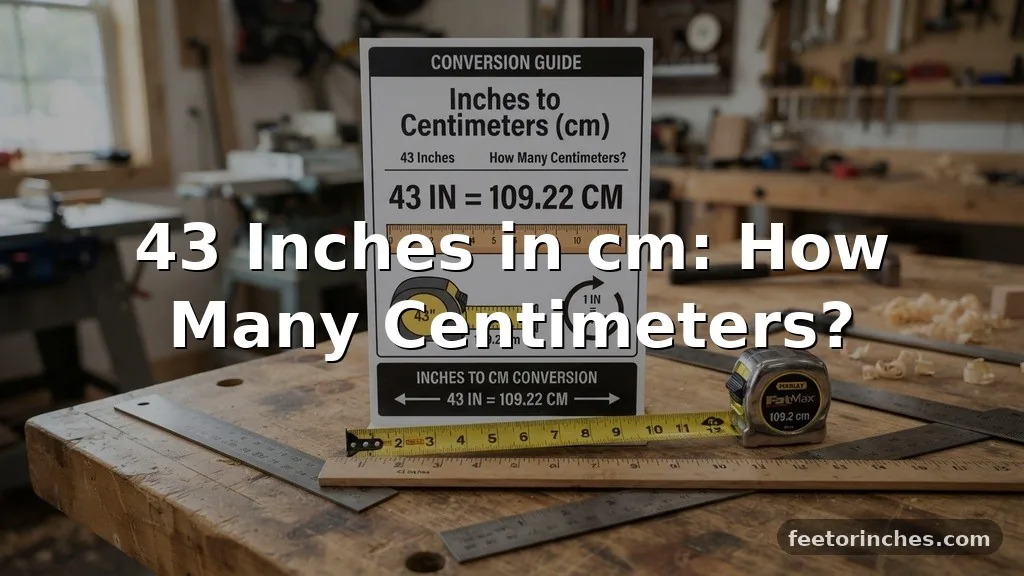
Calculating 43 inches in cm is a straightforward task once you apply the standard conversion factor. Specifically, 43 inches is exactly 109.22 centimeters.
Whether you are measuring a television screen, a piece of fabric, or a tabletop, understanding this relationship helps bridge the gap between the imperial system and the metric system. Because one inch is defined as exactly 2.54 centimeters, you can reliably calculate any length by multiplying the number of inches by this constant.
Getting these conversions right is essential for everything from home improvement projects to tech purchases. By mastering the math behind these units, you’ll avoid common errors and ensure your measurements are accurate every time. Let’s look at how these values translate across different formats.
Conversion Values for 43 Inches
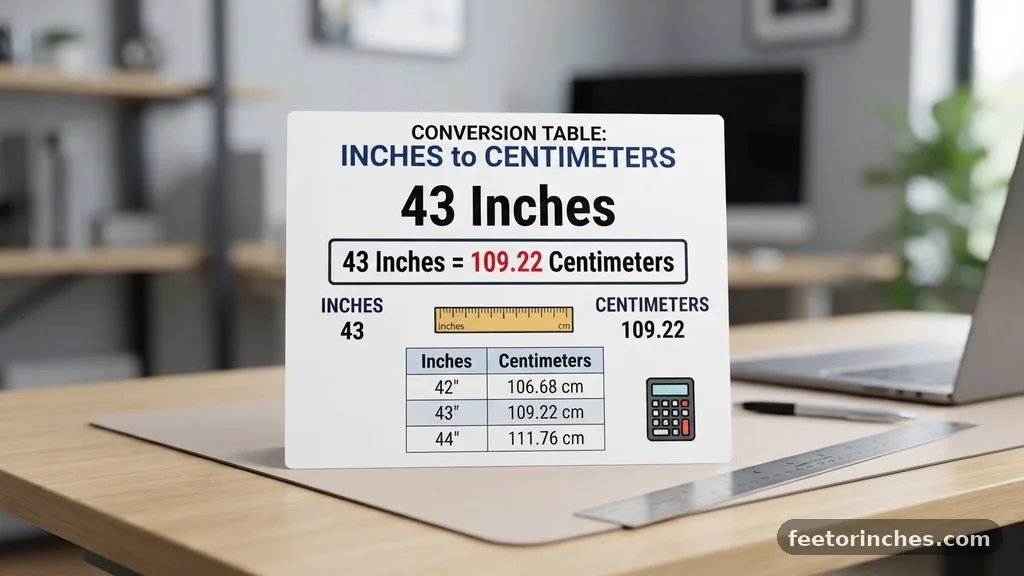
When you need to translate length across different units, having a quick reference chart saves time and prevents mental fatigue. The following table provides the conversion of 43 inches into the most common units of measurement used globally.
| Unit | Measurement |
|---|---|
| Centimeters | 109.22 cm |
| Millimeters | 1,092.2 mm |
| Meters | 1.0922 m |
| Feet | 3.58 ft |
These figures rely on the official definition of the inch provided by the National Institute of Standards and Technology. Since 1959, the international inch has been fixed at exactly 25.4 millimeters. Relying on this precise factor ensures that your calculations remain consistent whether you are working on a small craft or a large construction project.
Real-World Objects Measuring 43 Inches
Visualizing 43 inches can be difficult without a physical reference. Below is a list of 43 items categorized by their typical use, where 43 inches represents a key dimension like length, diameter, or diagonal width.
- Technology
- Diagonal screen size of a standard 43-inch smart TV.
- Length of a large computer monitor arm when fully extended.
- Approximate total width of a high-end desktop workstation setup.
- Length of some specialized professional-grade charging cables.
- Vertical height of a small-form-factor tower PC case.
- Household
- Width of many standard-sized bathroom vanity cabinets.
- Length of a standard hallway runner rug.
- Height of a child’s bedroom dresser or chest of drawers.
- Width of a small kitchen pantry storage unit.
- Length of a typical fireplace hearth extension.
- Kitchen
- Length of a large butcher block island countertop.
- Height of a tall bar stool measured from floor to seat.
- Width of a professional-grade range hood canopy.
- Depth of a large refrigerator unit.
- Length of a standard industrial kitchen prep table.
- Clothing and Textiles
- Total width of a standard roll of wide-format fabric.
- Length of a long winter coat for an average adult.
- Waist measurement for certain extended-size apparel.
- Length of a decorative window curtain panel.
- Width of a standard queen-sized duvet cover.
- Sports and Fitness
- Length of a standard youth-sized hockey stick.
- Width of a large yoga mat designed for extra space.
- Height of a portable basketball hoop backboard.
- Diameter of a large heavy-duty exercise stability ball.
- Length of a standard archery bow for specific draw weights.
- Tools and Hardware
- Length of a heavy-duty steel pry bar.
- Height of a standard folding step ladder.
- Width of a portable workbench surface.
- Length of a large pipe wrench handle.
- Total span of a heavy-duty garage storage shelf.
- Automotive
- Length of a standard car roof rack crossbar.
- Width of a small engine bay internal compartment.
- Diameter of oversized off-road vehicle tires.
- Length of a standard emergency roadside jack arm.
- Height of a custom truck bed storage box.
- Office
- Width of a standard executive desk return.
- Length of a large conference room whiteboard.
- Height of a standard office bookshelf unit.
- Width of a lateral filing cabinet drawer.
- Length of an ergonomic keyboard tray.
- Miscellaneous
- Width of a standard front door frame opening.
- Height of a large floor-standing decorative vase.
- Length of a medium-sized shipping box.
- Width of a bicycle handlebar assembly.
- Height of a garden gate panel.
Estimating 14 Inches Without Tools
Sometimes you need to estimate a measurement when a tape measure isn’t nearby. Using common objects as a proxy is a reliable way to gauge distance. A standard sheet of legal-size paper is 14 inches in length, making it an excellent reference tool for quick checks.
You can also use your own body to approximate length. Many adults have a hand span—the distance from the tip of the thumb to the tip of the pinky when stretched—that is roughly 8 to 9 inches.
By adding roughly half of that span, you can get very close to 14 inches. Always remember that these are approximations and should not replace precision instruments for critical tasks.
Understanding Screen Diagonals
A common point of confusion involves how we measure screens. When you see a “43-inch” TV, that number refers to the diagonal measurement from one corner to the opposite corner, not the physical width or height of the screen. The actual horizontal width is usually around 37.5 inches, while the height is about 21 inches.
This happens because screen dimensions are determined by the aspect ratio, usually 16:9 for modern displays. If you only measure the width, you will drastically underestimate the size of the device. Always look at the manufacturer’s specifications if you need the exact footprint for your wall or furniture.
Comparing Measurements
To understand the scale of 14 inches, it helps to compare it to adjacent measurements. Visualizing how these units relate to one another makes it easier to keep them straight in your mind.
12 inches is exactly one foot. 13 inches is an inch more, often found in smaller laptop screen sizes. 14 inches is slightly larger, commonly used for standard-sized laptop screens.
Moving up to 15 or 16 inches puts you into the range of larger, professional-grade workstations. Recognizing these subtle differences prevents errors when buying accessories like carrying cases or protective covers.
The Importance of Precision
In the world of engineering and design, the distinction between inches and centimeters is vital. The metric system provides a base-10 structure that makes complex calculations much easier than the base-12 system used in imperial measurements. When you convert 43 inches in cm, you are essentially translating between two different ways of perceiving physical space.
Precision is especially important in manufacturing. A discrepancy of even a few millimeters can result in parts that do not fit or structures that are unstable.
Always double-check your conversion factors before making cuts or ordering materials. Using a reliable calculator or reference table ensures that your work meets the necessary tolerances for your specific project.
Common Misconceptions
Many people confuse diameter and circumference when measuring circular objects. If you have a pipe that is 43 inches in circumference, its diameter is actually only about 13.7 inches. Measuring across the face of an object is always different from wrapping a tape measure around it.
Another frequent error is assuming that all measurements are the same regardless of orientation. Always define whether you are measuring the length, width, or height.
If you are dealing with a 3D object, these dimensions are distinct and cannot be used interchangeably. Taking a moment to label your measurements will save you significant time during assembly or installation.
FAQ
Is 43 inches the same as 100 cm?
No, 43 inches is equal to 109.22 centimeters. 100 centimeters is approximately 39.37 inches.
How do I convert inches to centimeters manually?
You multiply the inch value by 2.54. For 43 inches, the math is 43 multiplied by 2.54, which equals 109.22.
Are screen sizes measured in centimeters or inches?
Screen sizes are almost universally marketed in inches in the United States and many other parts of the world. However, the physical dimensions are easily converted to centimeters if you need them for custom housing or furniture.
Does the thickness of an object change its inch measurement?
The thickness does not change the length, but it does change the overall volume. When measuring for a shelf or a frame, you must account for the thickness of the material in addition to the primary length.
Conclusion
Understanding the conversion of 43 inches in cm provides a solid foundation for accurate planning and building. Whether you are selecting a new television or fitting a piece of furniture into a specific corner, knowing that 43 inches equals 109.22 centimeters allows you to move confidently between imperial and metric standards. By relying on the precise 2.54 conversion factor, you ensure your projects remain accurate and professional.
Keep this reference handy whenever you are tackling measurements that cross these two systems. Practicing these conversions regularly will make them second nature, helping you avoid mistakes in your daily tasks. If you have any specific projects requiring further measurement guidance, feel free to reach out and keep the conversation going.
Explore more on FeetOrInches.