
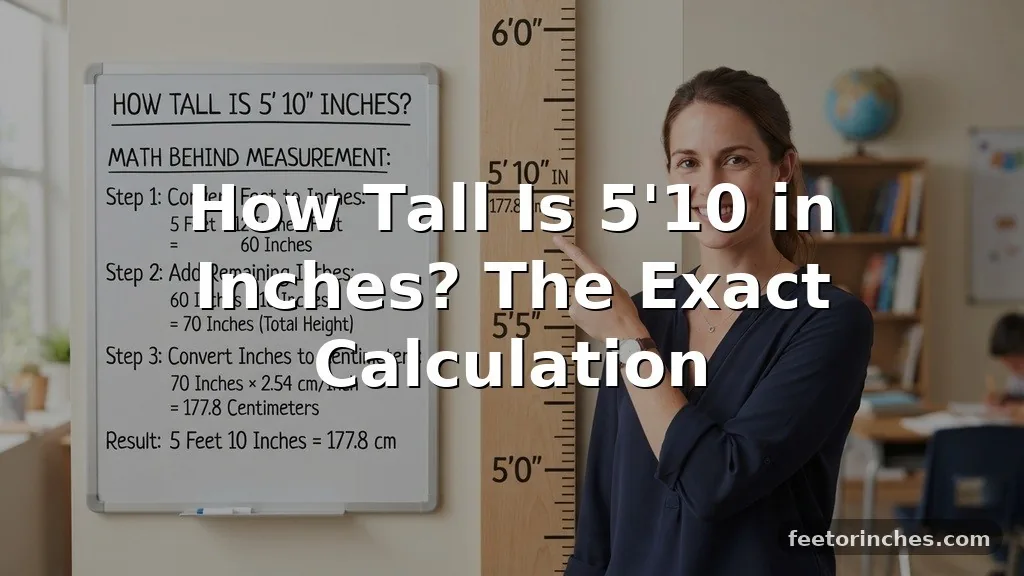
Determining how tall is 5’10 in inches is a straightforward mathematical task that relies on the standard imperial unit system. Since every foot contains exactly 12 inches, calculating this height simply requires multiplying the number of feet by 12 and then adding the remaining inches. When you perform this calculation for 5 feet and 10 inches, you arrive at a total of 70 inches.
Understanding this conversion is helpful for medical forms, athletic profiles, and general physical descriptions where precise measurements are required. Whether you are filling out a document or just curious about the math, knowing the exact figure helps you communicate your height clearly and accurately.
The Math Behind the Measurement
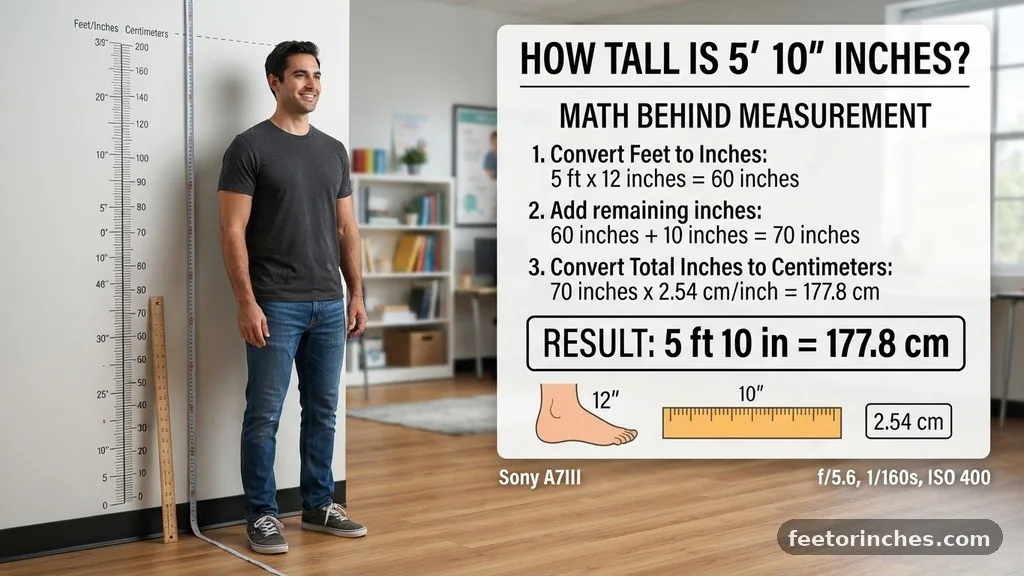
To convert 5 feet and 10 inches into total inches, you must use the standard conversion factor of 12 inches per foot. You start by multiplying 5 by 12, which equals 60 inches.
Adding the remaining 10 inches to that product results in a final total of 70 inches. This simple arithmetic serves as the foundation for all height-related conversions in the imperial system.
When you need to perform this calculation for other heights, the process remains consistent. You take the foot component, multiply it by 12, and add the remainder. This method ensures you never miscalculate your stature, especially when dealing with official records or fitness tracking apps.
Why Accuracy Matters
Precision in measurement is vital for health metrics such as calculating your Body Mass Index (BMI). If you are off by even an inch, your calculated BMI could shift, potentially giving you a misleading view of your health status. Using the correct figure of 70 inches is essential for maintaining accurate personal health data.
Consistent reporting also helps when you are purchasing clothing or gear that requires specific height ranges. Many manufacturers use standardized sizing charts, and knowing your height in total inches can help you cross-reference these charts more effectively. You can find detailed standards for these measurements through the National Institute of Standards and Technology to ensure you are using the most current units.
Conversion Table for Height
When you are looking at height data, it is often helpful to see how 5’10 compares to other common measurements. The following table provides a quick reference for converting various heights into total inches, centimeters, and meters.
| Height (ft/in) | Total Inches | Centimeters | Meters |
|---|---|---|---|
| 5’8″ | 68 | 172.72 | 1.73 |
| 5’9″ | 69 | 175.26 | 1.75 |
| 5’10” | 70 | 177.80 | 1.78 |
| 5’11” | 71 | 180.34 | 1.80 |
| 6’0″ | 72 | 182.88 | 1.83 |
Converting to Metric Units
While the imperial system is common in the United States, much of the world uses the metric system. To convert your height from inches to centimeters, you multiply the total inches by 2.54. Since 5’10 equals 70 inches, you multiply 70 by 2.54 to get 177.8 centimeters.
This conversion is particularly important if you are traveling internationally or filling out medical documentation outside of the U.S. Meters are also used, which simply involves dividing the centimeter result by 100.
Thus, 177.8 centimeters is equal to 1.778 meters. Keeping these conversions handy can save you time when you are working with international standards or scientific equipment.
Estimating Height Without Tools
Sometimes you may not have a tape measure, but you still need to verify a height. You can use common household objects or your own body to get a reliable estimate.
A standard sheet of U.S. letter paper is 11 inches long. By stacking these or using them as a reference, you can approximate height fairly well.
Another method involves using your own wingspan. For many people, their height is roughly equal to the distance from fingertip to fingertip when arms are outstretched. While this is not a perfect measurement, it provides a very close proximity to your actual height when a wall-mounted stadiometer is unavailable.
Common Reference Objects
If you are trying to visualize how tall 5’10 is, think about common objects you encounter daily. You can use these items to gauge height:
- Standard kitchen counters are usually 36 inches high, meaning two of them stacked are 72 inches.
- A standard doorway is typically 80 inches tall, so 5’10 is exactly 10 inches shorter than the top of the frame.
- Most residential ceilings are 96 inches high, leaving 26 inches of clearance above a person of this height.
- A standard chair seat is usually 18 inches from the floor, providing a reference point for seated measurements.
Addressing Common Misconceptions
A frequent point of confusion is the difference between physical height and screen diagonal measurements. When people ask about a 14-inch screen, they are referring to the diagonal distance from corner to corner. This is fundamentally different from the vertical height of a person, which is measured from the floor to the top of the head.
Another misunderstanding involves the assumption that height is static. Your height can fluctuate throughout the day as your spinal discs compress under the weight of gravity.
It is common to be slightly taller in the morning than in the evening. Therefore, when measuring how tall is 5’10 in inches, the time of day can actually cause a slight variation in your result.
The Importance of Proper Posture
When measuring your height, your posture significantly impacts the final number. If you slouch, you can easily lose an inch or more. To get an accurate reading, stand straight with your back against a wall and your feet flat on the floor.
Ensure your heels, shoulder blades, and the back of your head are touching the vertical surface. Looking straight ahead rather than up or down helps keep your neck straight, which is critical for precision. These small steps ensure that the measurement you record is the true representation of your stature.
Comparing Heights and Scales
Understanding where 5’10 fits in the broader spectrum of human height can provide useful context. In the United States, the average height for an adult male is approximately 5’9″, making 5’10” slightly above average. This specific height is often seen as a benchmark in various sports and social contexts.
When you look at the scale of 12 inches to 16 inches, you see that each inch represents a significant jump in stature. The difference between 5’10 and 6’0 is only 2 inches, yet it is often a threshold for specific athletic requirements. Recognizing these small increments helps you understand why even a single inch is treated with such importance in professional measurements.
Frequently Asked Questions
Is 5’10 exactly 70 inches?
Yes, because 5 feet equals 60 inches (5 multiplied by 12) and adding the extra 10 inches results in exactly 70 inches.
How do I convert 5’10 to centimeters?
You multiply 70 inches by 2.54, which equals 177.8 centimeters.
Does 5’10 mean 5.10 inches?
No, 5’10 is a notation for 5 feet and 10 inches; it is not a decimal measurement of 5.10 inches.
Why is my height different at night?
Your spinal discs compress throughout the day due to gravity, which can cause you to be slightly shorter in the evening compared to when you wake up.
Is 5’10 considered tall?
Height is relative, but in the United States, 5’10 is slightly above the national average for men, making it a common and standard height.
Final Thoughts
Knowing how tall is 5’10 in inches is a simple yet essential piece of information for accurate record-keeping. By applying the standard conversion of 12 inches per foot, you can confidently state your height as 70 inches whenever required. Understanding these conversions and the factors that influence measurement—such as posture and time of day—ensures your data remains consistent across all platforms.
Whether you are updating a medical profile or simply checking your stats, this knowledge provides the clarity you need. If you have questions about other height measurements or need further assistance with unit conversions, feel free to reach out and explore more about the systems that define our physical world.
Related conversions: How Tall Is 5 3 in Inches? (Complete Conversion Guide), How Tall Is 78 Inches in Feet? (Exact Conversion Explained), How Tall Is 48 Inches in Feet? Complete Conversion Guide, How Tall Is 69 Inches in Feet? (Exact Conversion Explained).
Explore more on FeetOrInches.