
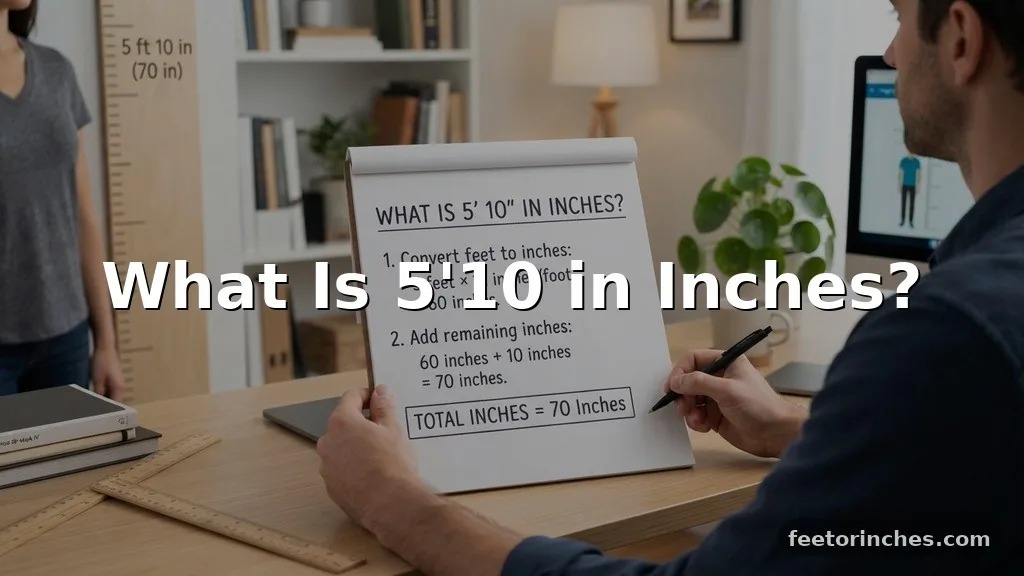
When you need to know exactly how many inches are in 5’10, the math is straightforward but often requires a quick refresher. Because there are 12 inches in every foot, calculating this height measurement is a simple matter of multiplication and addition. You’ll find that 5’10 equals exactly 70 inches in total.
This figure is a standard benchmark for height, often used in medical charts, driver’s licenses, and clothing sizing. Understanding how to arrive at this number helps you grasp the broader imperial system of measurement used throughout the United States.
Knowing your height in total inches is particularly useful when completing official forms or purchasing equipment that relies on specific length requirements. Whether you are checking your stature for a sports physical or simply curious about the math, this breakdown provides the clarity you need.
Calculating Total Inches
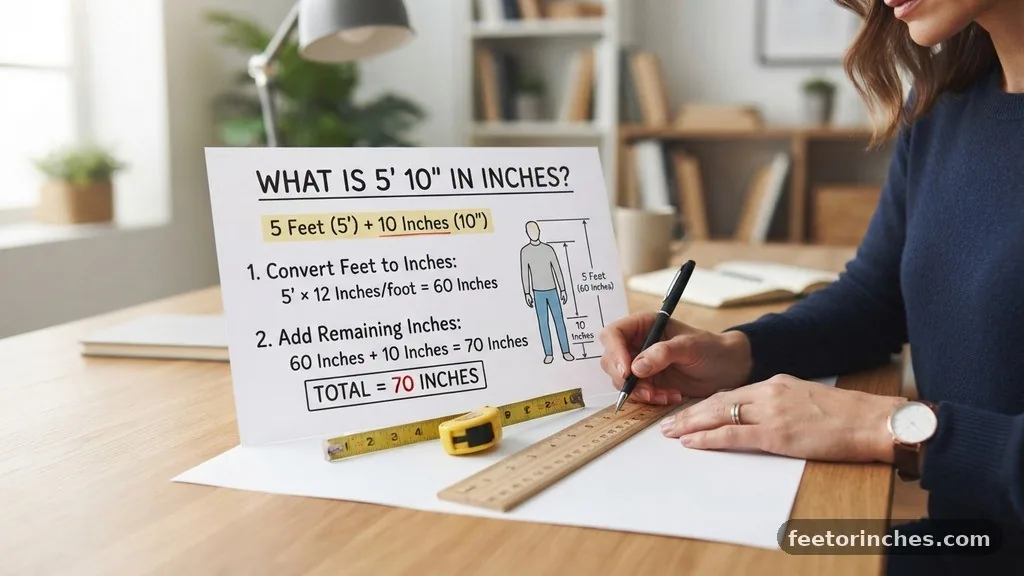
To find the total number of inches for any height expressed in feet and inches, you multiply the number of feet by 12. Since a single foot is equal to 12 inches, five feet represents 60 inches. You then add the remaining 10 inches to that subtotal to reach the final measurement.
This process is the standard way to convert feet into inches across the board. It ensures that you aren’t dealing with mixed units when you need to calculate space or physical capacity. By converting the entire height into one unit, you remove the complexity of working with two different scales simultaneously.
The Math Breakdown
- 5 feet multiplied by 12 inches per foot equals 60 inches.
- 60 inches plus the remaining 10 inches equals 70 inches.
- The final result is consistently 70 inches for a person who is 5’10.
Conversion Data Comparison
It is helpful to see how 5’10 translates across other common units of measurement. While the imperial system is the standard in the U.S., many other parts of the world rely on the metric system. Understanding how these units relate to one another is essential for global context.
The table below provides a quick reference for 5’10 across several common systems. This helps when you are comparing your height to international standards or technical specifications that might use centimeters or meters.
| Unit of Measurement | Value for 5’10 |
|---|---|
| Total Inches | 70 inches |
| Centimeters | 177.8 cm |
| Meters | 1.778 m |
| Total Feet | 5.833 ft |
Why 70 Inches Matters
The number 70 serves as a critical data point in various industries, from ergonomics to fashion. When engineers design workstations or airline seats, they often use 70 inches as a mid-range point for adult height. This ensures that the majority of the population can use the equipment comfortably.
In the medical field, height is recorded in inches for body mass index (BMI) calculations. Using a single unit like inches allows software to process your data without errors. If you ever need to check your BMI, knowing your height in total inches is the first step in the process.
Visualizing the Measurement
Estimating 70 inches without a tape measure can be tricky, but you can use common objects to get a sense of the scale. A standard piece of US legal-size paper is 14 inches long. If you laid five of these sheets end-to-end, you would reach exactly 70 inches.
Another way to visualize this height is by looking at common household furniture. A standard kitchen counter is typically 36 inches high.
Therefore, someone standing at 5’10 is almost exactly twice the height of a standard kitchen counter. These comparisons make the abstract number much easier to grasp in a physical space.
Common Misconceptions
Many people confuse the notation of 5’10 with decimals. It is a common mistake to assume that 5’10 means 5.10 feet, which would mathematically be 61.2 inches. However, in the context of human height, the “10” refers to inches, not a fraction of a foot.
This distinction is vital for accurate record-keeping. If you mistakenly enter 5.10 into a form that expects a decimal, you will significantly underestimate your height. Always remember that the imperial system uses a base-12 scale for feet and inches rather than a base-10 decimal scale.
Historical Context of Height
The use of feet and inches dates back centuries and remains deeply embedded in modern society. While many scientific fields have transitioned to the metric system, the imperial system persists in daily life, especially in the United States. You can learn more about the history of these standards through the National Institute of Standards and Technology, which maintains the official definitions of these units.
The foot was originally based on the length of a human foot, though it was eventually standardized to ensure consistency in trade and construction. This standardization is why we can confidently say 5’10 is 70 inches today. Without these fixed definitions, measuring height would be inconsistent and prone to error.
Comparing Heights Near 5’10
Understanding how 5’10 fits into the range of human height helps provide perspective on the scale. When you look at the measurements surrounding 70 inches, you can see how incremental changes affect the total. Each additional inch changes the total by exactly one unit.
Scale of Nearby Measurements
- 5’8 is 68 inches.
- 5’9 is 69 inches.
- 5’10 is 70 inches.
- 5’11 is 71 inches.
- 6’0 is 72 inches.
This linear progression makes it easy to add or subtract if you are comparing your height to someone else. If you are 5’10 and standing next to someone who is 6’0, you know immediately that the difference is exactly two inches. This simplicity is the primary benefit of the imperial system for day-to-day use.
FAQ: Frequently Asked Questions
Is 5’10 the same as 70 inches?
Yes, 5’10 is exactly 70 inches. You multiply 5 feet by 12 inches to get 60, then add the 10 extra inches.
How do I convert 5’10 to centimeters?
To convert to centimeters, you multiply the 70 inches by 2.54. This results in 177.8 centimeters.
Does 5’10 mean 5.1 feet?
No, 5’10 does not mean 5.1 feet. In the imperial system, 5’10 means 5 feet and 10 inches, which is 70 inches total.
Why is my height listed as 5.83 on some forms?
Some forms use decimal feet instead of feet and inches. To get this, you divide 10 inches by 12, resulting in 0.83, which is then added to the 5 feet.
Is 70 inches considered tall?
Height is relative, but 5’10 is often considered slightly above average for adult males in the United States. It is a common height that falls well within the range of standard clothing and furniture design.
Final Thoughts on Measurement
Knowing that 5’10 equals 70 inches is a useful skill that simplifies many daily tasks, from filling out medical forms to selecting the right gear. By understanding how the imperial system works, you can quickly convert any height measurement without needing a calculator. If you ever find yourself working with metric measurements, remember that 177.8 centimeters is your equivalent conversion.
Keep this conversion in mind the next time you are shopping for clothing or checking specifications for home projects. It is a small piece of knowledge that adds up to a better understanding of the physical world. If you found this breakdown helpful, feel free to share it with someone else who might be looking for a quick, accurate answer to their conversion questions.
Related conversions: What Is 15/32 in Inches · How Many Inches in a Meter · How to Read a Ruler in Inches




